Postcard from Marseille, France: Cantini’s insider to outsider art

A close-up view of a postmarked envelope featuring various stamps, including a red priority mail stamp and green stamps depicting abstract figures, along with handwritten details and doodles.
Above: Postal art incorporated in a collage by Louis Pons.

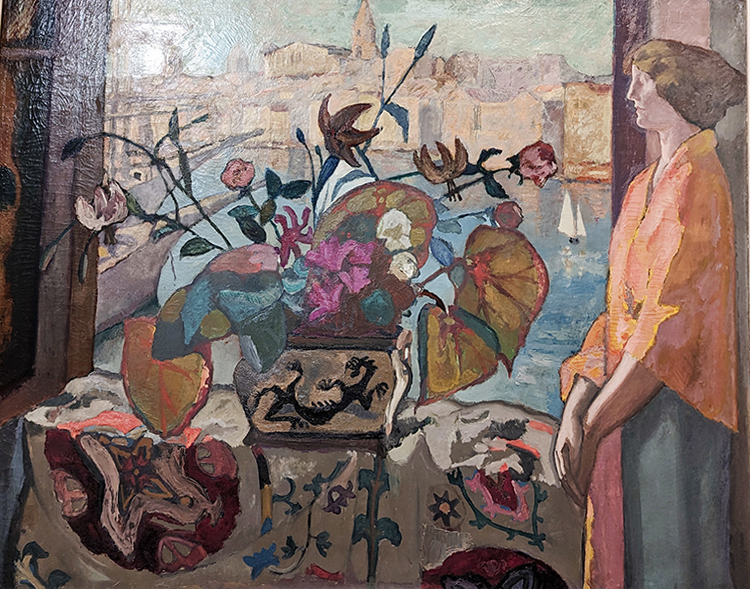
Above: “Les Fleurs et le Matin,” Alfred Lombard (1884-1973), 1913

I kill time with the strokes of the pen…. It will take a long time.”

Louis Pons (1927-2021)

A palace built at the tail end of the 17th century by wealthy trade merchants was acquired a century later by the artistic son of a stonemason. With a ready supply of fine marble at hand, Jules Cantini’s (1826-1916) attraction to sculpture was only natural. He designed altars for some of Marseille’s most important churches.
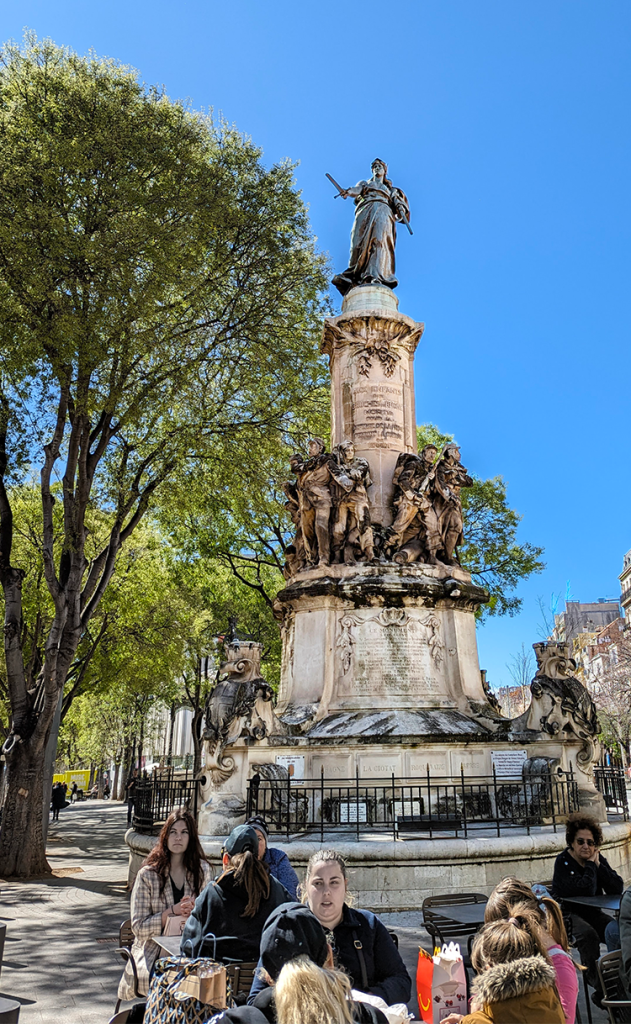
A statue atop a monument stands in a park with people seated at tables below it, surrounded by trees and a blue sky.
1894 “Monument des Mobiles” funded by Jules Cantini.

Retaining the profitable marble business of his father, Jules began to assemble a major art collection. For his native city, Cantini underwrote the construction of a landmark fountain and memorial designed by architect Gaudensi Allar (1841-1904) and dedicated to the citizens who perished during the 1870 Franco-Prussian War.

Cantini bequeathed his home to the Marseilles for use as a museum dedicated to decorative arts. The city opened the museum in 1936, eventually spotlighting emerging trends in French art from 1900-1980. A random sampling of works are found below.

Continue reading “Postcard from Marseille, France: Cantini’s insider to outsider art”
Postcard from Lyon, France: Where good food regarded as ‘a birthright’

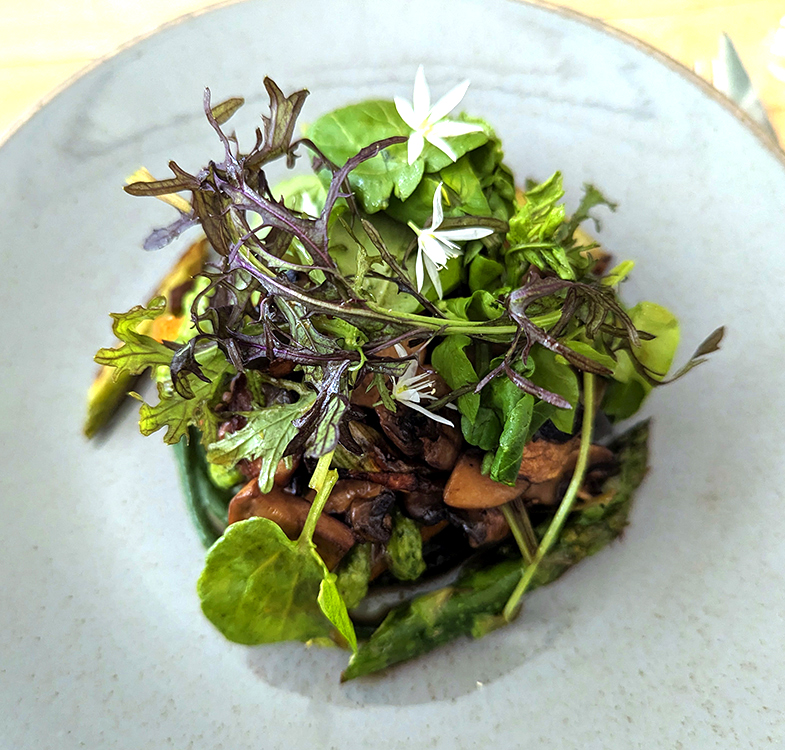
Above: Polenta and asparagus buried below a mound of fresh leafy ‘weeds’ at Les Mauvaises Herbes

Hope you’re ready to feast your eyes again because here comes part two of our restaurant experiences in the capitol of French gastronomy.

The pig in the name Le Cochon qui Boit intimidated me at first. I knew I wasn’t ready for a menu that goes all whole-hog-centric, but this is a drinking pig. That sounded more up my alley. Once inside gazing at the daily menu, I realized one even could graze all-vegetable there if desired. A red cabbage and hazelnut salad as an amuse bouche quickly confirmed the kitchen’s talents in that arena.

An endive salad was topped with ultra-thin slices of coppa ham and almonds, while tender cauliflower was paired with olives and fresh chervil. Shredded parmesan hides a serving of beet ravioli, and that shiny beige mound that appears to be a dessert is actually whipped up roasted parsnips, as good as a dessert. The rectangular dark wedge is Cochon Noir Gascon, meat of the highly prized black pig of the high Pyranees. This tender pork arrived with wedges of panisse and spinach.

Continue reading “Postcard from Lyon, France: Where good food regarded as ‘a birthright’”

Postcard from Lyon, France: Fertile ground for chefs

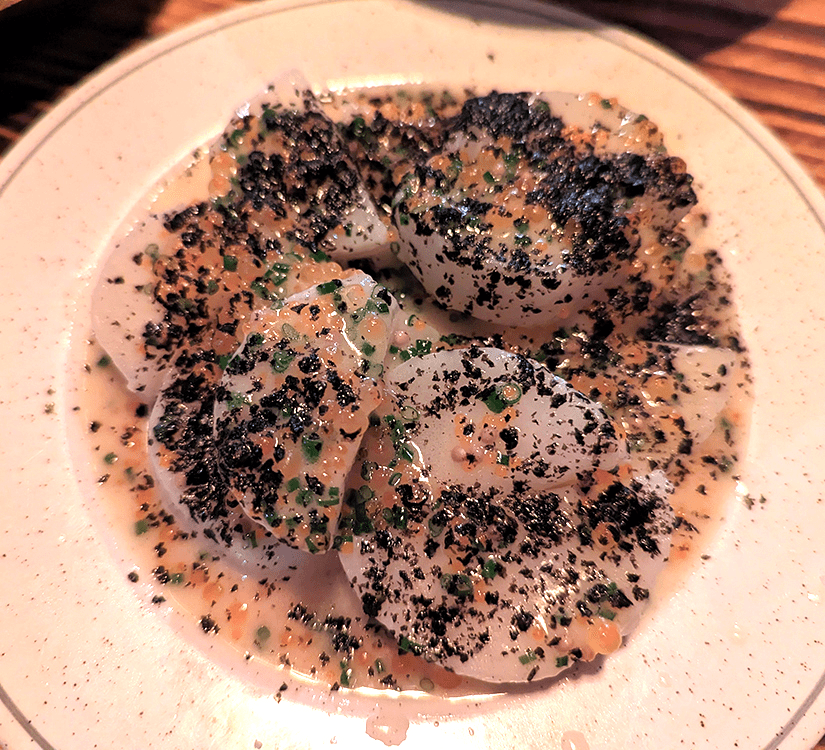
Above: Turnips with trout caviar at Armada

I know you might be thinking: “Seriously? Turnips?”

Lyon…. A culinary tradition that grew up to change the world of gastronomy…. It’s about food, lots of food, great food. Some of the greatest food on earth…. What is it exactly about this place? Over the past century, the system here, the tradition, whatever it is that took hold here, churned out a tremendous number of the world’s most important chefs…. Why Lyon? Why is this such a gastronomic capital?” 

Anthony Bourdain, Parts Unknown: Lyon, France, April 27, 2014

I can’t answer that. For Bourdain’s explanation, you might have to watch that episode of Parts Unknown. But I can state we lingered over some excellent meals during our stay in Lyon and hope these photos help you navigate among the many choices available.

Continue reading “Postcard from Lyon, France: Fertile ground for chefs”