Postcard from London, England: Globe-spanning collection ignites imagination

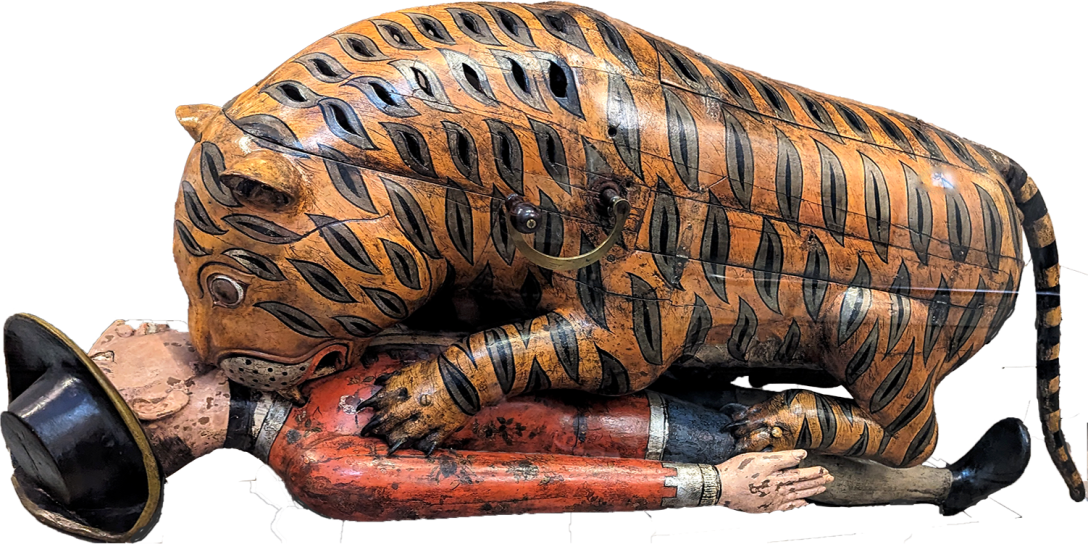
Above: “Tippoo’s Tiger,” Tipu Sultan’s automaton seized from Seringapatam, Mysore, South India, by the East India Company in 1799, eventually ending up displayed in the Victoria & Albert Museum.

It’s a giant mechanical tiger… and I just was so enchanted by it. Because I’d seen British propaganda – you know, cartoons and ethnographic representations of Indians – but I’d never seen Indian art depicting the colonizer or the English…. I think Tipu Sultan, who commissioned it… was so contemptuous of the British and so determined to drive them out of India…. This was a gift to his sons, who had been taken hostage by the British.”

Tania James, author of the novel Loot, interviewed in 2023 by Ari Shapiro for All Things Considered on NPR

By chance, I had recently read Tania James’ Loot when we visited Victoria & Albert Museum last year. Spying the 18th-century automaton tiger one grasps how it sent the author’s imagination flying back into history to investigate the tiger’s origins. The soldier-mauling tiger serves as a mighty symbol of conquered nations’ contempt for their colonizers.

Continue reading “Postcard from London, England: Globe-spanning collection ignites imagination”

Postcard from Palermo, Sicily: Are the tales about nudes nunsense?

Above: A portion of Fontana Pretoria, nicknamed Fontana della Vergogna

Officially it’s called Fontana Pretoria, so-named because of its location in the plaza fronting the palazzo that houses City Hall. But its nickname is Fontana della Vergogna, or Fountain of Shame. But shame on whom?

Well, obviously this fountain would be branded as more than shameful, downright pornographic, by some in Florida where a school principal recently was forced to resign after a teacher held up an image of Michelangelo’s “David” as part of a Renaissance art lesson for sixth graders. But art of the Italian Renaissance, even religious art, is not known to be puritanical in nature.

Amongst the theories, spouted off by guides to the huddled groups they shepherd, is that the name first was muttered by offended neighboring nuns, who would slip out onto the plaza under the cover of darkness and apply modest garb to the most exposed statues. Some guides magnify the vigilante efforts undertaken by the Dominican sisters to include amputation of numerous limbs and offensive protrusions. The sisters naturally were upset after they were coerced into giving up a large portion of their property to accommodate the grandiose plaza for the government.

Continue reading “Postcard from Palermo, Sicily: Are the tales about nudes nunsense?”