No need to travel afar to engage with contemporary art

Above: Detail of “11th-Century Persia to 19th-Century America,” from “The Black God Tapestry,” Sandra M. Sawatzky, 2008-2017

Today many of us have become so accustomed to abstractions in contemporary art that any kind of figurative work comes almost as a shock. Yet, how are we to connect to the many non-human worlds that surround us if not through figurative imagery?”

Amitav Ghosh writing about Sandra Sawatzky’s “Black Gold Tapestry”

Through the years, I find myself increasingly drawn to figurative art. After wandering around the Blanton Museum of Art this past weekend, I realized those were the only pieces that caused me to pause and read the descriptive text accompanying them. The only ones I snapped pictures of to share.

The other unifying factor of these images is that all the artists are from North America. And all, save Mexican muralist Sequieros, are living, contemporary artists. Several I have been fortunate enough to meet or hear them speak about their works.

When we travel, we enter as many art museums as we can squeeze into our trip. Yet, when home in Austin, we often fail to make time to see the art available in our own backyard.

Continue reading “No need to travel afar to engage with contemporary art”
Postcard from Oaxaca, Mexico: Santiago’s ‘Migrants’ and protesters haunting MACO

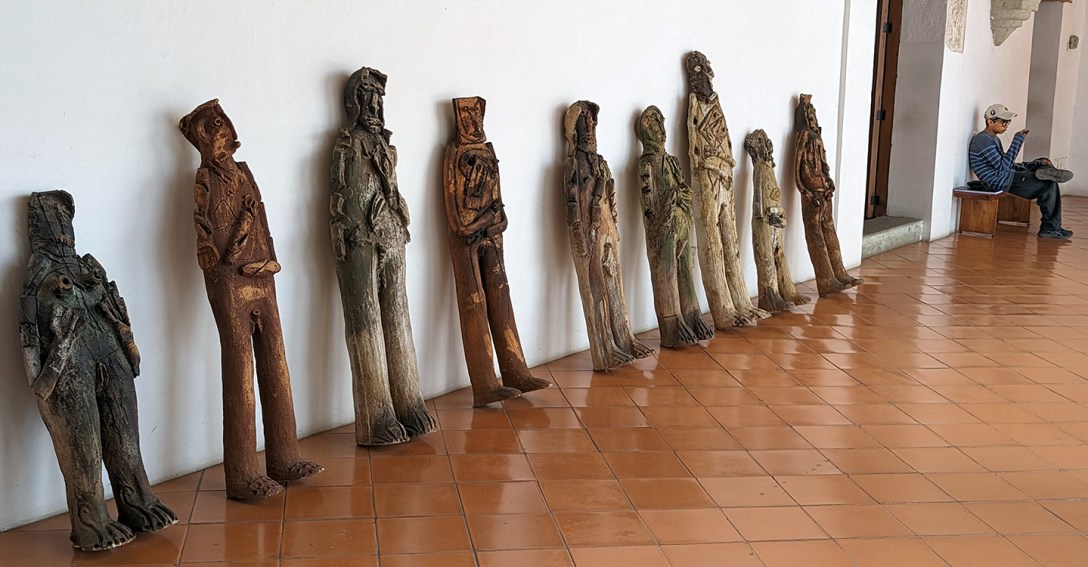
Above, nine “migrants” from Alejandro Santiago’s “2501 Migrantes” haunt a balcony inside Museo de Arte Contemporaneo, MACO

There is a Zapotec saying…. “Why leave when you have it all here?”

Alejandro Santiago in 2501 Migrants: A Journey, directed by Yolanda Cruz, 2010
two of alejandro santiago's 2501 migrantes

“Returning to his native Mexican village after many years, the artist was startled by what he didn’t see. ‘Where are my friends, my relatives?’ Alejandro Santiago asked the remaining residents of the town, Teococuilco de Marcos Perez, in a remote mountain area of Oaxaca state. Upon learning that most of them migrated from southern Mexico to the United States in search of work, he vowed to honor the departed and ‘repopulate’ his impoverished hometown.”

“Alejandro Santiago dies at 49,” Valerie J. Nelson, Los Angeles Times, July 28, 2013

Continue reading “Postcard from Oaxaca, Mexico: Santiago’s ‘Migrants’ and protesters haunting MACO”

Postcard from Zaragoza, Spain: Escalating focus on modern art

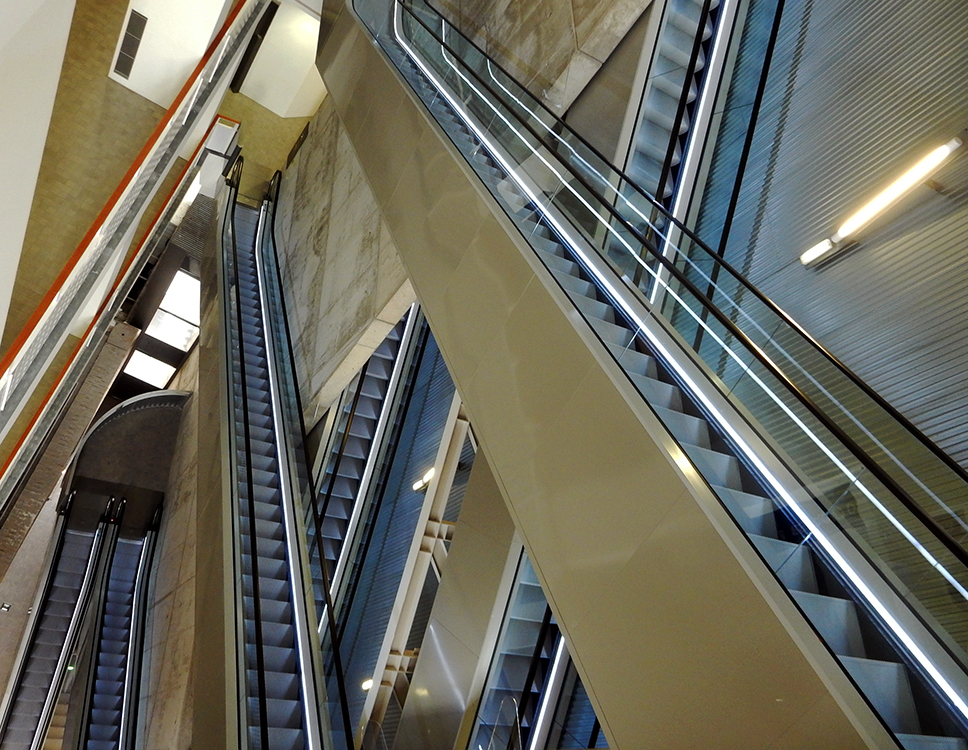
Above: Escalators in the Pablo Serrano Instituto Aragones de Arte y Cultura Contemporaneous

Science and humanism must be an embrace and not a wall that separates reason and feeling.”

Pablo Serrano (1908-1985)

Born in Crivillen in Teruel, a province of Aragon Spain, Pablo Serrano must have felt his calling toward art at a young age. When he was 14 years old, he left home to begin eight years of study in sculpture in Barcelona. At age 22, he packed his bags and moved to Montevideo, Uruguay.

Despite his distance from Spain, the abstract sculptor’s influence rose as a major force in the Spanish avant-garde movement. Known as an expressionist, he interjected his subjective perspective in his work instead of feeling compelled to accurately replicate nature or his subjects. Serrano returned to Spain in 1957, continuing to exhibit internationally and often working on major public art commissions, including a sculpture of King Juan Carlos of Spain unfinished at the time of his death.

Continue reading “Postcard from Zaragoza, Spain: Escalating focus on modern art”