Old and New World artistry merge in Hispanic Baroque

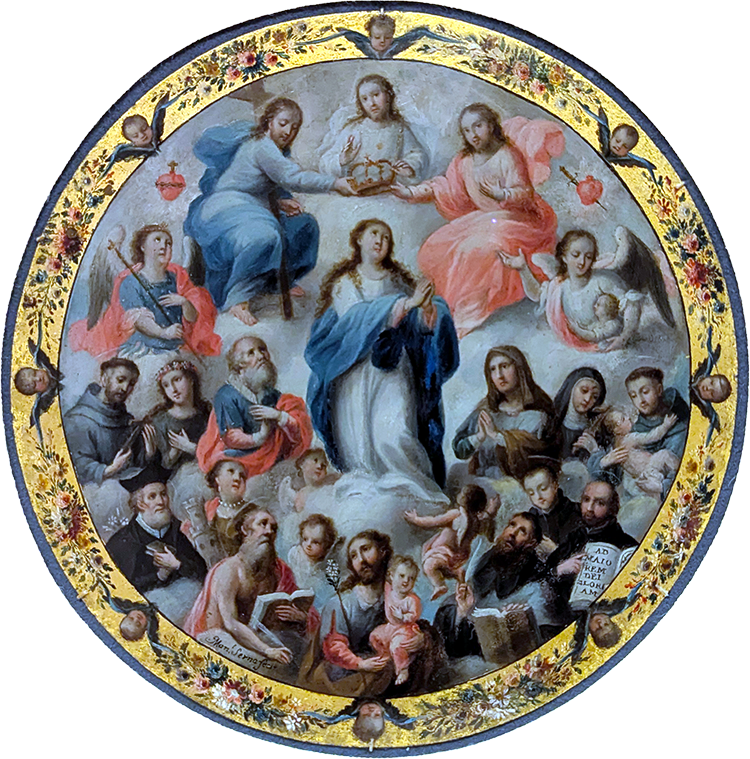
A 1893 one-cent postage stamp depicting Christopher Columbus and indigenous figures, surrounded by an ornate border. The inscription reads 'Columbus in Sight of Land.'

Above: “Annunciation and Saints,” Jose de Paez, Mexican (1727-1790), oil on copper, 1750-1760.

Spirit & Splendor: El Greco, Velázquez, and the Hispanic Baroque” surveys 150 years of Spanish art leading to the Baroque period with works culled from the collection of the Hispanic Society of America in New York City. Some of Spain’s most renowned and respected artists are represented in this ongoing exhibition at the Blanton Museum of Art, but don’t expect much more than a dozen of these works.

What I love are the pieces demonstrating the Baroque style translated by transplants and native-born artisans in the Americas. Artists took advantage of materials available in this so-called “New” World – copper, shells and, of course, more precious metals. They added a magical sheen to art designed to convert “pagans” to the foreign beliefs held by the Catholic conquerors.

Continue reading “Old and New World artistry merge in Hispanic Baroque”
Postcard from Morelia, Mexico: Foreign beliefs transform both faith and art

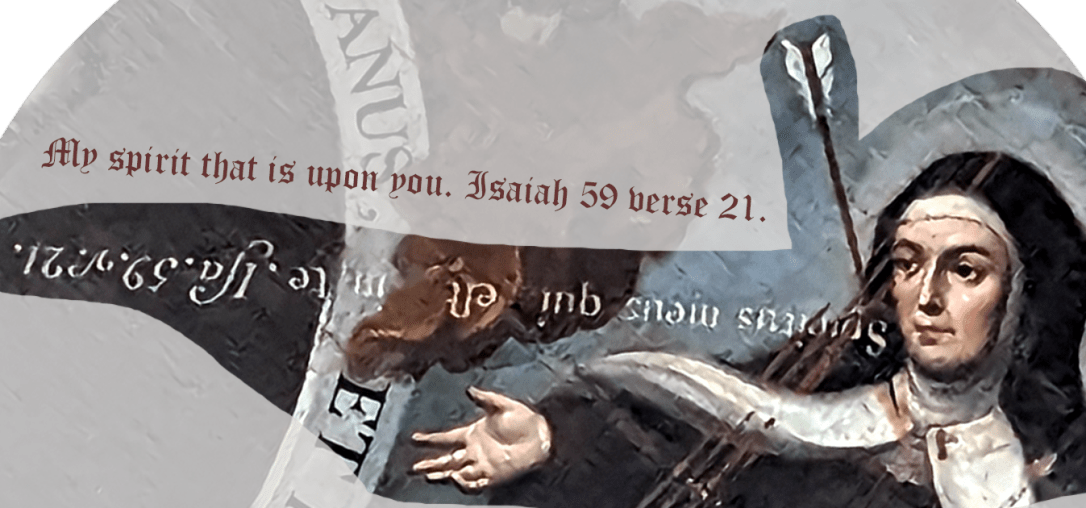
My spirit that is upon you,” Isaiah 59 verse 21, translation of one of the Latin phrases floating around the canvas of “El Obispo Juan de Palafox y Mendoza” by Miguel Cabrera

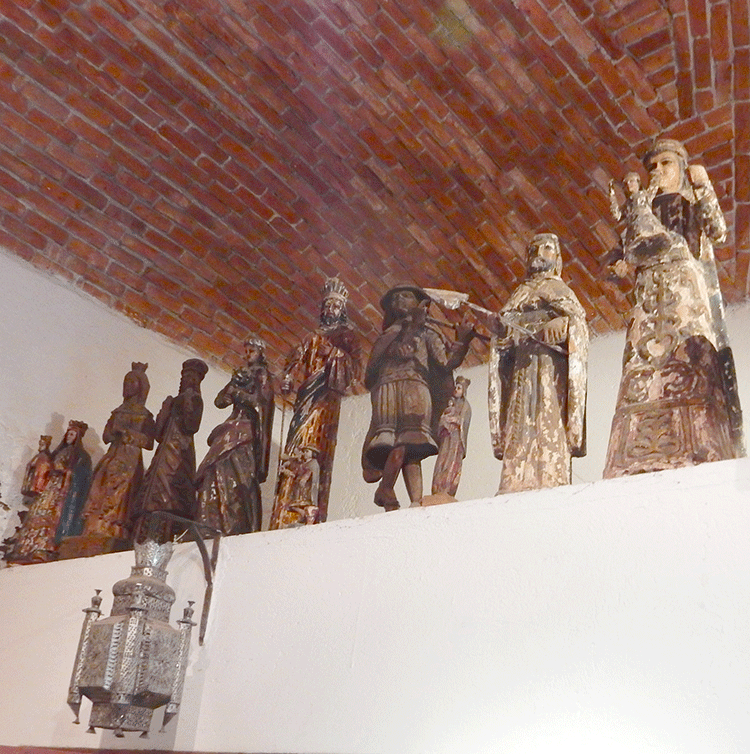
As in Europe, art served as a primary tool for friars to introduce the mysteries of Catholicism to those of other beliefs. Consequently, religious paintings from that period form the core of the collection of Museo de Arte Colonial. The works are displayed in a house of the Colonial period which was renovated in 1984.

Continue reading “Postcard from Morelia, Mexico: Foreign beliefs transform both faith and art”

Postcard from Marfil, Guanajuato, Mexico: Artists gave new life to ancient hacienda

Silver from el Minero de Santiago Marfil afforded one of the Spanish elite settling in Mexico to purchase land above the Rio Guanajuato and oriented toward a church for a luxurious hacienda in the late 1700s.

Centuries later in the 1960s when Canadian artist Gene Byron (1910-1987) and her husband Virgil Fernandez del Real purchased the ex-hacienda Santa Anna, Marfil was somewhat of a ghost town. The couple transformed the ancient buildings and grounds into a showcase for their collections of Colonial art and the results of their own artistic endeavors. In addition to her painting, Byron learned to craft handsome punched tin and copper pieces that are found throughout the house museum her husband opened to the public after her death.

The museum often hosts live classical or jazz concerts on Sundays in an intimate setting. During the week, wandering through the house with a docent often is a private tour.

There is a restaurant on site, but we visited on a Monday when it was closed. Although the road through no longer-sleepy Marfil has traffic speeding along, we walked along the narrow sidewalk to ascend to the colorful church perched above and then passed by the ancient statue-topped dam across the river on our way to score an incredible Italian feast at Piccato di Gola, fifteen minutes away at the other end of town.