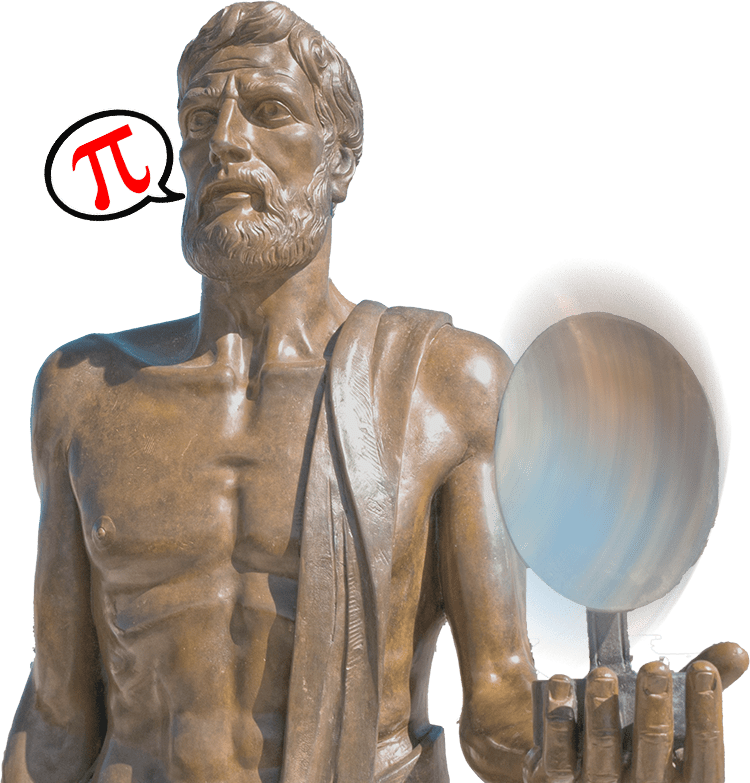
Above: Monument commemorating a hometown hero, Archimedes
Certain things first became clear to me by a mechanical method, although they had to be demonstrated by geometry afterwards because their investigation by the said method did not furnish an actual demonstration. But it is of course easier, when we have previously acquired by the method, some knowledge of the questions, to supply the proof than it is to find it without any previous knowledge.”
Archimedes (About 287-211 BC)
Seriously? The above is an example of Archimedes-speak that is babble to me. Math is far from one of my languages – Greek to me. In fact, I would almost consider Archimedes an enemy – the Father of Mathematical Physics, the Father of Integral Calculus and the man who tortured himself long enough to figure out such seemingly unsolvable puzzles as Pi.
Except, a visit to Siracusa convinced me that in times of war, or peace, you definitely would want Archimedes with all his math and inventions on your side.
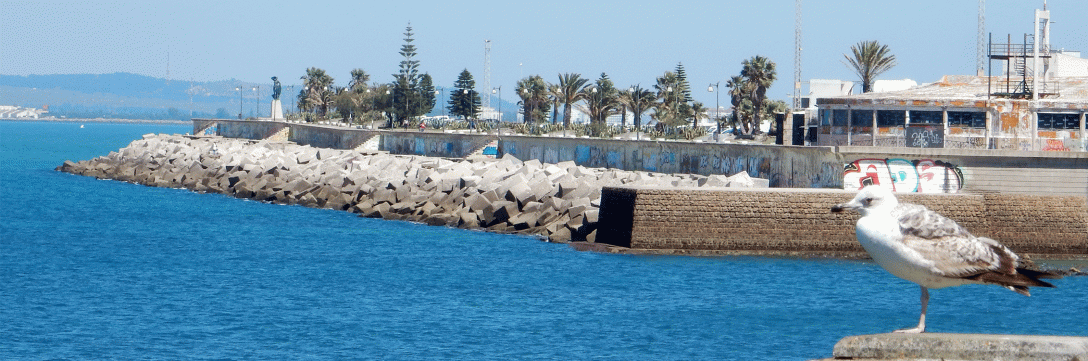
Water. No matter what direction you walk, you quickly encounter it. It’s visually stunning and soothing, with ever-changing colors depending on the weather, time of day and whether you are on the east or the west side.
Geographically termed a peninsula between the Atlantic and its bay, Cadiz seems more an island. The thin band connecting it to the Spanish mainland is narrow to the point it feels but a fragile manmade thread that could easily be severed by an Atlantic storm.
This isolated location made it an ideal stronghold for early Phoenician explorers from Tyre to establish a stronghold on the Atlantic in 1104 B.C. Gadir, as it was called then, is considered Europe’s most ancient city still standing. The city is associated with the slaying of the three-headed monster Geryon by Hercules in Greek mythology.
Cadiz has been ruled by Carthaginians, Romans, Visigoths, Byzantines and the Moors. Christopher Columbus set sail from the port during his second and fourth voyages to the New World. When sandbars made navigation of the Guadalquivir River to Seville no longer possible, Cadiz flourished as the center for trade with the Americas. The fleet based in Cadiz invited frequent attacks and pillaging by Spain’s enemies through the centuries.
Today, the population of Cadiz numbers about 100,000. With much of the peninsula occupied by its industrial port, the actual residential area covers less than two square miles. There is no land for the city to expand in size, and, because of the city’s historical importance, buildings in the historic center are restricted in height. Unemployment is fairly high, which means the port still welcomes the arrival of cruise ships disgorging huge numbers of people for several hours at a time. Those temporary invaders were easy to avoid, however, as they failed to explore more than a quarter of the city.
The city is laid-back, and its narrow, mainly pedestrian streets, are pleasant to wander. Boardwalks skirt the water on all sides.
The island-like setting attracted the attention of 007. In 2002, Cadiz starred as Havana in the James Bond film, Die Another Day. I share this for one of the above views shown in the background of the film, not the non-subtle sexual interaction between Halle Berry and Pierce Brosnan.
Instead of being catty about the film, I will switch to the topic actual cats. The most surprising inhabitants encountered is a large feral cat colony perched on rugged boulders on the Atlantic side. Tender-hearted residents provide the felines with boxes and crudely constructed shelters, and fishermen toss them scraps from their catch.



 Postcards from Barton Springs