Postcard from Ronda, Spain: Formidable fortress now scenic escape

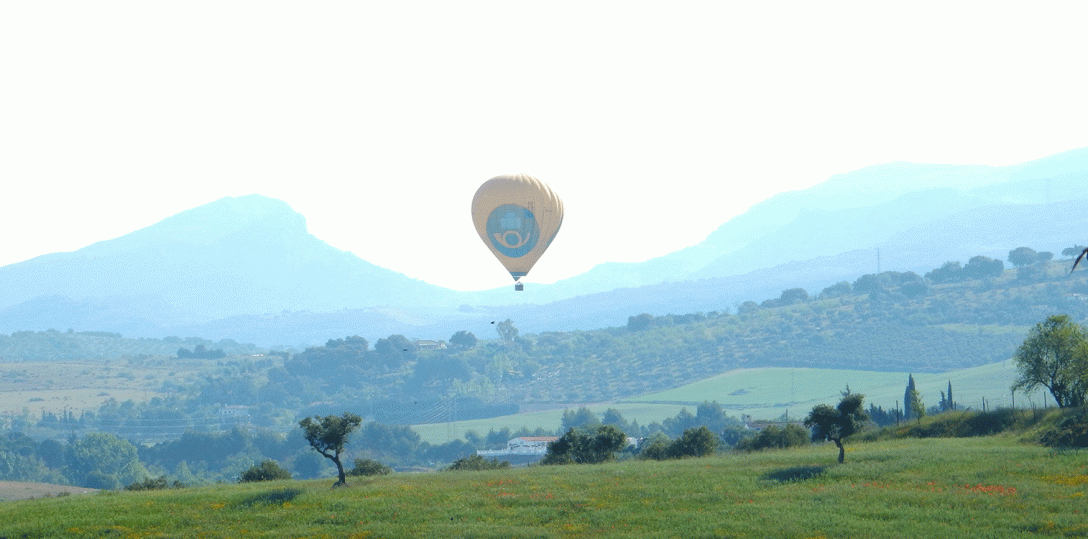
Balloonists drift through morning haze outside the back patio of our rental in Ronda.

Ronda is the place to go, if you are planning to travel to Spain for a honeymoon or for being with a girlfriend. The whole city and its surroundings are a romantic set.

…nice promenades, good wine, excellent food, nothing to do….

Ernest Hemingway (1899-1961)

Yes, there are several museums in Ronda. But its overall attraction, as Hemingway once typed, is there is relatively nothing to do but soak in the view from the majestic perch or take meandering walks below looking back up at the perch. And what a spectacular view it is on all sides.

Of course, Hemingway was not drawn to Ronda for its peacefulness but for the excitement of its bullfighting. The thrill of the kill. Ronda’s bullring is the birthplace of the tradition of the matador standing his ground before the bull instead of evading the bull on horseback. The place where matadors chose to dress in the elegant style depicted in the paintings of Goya.

And the ancient foundations of Ronda were not tourist perches but fortifications providing sweeping surveillance points for guarding against approaching enemies.

The site chosen either by the Iberians or the Bastulo Celts for the settlement that would one day become Ronda was perfect. (This was all a long time ago and no-one can be sure.) Rocky, protected by Nature like a favourite child, and so easily defended that even the most nervous members of the tribe could get a good night’s sleep. Naturally the Romans, whose paranoia was unparalleled but understandable, given their penchant for treating non-Romans with brutal disdain, liked what they saw and were determined to have it. Even the stoutest fortress is only as invincible as its defenders, and the Iberians, damned forever by the historian Strabo as “unable to hold their shields together,” proved no match for the determined invaders, who most certainly could. The supposed Iberian stronghold was easily taken, and rapidly “Romanised.”

John Gil, Andalucia.com

Moorish rulers recognized the value of this outpost in their frequent battles for control amongst themselves, and many of the remnants of fortifications date from their long occupation – from the 700s until 1485. After their water supply was seized, Moorish forces surrendered to Christians.

While Ronda appears rock-solid, many of its important buildings were felled by an earthquake in 1580. Then in 1810, retreating Napoleonic forces blew up the castle and many of the fortifications before their departure. And churches were again damaged during the Civil War in the 1930s.

Despite the imposing remaining ramparts, it is difficult to imagine violence in Ronda. Sheep graze peacefully outside the walls.

The main assaults upon the city today are busloads of day-trippers, welcomed by the town’s restaurants dependent upon them. They remain in a fairly concentrated area though, elbowing their way to viewpoints overlooking the plunging gorge (Okay, of course we joined them there.).

The other tourists were particularly useful, though. They provide scale for our snapshots. If you look closely at many of these photos, there are tiny specks of people admiring the spectacular scenery from atop the enormous rock mound.

Looking for a feel-good holiday story? Don’t click here.

Hola my Teresa, I’m thinkin’ of you now in San Antonio.
I have 27 dollars, and the good luck of your picture framed in gold.
Tonight I’ll put it all on the fighting spurs of Gallo del Cielo,
Then I’ll return to buy the land Pancho Villa stole from father long ago

Gallo del Cielo by Tom Russell
 
Men lay down their bets on their roosters on this plate produced in San Antonio by San Jose Pottery.

I’ve listened to Joe Ely weaving the sad tale toward the inevitable death of El Gallo countless times.  It’s tragic, but I dismiss it as more of a folk tale than a current event. 

After all, one of my favorite possessions is a cockfighting plate produced in San Antonio by Ethel Harris’ San Jose Pottery

And I find it amusing to reflect on San Antonio’s rough and tumble past as evidenced in the pages of the 1911-1912 edition of The Blue Book, a visitors’ guide to the city’s red light district.  In addition to a multitude of brothels just south and west of City Hall, there were at least two cock pits – Ogden’s and Monterrey – located on South Santa Rosa.  I even incorporated their ads in one of my Blue Book series of prints:

The Blue Book No. 2. The Blue Book's listings for cock pits on South Santa Rosa Avenue in downtown San Antonio is combined with images of roosters and a period map of the area. Edition of 25. 10 1/4 x 3 1/4 inches.


“Mayor Callaghan crowed at City Hall during the week, but spirited fights could be found just two blocks to the west on weekends.”

The palenque, or cock pit, in Real de Catorce

The palenque, or cock pit, in the former ghost town of Real de Catorce remains one of my favorite landmarks to explore.  But that is made easier because I was not with my husband and his younger brother when they stumbled upon men placing their bets on an actual cockfight there. 

During one of our jaunts to Mexico, I tried to convince my husband we should buy the ruins of the palenque in Mineral de Pozos, a former ghost town near San Miguel de Allende, to incorporate in a retirement home for us (one of many ill-conceived notions expressed during more than three decades of marriage from which he wisely has managed to divert my attention until common sense returned, albeit always on a fleeting basis). 

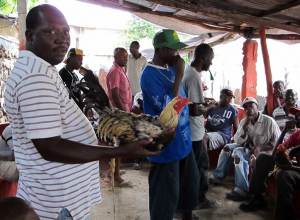
"A Competitor and His Cock," Haiti, June 2010, photograph by Vic Hinterlang

Our friend Vic pulled out his camera in Haiti this past June to document a cockfight at Delmas 31.  When he lagged on posting a follow-up, I feared he was hooked and was out training a cock of his own.  But my fears were groundless; he simply was flying back to Austin.

Cockfighting is something I prefer to pretend only occurs in the past tense, or, at least, takes place in some other country.  The world is becoming a kinder, more gentle place (dream on, Gayle).  But, in support of this argument, Spanish Catalonians recently enacted legislation drawing an end to their deeply entrenched tradition of bullfighting. 

Periodically, media intefere with my naive theories.  The other day, I made the mistake of reading Brandi Grissom’s coverage of cockfights, and their aftermath, outside of Dallas for Texas Tribune

One by one, Domanick Muñoz pulled bloody and battered bodies out of a pile of feathers, claws and beaks. Roosters that were still gasping for life….

The posted videos are not for the faint of heart.  Grissom makes it impossible to continue in a state of denial.  Cockfighting is not something that should be included in “It’s a Texas thing.”

Update Posted on February 8: Had to add this cautionary tale – “Man Killed by His Own Cock” (my headline)

Update Posted on March 17: Oscar Barajas, who recently wrote a post about his father’s disappointing cock, forwarded this link to “La Muerte de un Gallero.”

Update on May 22, 2011: Bobby Jones calm defense in Texas Monthly of his livelihood, breeding game birds, seems blood-chilling to me. “Harvesting” is the professionals’ word for cockfighting:

…what goes on at harvesting facilities is no different from what you see at a golf course, the rodeo circuit, or a bass tournament. It’s a gentleman’s wager, like betting on a football game.

As part of his explanation of legitimacy, he claims that gaffs for cockfighting were brought over on the Mayflower. But, his best point is:

No, what I’d like to see is a law that gives rural counties the power to decide what they want, instead of being told what to do by people in cities. Why are people in areas like Houston and Dallas, where there’s practically no morality, able to dictate what we do in rural areas, when they know nothing about it?

Poor guy:

Politics often gets in the way of my livelihood.