No need to travel afar to engage with contemporary art

Above: Detail of “11th-Century Persia to 19th-Century America,” from “The Black God Tapestry,” Sandra M. Sawatzky, 2008-2017

Today many of us have become so accustomed to abstractions in contemporary art that any kind of figurative work comes almost as a shock. Yet, how are we to connect to the many non-human worlds that surround us if not through figurative imagery?”

Amitav Ghosh writing about Sandra Sawatzky’s “Black Gold Tapestry”

Through the years, I find myself increasingly drawn to figurative art. After wandering around the Blanton Museum of Art this past weekend, I realized those were the only pieces that caused me to pause and read the descriptive text accompanying them. The only ones I snapped pictures of to share.

The other unifying factor of these images is that all the artists are from North America. And all, save Mexican muralist Sequieros, are living, contemporary artists. Several I have been fortunate enough to meet or hear them speak about their works.

When we travel, we enter as many art museums as we can squeeze into our trip. Yet, when home in Austin, we often fail to make time to see the art available in our own backyard.

Continue reading “No need to travel afar to engage with contemporary art”
Caste discrimination woven into Spanish Colonial art of the Americas

Above: “Virgin of the Tailors,” Cusco, Peru, circa 1750, on loan from Museo Pedro de Osma, Lima

Late-colonial New Spain was awash with conflicting energies: American-born Spaniards (Creoles), like their North American counterparts, felt a growing desire for independence, yet needed their identification with Europe to cement their sense of superiority over the racialized indigenous, African, and mixed-race lower classes….”

“Casta Painting and the Rhetorical Body,” Christa Olson, Rhetoric Society Quarterly, Fall 2009

And 18th-century fashion statements as recorded in paintings and sculpture became a tool to exhibit the claimed superiority of those with pure, or at least high, percentages of Spanish blood flowing through their veins. On display at the Blanton Museum of Art through January 8, Painted Cloth: Fashion and Ritual in Colonial Latin America focuses on the societal role of textiles in conveying class distinctions.

Continue reading “Caste discrimination woven into Spanish Colonial art of the Americas”

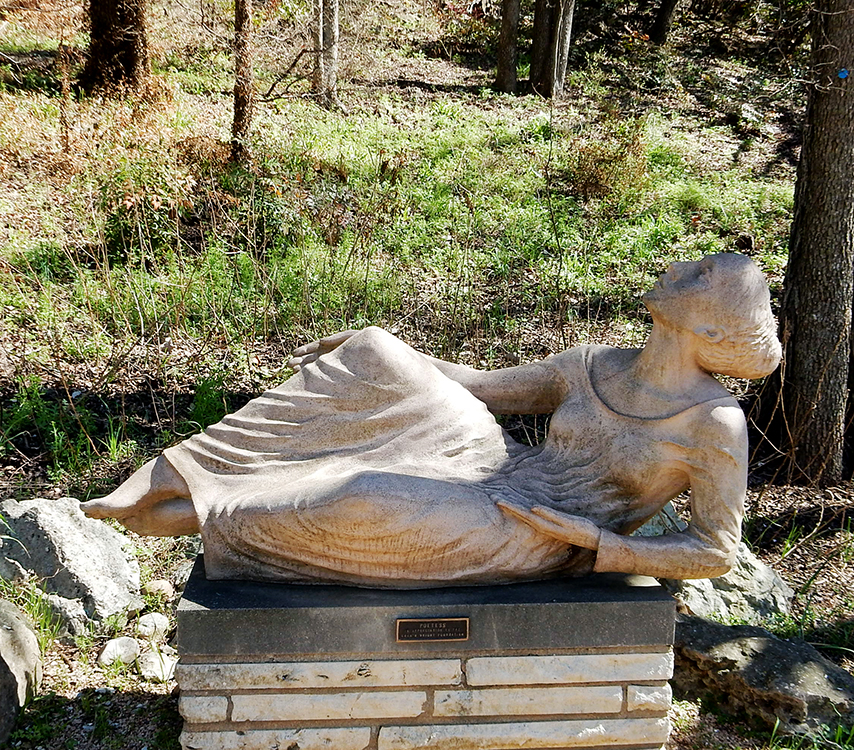
The lush landscape frostbitten, art commands centerstage at Umlauf Sculpture Garden

charles umlauf poetess

Above, Charles Umlauf’s 1956 “Poetess” represents a tribute to his wife, Angeline Umlauf (1915-2012), as his muse.

Charles Umlauf, Neal Douglass, 1951, Austin History Center via The Portal to Texas History

Born in rural Michigan, Karl (Charles) Julius Umlauf (1911-1994) was the sixth of eight children of a family of impoverished European immigrants. The family moved to Chicago when Umlauf was eight years old, and it was in elementary school there that a teacher spotted and began nurturing his artistic talents. The teacher helped him earn summer scholarships at the Art Institute of Chicago. Upon graduation from high school, he was able to study at both the Art Institute and the Chicago School of Sculpture.

Continue reading “The lush landscape frostbitten, art commands centerstage at Umlauf Sculpture Garden”