Postcard from Puebla, Mexico: Uriarte ensures talavera traditions endure

Deep blue and light blue from cobalt, green from copper, yellow from antimony, orange from amatita (?) and black from iron. These are the only mineral-based colors permitted to create authentic talavera pottery in Mexico, and the special glazing helps them last and last and last.

Dominican friars arrived in Mexico from Spain centuries ago to teach Native Americans their techniques, and a potters’ guild formulated regulatory ordinances in 1682. The colors of the ancient tiles adorning churches and public spaces throughout Puebla remain brilliant, testimonies to the enduring quality of their craftsmanship.

There are only nine workshops currently authorized to produce the now even more stringently regulated form of art. To many, the leading workshop is in the heart of downtown Puebla, the tile on the façade of the building advertising its presence – Uriarte Talavera.

Many of the tiles around Puebla predate the workshop because it is relatively new by colonial standards. Don Ygnacio Uriarte did not found his workshop until 1824. Today, Uriarte Talavera is recognized as the eighth oldest company of any kind in all of Mexico.

Years ago, when we made our way into Uriarte, every single inch was lined claustrophobically with tall shelves of pottery of every shape and size in varying degrees of completion with layers of powdery pottery dust covering it all. We wandered around among the hundreds of offerings crowding the shelves and finally settled on a very fine, classic talavera pot to bring home with us.

Now the presentation one encounters upon entering is artful, not overwhelming. The company was purchased recently by new investors whose love of the caring craftsmanship and talavera traditions is clearly evident. The entire interior has been renovated.

Alas, as we were not driving this trip but flying and we have both downsized and modernized our décor to better suit our loft, no major purchases were made. But I did end up with some blue Uriarte earrings that were easily transported and that I love. And we still have our very fine pot.

Sometimes I still find myself lusting for a set of talavera dishes or, better yet, a house with walls completely covered with azulejos azules….

Postcard from Lisboa, Portugal: Too Many Tiles and a Few Juicy Royal Tidbits

The influence of the Moors and world exploration opening doors to the art forms of India and the Orient are evident in the tile designs augmenting architecture throughout Portugal. The photographs here are from Museu Nacional do Azulejo, the National Tile Museum.

The home of the tiles is the Convent and Church of Madre de Deus, founded in 1509 by Queen Dona Leonor (1458-1525). The gilded church and large collection of reliquaries containing remnants of saints seem fit for a queen, and the queen did indeed spend her retirement years there praying for the poor and presumably for the souls of deceased members of the royal family who played parts in the lethal jockeying for political power and rights to the throne.

This slideshow requires JavaScript.

Tile overload? Sorry, I have no power to resist them.

But, here, pause to take in some of the court conniving surrounding the family of Queen Leonor.

Leonor was only 12 years old when she wed Prince Joao (John) (1455-1495). She became queen consort when her husband rose to the throne as King John II in 1481.

Perhaps wisely so, King John II perceived many plots and conspiracies swirling about during the early years of his reign, and relatives of his wife were among the prime suspects. The King had her sister’s husband executed for treason and personally plunged in the sword ending the life of her older brother. The Bishop of Evora was imprisoned, where he succumbed to poison.

Their son Alonso (1475-1491) married into the royal family of neighboring Castille. Unfortunately, his in-laws, King Ferdinand II and Queen Isabella, only had one feeble and frail son. They viewed Alonso’s marriage into the family as a potential threat to the sovereignty of Spain. Prince Alonso died under suspicious circumstances while out riding, contributing yet one more thorn to the relationship between the countries sharing the Iberian Peninsula.

This left the crown of Portugal without an heir apparent, and King John II lobbied hard to propel his illegitimate son into that role. Queen Leonor did not welcome those efforts and even appealed to the Pope for intervention.

King John II died unexpectedly early at only 40 years of age, quite possibly the victim of one of the poisonous plots he feared. The crown passed on to the Queen’s brother, Manuel I (1469-1521), as explorations were launching Portugal’s golden age.


Postcard from Coimbra, Portugal: Saintly secrets whispered from walls

Aside from choosing a saint’s name for First Communion, the stories of saints were pretty much swept under the rug during my Catholic upbringing. But there are more than 10,000 mere mortals whose miraculous deeds, and/or martyrdom, have merited elevation to sainthood.

Their lives envelop you in Portugal, in churches, convents, monasteries and museums. Some saintly stories send signals arousing skepticism, such as the painting of the miracle “St. Bernard and the Lactation” in the Machado de Castro Museum in Coimbra. I didn’t take a photo because it seemed juvenile of me, but baby Jesus nursing on one of Mary’s breasts with a stream of milk squirting out the other into the open mouth of an adult man is a little hard to swallow as an appropriate vision for a sane man to proclaim publicly. And yet attain sainthood?

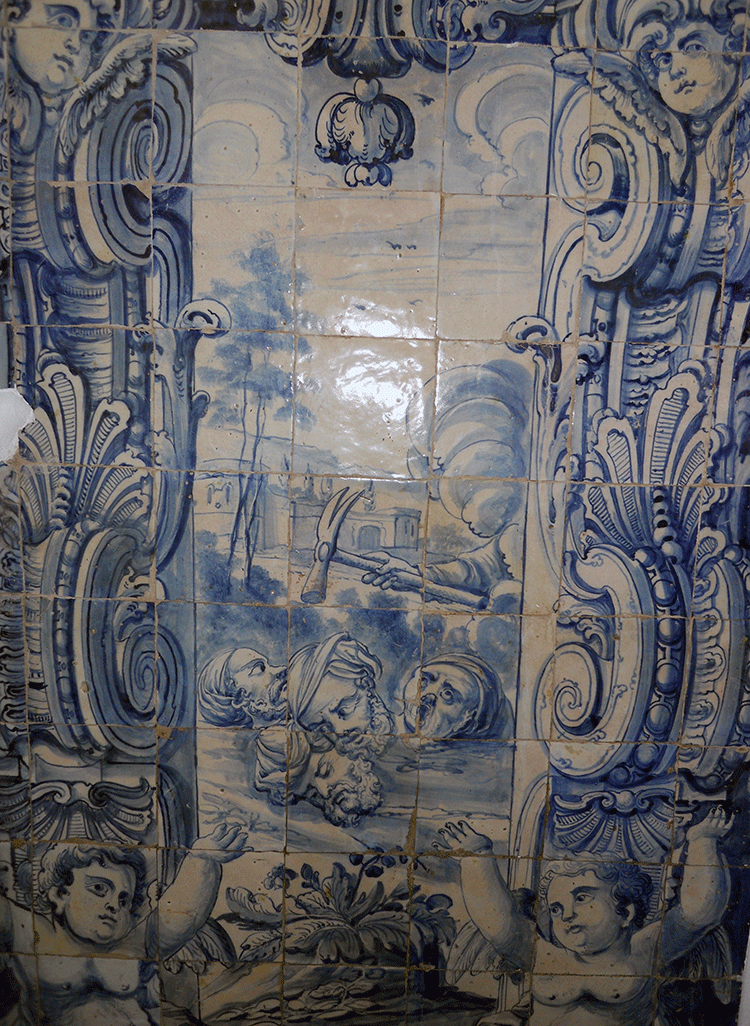
The fate of the five faithful Franciscans St. (that title bestowed later) Francis sent, or sentenced, to proselytize to the Moors in southern Spain and Morocco, on the other hand, is easier to grasp as saint-worthy. Not surprisingly, the Sultan did not embrace their message. So much so he personally beheaded the five (their shocked expressions captured on the azulejos above), whose remains were miraculously moved to Coimbra where they would inspire missionary zeal in a young Anthony – later to become St. Anthony and a great excuse for someone from a city named in his honor to journey to Portugal in advance of his feast day.

And Queen Isabel (Saint Elizabeth of Portugal, 1271-1336) certainly is recorded as a virtuous role model. Pledged to King Dinis at age 12, she plunged herself into daily devotions as he continued to relish rowdy romps at court while awaiting the actual marriage date a few years later. Once at court, she slowly began to alter the king’s ways by her pious example of prayer and service to the poor, pressuring ladies of the court to assist her, not welcomed as a popular pastime by all.

Queen Isabel was known as a peacemaker, even positioning herself upon a mule between two armed factions poised on the battlefield. She managed to broker peace between her son Affonso and his father during the Civil War arising because Affonso felt the King favored the rise in power of one of his illegitimate sons. (“Ah, Mom,” whined the Prince. “My wife, ever the party-pooper,” grunted the King.) Queen Isabel lavishly funded construction of the Santa Clara Convent while the king was still alive, and, after his death, retreated there herself to serve the poor.

This slideshow requires JavaScript.

And, of course, it’s not just their stories. Often it’s parts of them. Literally. Portugal hosts many gleaming reliquaries designed to preserve and display a bone or two of various sizes. As the Mister once remarked years ago with amazement, “One saint sure goes a long way.” Although mysteriously, many of the bones of the reliquaries prominently displayed in Portugal seem to be missing.

One day, much later, I will post my confession about my fascination with relics of saints.

But must be going, if we can make our way through all the partying Spaniards swarming Lisboa for a major soccer match. Two Spanish teams, for some reason. The Lisboa police might welcome some intercessions by Saint Isabel in the streets tonight to part the well-lubricated factions.