
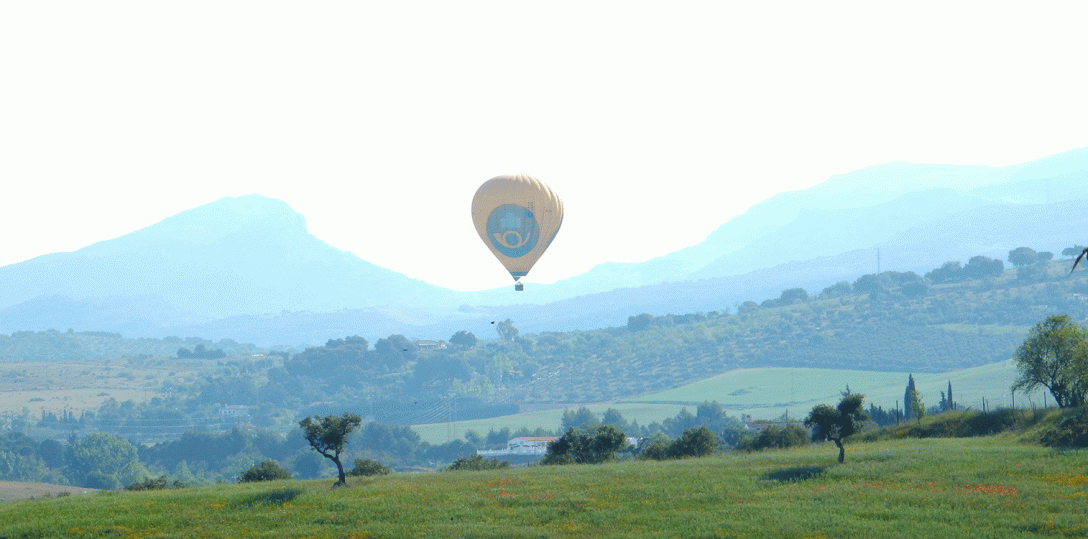
Balloonists drift through morning haze outside the back patio of our rental in Ronda.
Ronda is the place to go, if you are planning to travel to Spain for a honeymoon or for being with a girlfriend. The whole city and its surroundings are a romantic set.
…nice promenades, good wine, excellent food, nothing to do….
Ernest Hemingway (1899-1961)
Yes, there are several museums in Ronda. But its overall attraction, as Hemingway once typed, is there is relatively nothing to do but soak in the view from the majestic perch or take meandering walks below looking back up at the perch. And what a spectacular view it is on all sides.
Of course, Hemingway was not drawn to Ronda for its peacefulness but for the excitement of its bullfighting. The thrill of the kill. Ronda’s bullring is the birthplace of the tradition of the matador standing his ground before the bull instead of evading the bull on horseback. The place where matadors chose to dress in the elegant style depicted in the paintings of Goya.
And the ancient foundations of Ronda were not tourist perches but fortifications providing sweeping surveillance points for guarding against approaching enemies.
The site chosen either by the Iberians or the Bastulo Celts for the settlement that would one day become Ronda was perfect. (This was all a long time ago and no-one can be sure.) Rocky, protected by Nature like a favourite child, and so easily defended that even the most nervous members of the tribe could get a good night’s sleep. Naturally the Romans, whose paranoia was unparalleled but understandable, given their penchant for treating non-Romans with brutal disdain, liked what they saw and were determined to have it. Even the stoutest fortress is only as invincible as its defenders, and the Iberians, damned forever by the historian Strabo as “unable to hold their shields together,” proved no match for the determined invaders, who most certainly could. The supposed Iberian stronghold was easily taken, and rapidly “Romanised.”
John Gil, Andalucia.com


Moorish rulers recognized the value of this outpost in their frequent battles for control amongst themselves, and many of the remnants of fortifications date from their long occupation – from the 700s until 1485. After their water supply was seized, Moorish forces surrendered to Christians.
While Ronda appears rock-solid, many of its important buildings were felled by an earthquake in 1580. Then in 1810, retreating Napoleonic forces blew up the castle and many of the fortifications before their departure. And churches were again damaged during the Civil War in the 1930s.
Despite the imposing remaining ramparts, it is difficult to imagine violence in Ronda. Sheep graze peacefully outside the walls.
The main assaults upon the city today are busloads of day-trippers, welcomed by the town’s restaurants dependent upon them. They remain in a fairly concentrated area though, elbowing their way to viewpoints overlooking the plunging gorge (Okay, of course we joined them there.).
The other tourists were particularly useful, though. They provide scale for our snapshots. If you look closely at many of these photos, there are tiny specks of people admiring the spectacular scenery from atop the enormous rock mound.


 Postcards from Barton Springs