
Once again, “The liberal media has put the Texas educational system under a great deal of scrutiny lately….” This opinion is offered by Texas GOP Vote Blog.
That blog is not anywhere I normally hang out. In FACT, I truly try to keep politics out of my blog, but…
I was trying to find the text somewhere, anywhere online with the exact wording of the new social studies guidelines approved by the Texas State Education Agency. If we are once again the laughing-stock (although it really is not funny) of the nation, I wanted the FACTS. I could not find the approved guidelines in writing so tried listening to some of the actual debates online. Took about two minutes, perhaps less, to decide I’d wait for the transcripts.
But then I found this GOP blogger ready to straighten out the biased news reports:
To help sort out fact from fiction, Jonathan Saenz from Texas Legislative Update has sent in a fact versus fiction summary….
One of Jonathan’s FACTS follows:
FALSE ALLEGATION: The State Board of Education has eliminated Tejanos who fought at the Alamo.
FACT: The Social Studies TEKS include Tejano leaders who fought at the Alamo.
In Grade 4 Texas history, Tejanos Juan Seguin, Placido Benavides and Francisco Ruiz are required to be studied as important participants in the Texas Revolution.
Benavides and Ruiz were not participants in the Battle of the Alamo (so are unrelated to the discussion of the allegation), but we’ll let this part slide because the sentence above only identifies the three as participants in the Texas Revolution. Maybe Jonathan should have stopped (or never started) his argument there.
Lorenzo de Zavala and Jose Antonio Navarro, Tejano leaders who died at the Alamo, also are required figures in Grade 4.
Hold everything. The GOP factoid provider needs a FACT checker before he kills off de Zavala and Navarro at the Alamo.
I always place great trust in the Handbook of Texas Online, an incredible resource offered by the Texas State Historical Association. Here is the Handbook’s view of history:
FACT: Manuel Lorenzo Justiniano de Zavala y Sáenz, first vice president of the Republic of Texas:
Zavala returned to his home in poor health and relinquished his part in the affairs of state. He resigned the vice presidency on October 17, 1836. Less than a month later, soaked and half-frozen by a norther after his rowboat overturned in Buffalo Bayou, he developed pneumonia, to which he succumbed on November 15, 1836.
FACT: José Antonio Navarro was one of three Tejanos signing the Texas Declaration of Independence, along with his uncle, José Francisco Ruiz and Lorenzo de Zavala. “He died on January 13, 1871.”
I was taught seventh-grade Virginia history from a book emphasizing most masters were kind to their slaves, treating them like family members. I do not think anyone in my class fell for it. (FACT: Relationships were so close that many slaves bore the children of their masters.)
Fortunately, children do not always believe what is taught them. They are not stupid. But what’s these two GOP bloggers’ excuse for their ignorance of Texas history? Happy Jonathan did not tackle too many FACTS past what is taught at Grade 4.
Oh well. Thanks, guys, for keeping us posted with well-informed FACTS. Did not even need to reference any of the liberal media stories online to debunk your version of history.
Guess I’ll keep looking for FACTS elsewhere.
Texas, Our Texas! so wonderful so great!
Boldest and grandest, withstanding ev’ry test….
Except maybe fourth-grade history.
Note Added on May 25: My apologies to Jonathan. He merely attributed incorrect roles to real people. In this morning’s San Antonio Express-News, columnist Cary Clack pointed out the hero praised most by one member of the State Board of Education is fictitious:
Then there’s Don McLeroy of Bryan, the board’s wizard who — among many dubious proposals — wanted to evaluate the impact of reform leaders such as Upton Sinclair, Susan B. Anthony, Ida B. Wells and W.E.B. DuBois. Instead of citing these men and women as people who loved their country so much they devoted their lives to changing it for the better, McLeroy was concerned that their tone wasn’t as optimistic as the Belgian immigrant Jean Pierre Godet who said, “I love America for giving so many of us the right to dream a new dream.”
…. Godet is a fictional character in the 1998 book, “The Spirit of America” by the painter Thomas Kinkade.
McLeroy is so afraid of the nation’s past he’d prefer to elevate a fictional character at the expense of genuine American reformers. Maybe he’s right and we can eliminate from our textbooks more of those insufficiently patriotic do-gooders and replace them with true American heroes like the Legion of Superheroes, led by Superman, who made no mistakes and made everyone happy except for the bad guys.
Students can learn about justice and interracial cooperation through The Lone Ranger and Tonto and be taught examples of loyalty, friendship, hard work and ingenuity through the stories of Lassie….
That’s what we need, the “painter of light” to illuminate Texas history. Maybe we can incorporate his work in the math curriculum as well. Students can be challenged to figure out how many times Tinker Bell appears in Kinkade’s eight Disney images.
Note No. 2 Added on May 25: From David McLemore’s blog:
After wrestling Santa Ana to the ground, Davy Crockett parted the San Antonio River and said, “Let my people go!”
Note Added on May 30: Jonathan, read about three Tejanos who actually were at The Alamo.
Note Added on September 19: Great John Branch cartoon in today’s San Antonio Express-News:
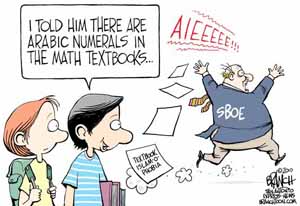
February 20, 2011, Update: The conservative Fordham Institute condemns revisionist history in Texas, and someone recently sent me a link to a great 2010 cartoon from The Washington Post.
Note added on March 3, 2011: Veronica Flores-Paniagua weighs in on the current state of the State Education Board.
Note added on May 27, 2011: Senate Democrats refused to rubber-stamp the governor’s nomination to lead the SBOE….


 Postcards from Barton Springs