Postcard from London, England: ‘Strange bedfellows’ for eternity

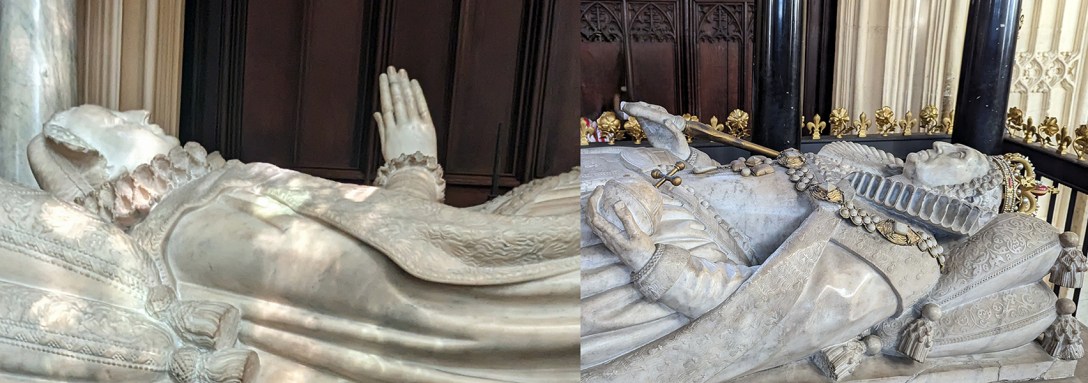
Above left: Monumental effigy of Mary Queen of Scots (1542-1587). Above right: Queen Elizabeth I (1533-1603). Lady Chapel, Westminster Abbey

There is no other shelter hereabouts: misery acquaints a man with strange bedfellows.” 

The Tempest, William Shakespeare, 1611

In recent years, you’ve been exposed to an immense quantity of footage showing the interior of Westminster Abbey: the wedding of Prince and Princess of Wales in 2011; the funeral of Queen Elizabeth II (1926-2022); and the coronation of King Charles III and Queen Camilla in 2023.

With no need to cover that aspect, this taphophile is jumping straight to the everyday role of Westminster – a splendid monumental cemetery housing the remains of more than 3,300 elite, a veritable who’s-who of a thousand years of British history. Grave markers underfoot lie ignored, overwhelmed by the sculptural and polychrome effigies and memorials climbing ever higher up the church walls.

If ghosts rise in the night, what bedlam must reign. According to the Westminster website, the remains of 13 kings, four queens regnant, 11 queens consort, and two more queens are interred there. Blood might run thicker than water, yet British bluebloods frequently spilled that of their kin.

Continue reading “Postcard from London, England: ‘Strange bedfellows’ for eternity”

Japanese woodblock prints at Blanton reflect ‘Floating World’ values

Above: “Shadows on the Shoji,” Kikukawa Eizan, 1815

The two fashionably dressed courtesans in the foreground appear to have just stepped away from a lively party and are chatting on a veranda. The drinking and flirting figures inside cast shadows against the shoji (lattice-and-paper screen doors) of the brothel behind them.”

Curatorial notes for “Shadows on the Shoji,” Blanton Museum of Art

1815. The date surprised me, due to my lack of understanding the accepted restrictive roles assigned courtesans and geishas in Japanese culture. The witty social commentary and humor contained in Edo-era (1603-1868) woodblock prints in “The Floating World: Masterpieces from the Edo Period” on display at the Blanton Museum of Art prove captivating.

Continue reading “Japanese woodblock prints at Blanton reflect ‘Floating World’ values”

Postcard from Palermo, Sicily: Byzantine mosaics and Moorish muqarnas

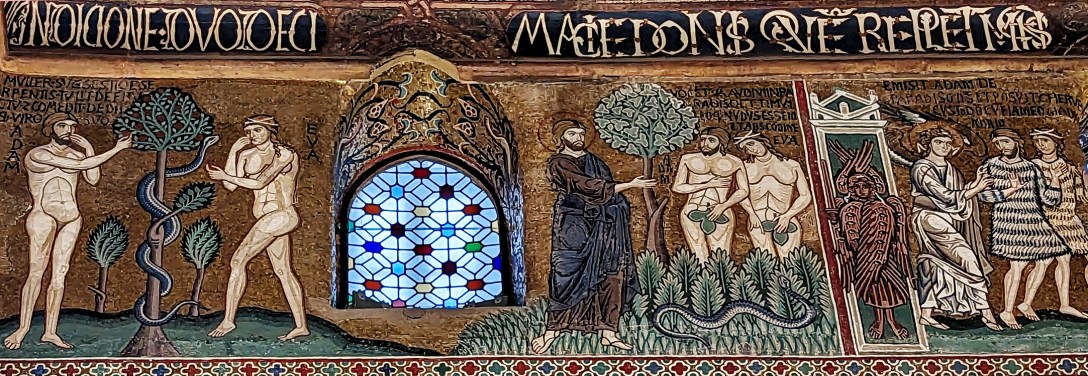
Adam and Eve, 10th-century mosaic in the Palatine Chapel inside the Norman Palace

The Palatine Chapel is the most beautiful in the world, the most surprising religious jewel ever evolved up by the human mind and executed by the hand of an artist…. where the harshness of the Gothic style brought here by the Normans is tempered by the wonderful art of Byzantine ornamentation and decoration.”

Guy de Maupassant, “La Vie Errante,” 1901

The facade of the immense Norman Palace is so cold and boring, I could not bear to take a photo of it. The original stark building was built to serve as the residence of kings installed after the Norman conquest in 1072. But one should never judge a book by its cover….

Proclaimed the King of Sicily by papal bull in 1130, Roger II (1095-1154) had been exposed to the various architectural influences that had ebbed and flowed with invasions of the island for centuries. For the eight-year construction of the royal chapel within the palace, he recycled some rather wild Corinthian columns and tapped both the talents of Moorish builders to craft the honey-combed muqarnas of the vaulted ceilings and Byzantine artists for the exquisitely detailed mosaics of the transept. The mosaics of the nave, a little bit cruder but still stunning, were commissioned from local artisans by William I (1120-1166), known as William the Bad; and William II (1153-1189), known as William the Good.

Continue reading “Postcard from Palermo, Sicily: Byzantine mosaics and Moorish muqarnas”