Marked Un-Graves Haunt Morning Walks

I know whom I am supposed to be researching:  The large and unwieldy cast of characters living in San Antonio between 1910 and 1920 whose stories seductively slip their way into the pages of An Ostrich Plume Hat whether they forward the plot or not.  Their ever-present ghosts float above my desk, my bathtub, my pillow at night, beckoning me to resurrect their lives on paper.  

The last thing I need is the distraction of unrelated people haunting me.  Blame it on the failure of native grasses to take root quickly on the Mission Reach.  If the construction workers or stray dogs guard the entrance by Roosevelt Park, I am forced to cross Roosevelt to South Presa.  

And there they are.  Their names prominently etched in stone disembodied from any gravesites.  

Who are they?  I worry they are not resting in peace but lying lonely underground in unmarked paupers’ graves.  

Did ungrateful descendants collect their inheritances and then decline to pick up the tabs for their headstones?  Or were they never real people, just imaginary inhabitants of San Antonio invented to serve as samples for those shopping for monuments to loved ones?  Or are they mistakes, large typos carved permanently in stone? 
From Meier Bros. Website


The latter two theories are more settling.  Meier Bros. Monuments has been in business for a long time, since 1900.  Surely the brothers have made a few spelling or date errors.  

But the names kept nagging me.  After all, Edna Viola Clift was someone’s “beloved grandmother.”  I owe her just a few short clicks on ancestry.com or in census records.  She did exist, dying in San Antonio in 1977.  Another woman was a longstanding member of St. Mark’s Episcopal Church, still living just a couple of years ago.  How did she end up carved in stone with only her birth date? 

His stone proclaiming “Dios es Amor,” Severo O. Cervantez was born in Mexico in 1887.  In 1910, he made his living in “cement work” and resided on Division Avenue with his wife Francisca and two-year-old son Geronimo, both native Texans. 

Mattie was the one, however, who finally freed me to resume contact with the ghosts entitled to haunt me.  The letters carved in granite read “Martha May Lazrine Miller.” 
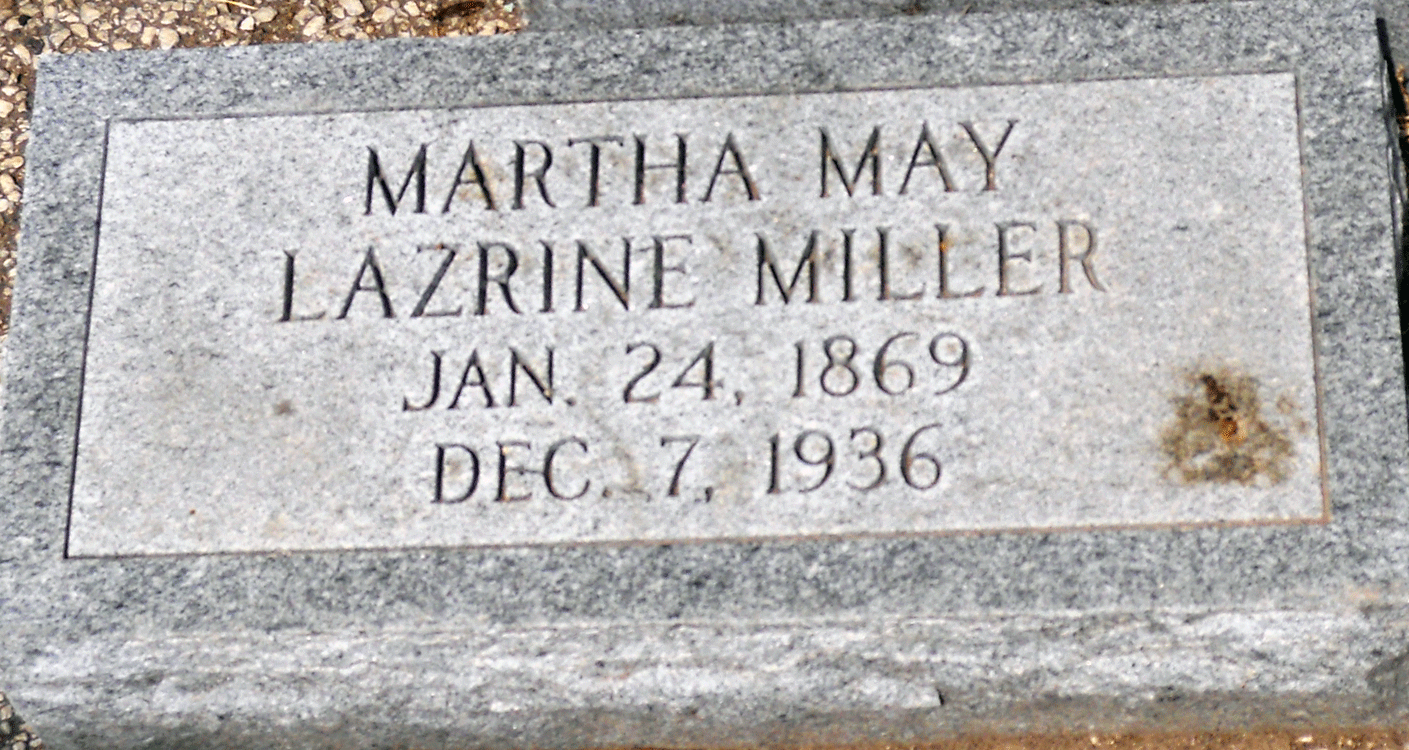
Mattie was born in 1869 and married Lee, her senior by 13 years.  The couple raised at least seven children on their farm in Del Rio, Mattie’s mother residing with them, perhaps to lend a hand.  

In 1918, the 5’6.5″-tall Lee applied for a passport so he could board a ferry-boat to take one of his sons to spring baths in Las Vacas, San Carlos, Mexico, to cure his rheumatism.  Mattie and Lee now lie together in Del Rio’s Westlawn Cemetery with some other stone at their heads.  

Lee Lazrine's Passport Photo


Thank you, ancestry.com, for giving me the answer I sought.  A major typo.  

Martha May’s maiden name was Miller, and she married Lee Lazrine. 
Rest in peace, Mattie.
Time for me to get back to work.

Max and Minnie Voelcker left more than their farm behind

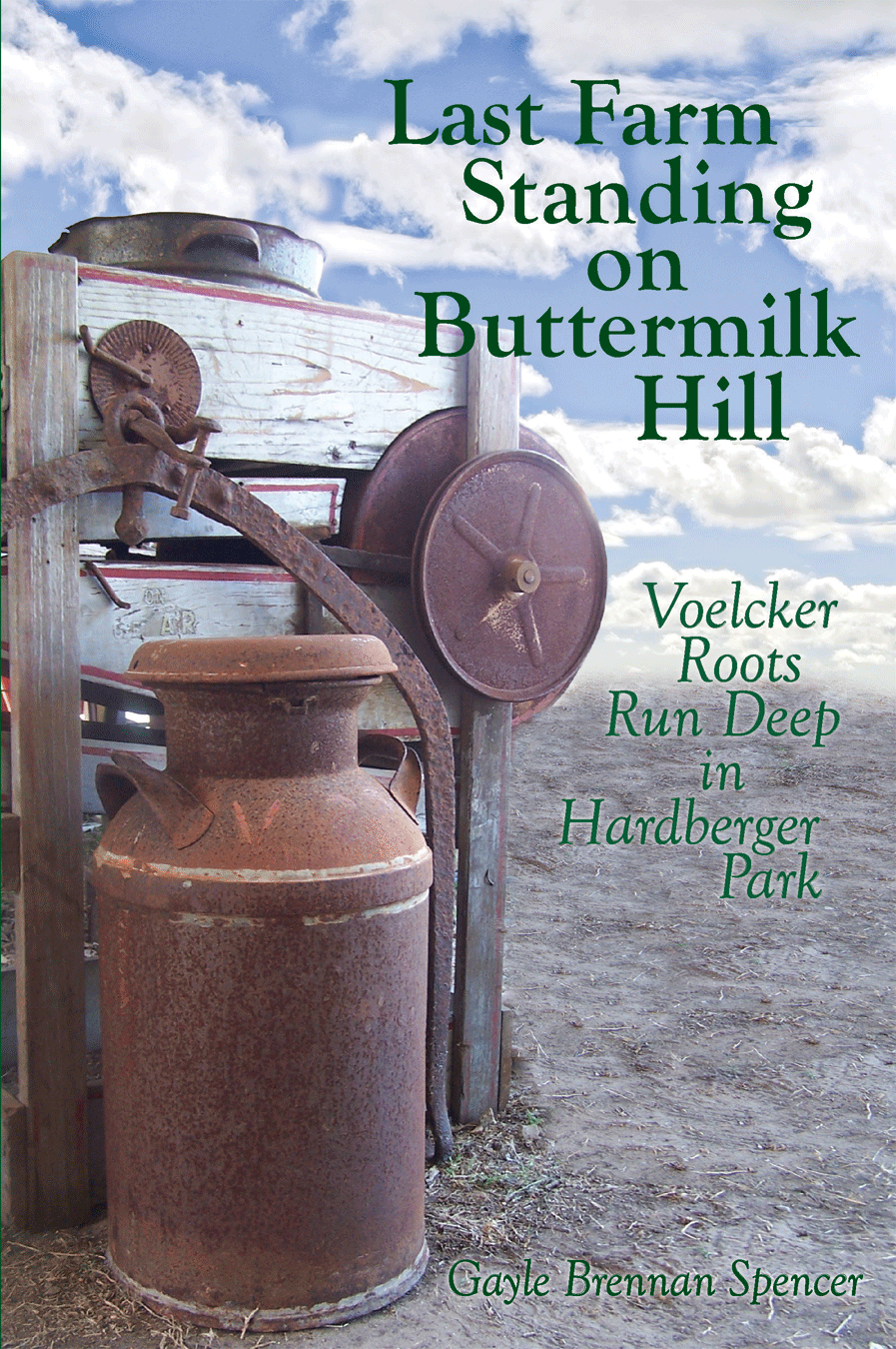
Front Cover of "Last Farm Standing on Buttermilk Hill: Voelcker Roots Run Deep in Hardberger Park"


Never realized how much virtual travel it would take to get a book to press. Certainly, Max and Minnie Tomerlin Voelcker could not have envisioned their story would do the amount of traveling it has done this summer; of course, they would be shocked to find their story told at all.   

Editor Lynnell Burkett of LBJ CommuniCo of San Antonio found our book designer, Amy Layton, in Sanger, Texas. The indexer (I never had given any thought at all to how indexes arrived in the back of books.), Sherrye S. Young, PhD, of RedLine Editorial Services worked from her home in White Bluff, Tennessee. I tracked down Char Miller in Delaware.  He read Last Farm Standing on Buttermilk Hill while relaxing on a beach, then wrote the blurb for the back of the book when back in Claremont, California, where he serves as director and W.M. Keck professor of environmental analysis at Pomona College.   Former Mayor Phil Hardberger docked his sailboat at some unknown port to email in his blurb.  And now Last Farm temporarily has moved to the offices of Four Color Print Group in Louisville, Kentucky, before its journey to somewhere in China.   

Back Cover of "Last Farm Standing on Buttermilk Hill"


And then we wait.  And wait.  While Max and Minnie were doing all of this virtual travel with the click of a send button, that is not how they will return.  Their journey back to San Antonio actually will be aboard a proverbial slow boat from China.  Their story will arrive, no longer in only a virtual state, at the end of October.   

As I packed up the pieces of paper and photographs documenting their lives that have encircled my desk for so long, I wondered what good the couple has accomplished posthumously since I completed writing the manuscript more than a year ago.   

The Max and Minnie Tomerlin Voelcker Trust has announced their Scholar and Young Investigator Awards for 2010.  The Young Investigator Awards are designed to support young scientists conducting medical research to find cures for cancer, heart disease, arthritis, muscular dystrophy, retinitis and/or macular degeneration of the retina.  Recipients are provided $150,000 per year for three years ($450,000).  The Scholar Awards provide a one-time award of up to $500,000 to each recipient and are intended to foster development and productivity of outstanding, established scientists conducting medical research to find cures for the same diseases.   

Investigator Award recipient Alexander Bishop, PhD, of the University of Texas Health Science Center at San Antonio (UTHSCSA) is striving to determine cisplatin survival factors to augment ovarian cancer treatment.  UTHSCSA’s Doug E. Frantz, PhD, is working on the development of novel stem cell-based therapeutics to treat heart disease and cancer.  Lorena M. Havill, PhD, of the Southwest Foundation for Medical Research, is studying genetic contributions to knee osteoarthritis risk.  Sunil Sudarshan, MD, PhD, of UTHSCSA is delving into the metabolic links to renal cancer.  Scholar Award recipient Tyler J. Curiel, MD, MPH, also of UTHSCSA, is devoting his energies to the development of effective and tolerable age-specific tumor immunotherapy.  

Pretty amazing that the frugality of two former dairy farmers with little formal education is contributing so much to the advancement of medicine.  Makes me even more proud to have been privileged to get to know them, if only from the scraps and traces they left behind, and to preserve some remnant of their lives on paper.    

Bon voyage Max and Minnie, and, as I resume my other writing projects, I already miss your presence in my study.   

Note Added on September 15The Twig Book Shop, 200 East Grayson in the Pearl Brewery complex, will host a book-signing welcoming Max and Minnie back from China from 5 to 7 p.m. on Tuesday, November 16. 

November 17 UpdateGifts with enduring ramifications….

This Deadly Scenario Should Not Have Been Written

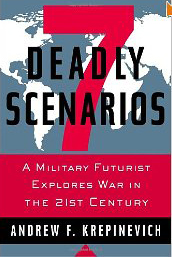
7 deadly scenariosAndrew Krepinevish has done what I would have sworn impossible.  He has almost managed to evoke a sentimental attachment to all of the horrible signage violations invading the Alamo Plaza Historic District, even Shamu disrespectfully flipping his tail toward the shrine of Texas liberty.

The West Point and Harvard graduate struck a little too close to home – only about six or seven blocks away – in one of his 7 Deadly Scenarios: A Military Futurist Explores War in the 21st Century.  His book, not light end-of-the-summer beach-reading material, was published in January 2009 by Random House, and I’m probably the last person to hear about it.  But the “future” he described is nearly here, and he is picking on the 175th anniversary of the Battle of the Alamo:

At precisely 8:28 a.m. on the morning of March 6, 2011, just as the city’s morning rush hour is at its peak…

Sorry to interrupt his story, but have the reenactors cleared out before 8:30, or are they in big trouble?  Am I on the plaza at the tail end of my morning walk?

…a blinding flash of light rips through the downtown area.  Nearby buildings are immediately vaporized.  Buildings farther off buckle and collapse….  A local television station’s traffic helicopter captures the blast at a distance of nearly nine miles away.  As the telltale mushroom cloud begins to rise from the city, the traffic reporter remarks, “My God, it’s an atomic bomb!…”

“Remarks?”  My loft and I were just vaporized.  That reverse commute my husband makes five days a week sounds pretty appealing at this point in the narrative.  I sure hope this is Krepinevich’s worst-case scenario.

The lead shot on the evening news, not only in America but around the world that night, centers on two images: the footage from the traffic helicopter with the reporter’s horrified voice-over; and on-the-scene reporters standing at locations where the severely damaged Alamo mission – the shrine to Texas’s independence – can be seen in the distant background.

The Daughters of the Republic of Texas must have gotten the roof repaired in order for it to withstand such a powerful attack, but I’m not reading another word.  This book gives me the creeps.  Ban this book. 

I certainly prefer a symphonic concert for the 175th anniversary.  But tell the reenactors to be on alert, and please, Tony, maybe don’t hang the banner.  Let’s not give the nefarious characters invented by Krepinevich that kind of directional signage. 

Rather selfish of me (an understatement much like “remarks”), but could we instead install a banner steering them toward the “reel” Alamo, John Wayne’s Alamo, the one in Brackettville? 

Update on August 31:  The “reel” Alamo is closing to the public.