Postcard from Valencia, Spain: Three-day holiday weekend a jumble of events demanding Valencian attention

Saint George (275?-303) has been the patron saint of the Aragon region since 1096. Peter I of Aragon and Navarre (1068-1104) reconquered the city of Huesca in the Battle of Alcoraz that year. After freeing them from Moorish rule, the crown of Aragon tied Barcelona and Valencia together with a common language, Catalonian.

The dialect derived from this period remains a source of civic pride in Valencia today. The distinctive spelling associated with Catalonian is featured more prominently than Spanish in museums and, as though to confuse us, on street signage.

But, back to Saint George. His saint’s day is celebrated in much of Spain as a holiday, and this year it landed on a Monday, creating a three-day weekend. At least I assumed George should get the credit.

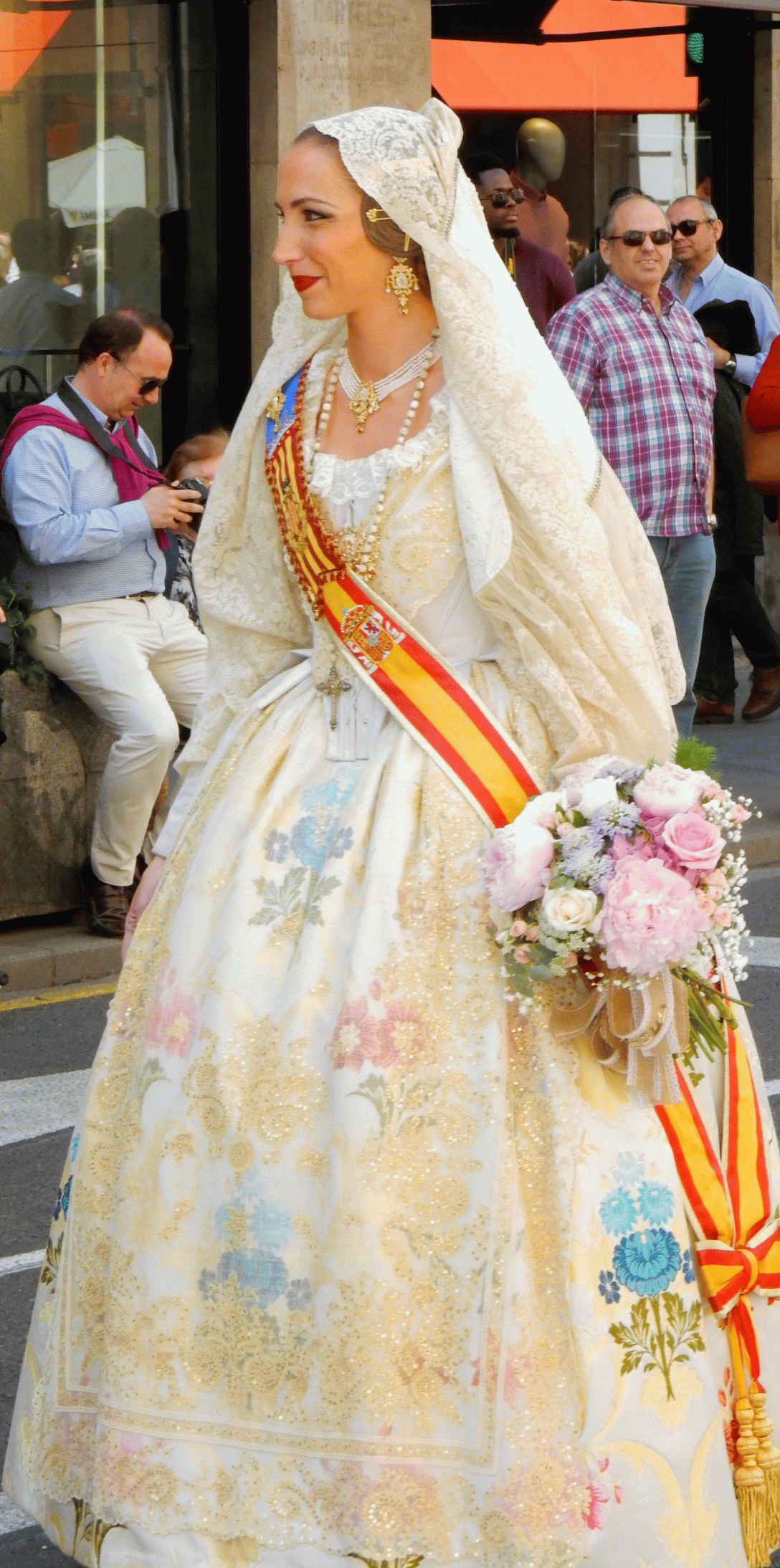
Throughout the prior week, carpenters scrambled to erect elaborate stages, some almost as gaudy as New Orleans Mardi Gras floats, directly in front of numerous churches. We came across several women and young girls attired in crinolined full-length dresses made from yards and yards of brocade posing for portraits in front of notable landmarks. Stores displayed these quaint-looking costumes and bolts upon bolts of fabric, probably more brocade than Orville Carr used to upholster sofas and chairs for clients during his entire lengthy career in San Antonio.

The preparations remained mysterious to us at the beginning of the weekend, so we launched out with the lofty goal of finding the book fair – Fira del Llibre (note the tricky spelling). Thinking we spied it, we instead stumbled into a regional wine festival in the Turia Gardens.

Books published in languages I can barely comprehend or wine? Good intentions hijacked.

The wine festival presented my first close-up sighting of the hairpiece(s) I nicknamed dona buns. I so wanted a coiled trio for Fiesta, but, as I am ungracefully letting my hair assume its natural color, I have no idea yet what shade of gray, white or in-between stripes that is. Aside from the lack of the comb-over camouflage, these dona buns matched the hairstyles of the costumed women we noticed earlier.

The next day, we resumed our quest for the book fair. We found it. It was large, some 300 vendors, and absolutely packed with people seduced by books above the nearby wine festival. Or maybe they follow a books-first, wine-second rule.

Not lingering long at the crowded literary event, we risked temptation by taking the bridge crossing the Turia Garden above the wine festival. Could we avoid the siren-like call of all of those clinking glasses?

Amazingly, the Mister managed to steer me clear. Only, though, because I spied a trio of women wearing beautiful long black mantillas crossing the bridge (No, daughter, I was not nun-hunting again.). These mantillas were not everyday headgear. I opted to follow the path from whence they came, instead of heading for more wine. Photos snapped from where that led will be in the next post.

Back to Saint George. While I assumed the holiday in Valencia related to him, the performances on Monday made me realize the day might focus on multiple saints. The second Easter Monday in Valencia is celebrated in honor of Saint Vincent Ferrer (1350-1419), not to be confused with Saint Vincent Martyr whose semi-incorrupt arm resides in the Cathedral.

Born in Valencia, Saint Vincent Ferrer was named in honor of Saint Vincent Martyr. Fortunately, his path to sainthood was not as brutally painful as that of the martyr who preceded him. Saint Vincent Ferrer was a powerful Dominican who became embroiled in politics during the schism that created rival papacies in Rome and Avignon and was part of a panel selecting Ferdinand I (1380-1416) as king of Aragon in 1410.

Saint Vincent Ferrer reputedly spoke in tongues, allowing people of many different nationalities to understand his preaching, and his vocal chords somehow projected his sermons over massive gatherings. The church credits his words with the conversion of thousands of Jews and Moors to Catholicism.

The saintly deeds ascribed to him include bringing numerous corpses back to life; reviving a dead man to testify to free an innocent man; ending a fidelity dispute by commanding the infant to identify his real father (the child, fortunately, pointed to the woman’s spouse); and beautifying a woman who had been beaten by her husband who deemed her ugly (and, hopefully, also freeing her from the marriage).

The altars erected on plazas around town were used as stages for children under age 13 to reenact, in Valencian verse as they have for about the past 500 years or so, some of the miracles attributed to Saint Vincent Ferrer. We are not sure which miracles were included in the plays due to lack of comprehension of the dialect and one might need to be related to a cast member to endure sitting or standing through an entire performance, but probably some of the above were left out of the scripts. We missed seeing a statue of the saint carried aloft through the streets, but certainly heard the firecrackers heralding his return home.

And, as I surely have lost your attention by now, more about the dona buns and brocade parade later.


Postcard from Valencia, Spain: Philips lightbulb only hint of ‘secret’ garden of tiles beyond

An over-the-top flashy exterior of a former home now the National Museum of Ceramics and Decorative Arts commands the attention of most visitors in the historic center of Valencia. Almost the only thing attracting one’s attention to a smaller house museum on a busy street above the Turia Park is this old tile advertisement. But this, the House Museum José Benlliure, we enjoyed so much more.

The first floor of the former home provides insight to period furnishings, with the upper floors featuring paintings by José Benlliure y Gil (1858-1937) and his son. While the art is worthwhile on its own, the more intriguing spaces are found out the back door.

Benlliure designed the garden upon his return from Rome in 1912. The intimate retreat is filled with tile murals he collected and a colorful series he commissioned depicting regional costumes and agricultural products – mainly oranges and grapes.

At the rear of the garden is the artist’s former art studio and office, wonderfully cluttered and personal. A pure pleasure to explore.

Having the house mostly to ourselves, we felt as though we stumbled into a secret garden of Spanish tilework.

Postcard from Xativa, Spain: Socarrat good for paella but not for a town

In Valencia, the crispy caramelized socarrat around the edges of the paella pan is a cook’s goal, but scorched is far from ideal when applied to your town.

Spaniards have referred to residents of Xativa as socarrats since the early 1700s. Flush with victory at the Battle of Almansa securing Spain for the Bourbons, the vengeful Phillip V (1683-1746) ordered the town taken and set ablaze. Felipe has not been forgiven, his portrait condemned to hang upside down in the city’s Almodi Museum.

The twin peaks of Monte Vernissa above Xativa have been fortified since Roman times. Himilice, the wife of Hannibal, gave birth to a son there in 218 B.C. Although the fortress appears difficult to conquer, sometimes alliances place one on the conquered side because of battles lost elsewhere.

While under Moorish control, Xativa became the 12th-century European center for production of paper. Most of the walls stretching across the two hilltops today are preserved from the Islamic and Gothic periods. Portions of the castles and fortifications were rebuilt more frequently, including the upper Santa Fe Tower – destroyed by a gunpowder explosion in 1563, an earthquake in 1748 and the French in 1813.

Xativa was home to the powerful Borgia family, known for their Machiavellian political maneuvers. Two of the Xativa-born Borgias became popes, Calixtus III (1378-1458) and Alexander VI (1431-1508). The city also takes great pride as the birthplace of the painter Jose de Ribera (1591-1652).

Out of respect for possible remaining scorched sensibilities, the Mister opted for rabo del toro instead of socarrat-crusted paella. Translated literally, this means bull’s tail, making one think this was one way Spain took care of the remnants of bullfights. But it is oxtail, slowly cooked to an extremely tender stage and served with the resulting rich broth.