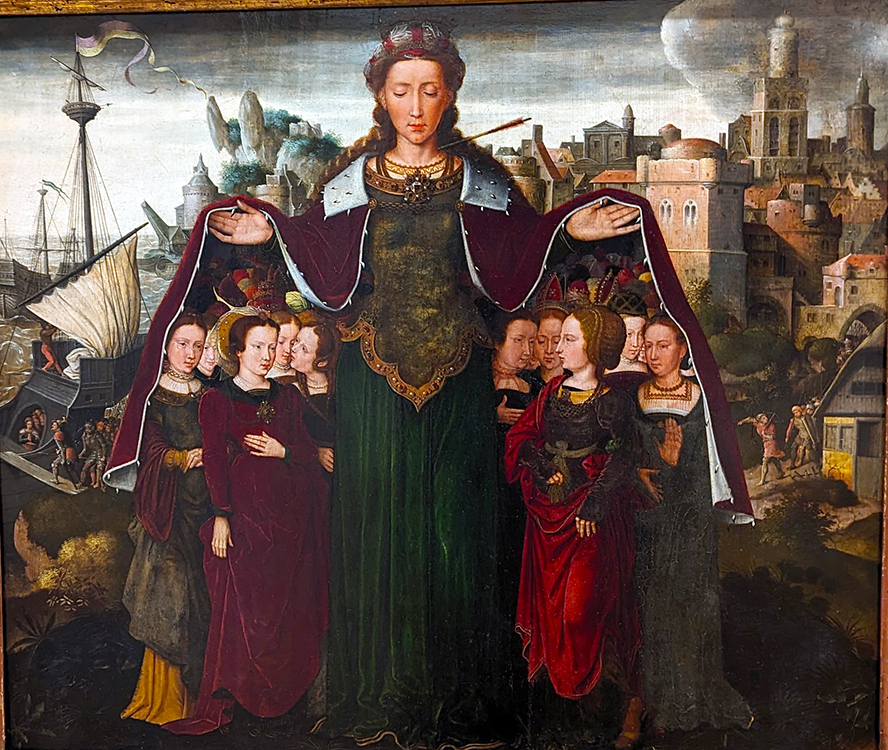
Postcard from Oviedo, Spain: A few pieces from Museo de Bellas Artes

Above: “Saint Ursula and the 11,000 Virgins,” Pieter Claeissens, 1560

Pieter Claeissens’s painting hanging in Museo de Bellas Artes de Asturias attracted my attention because of my unfamiliarity with Saint Ursula. According to legend, 11,000 handmaidens of Princess Ursula set sail with her from southern England on a journey to marry the pagan to whom her father had betrothed her. The ship was blown off course, so Ursula and her entourage decided on an extended pilgrimage to Italy first. Huns had taken over Cologne by the time they finally arrived there, and, for some reason, the Huns failed to appreciate having all those virgins in their midst and slaughtered them.

Continue reading “Postcard from Oviedo, Spain: A few pieces from Museo de Bellas Artes”

Postcard from Palermo, Sicily: Putti play while Jesuits pray

Above: Putti sculpted of marble in Chiesa del Gesu

Known as soldiers of God, Jesuits travel throughout the world to educate and evangelize the masses. They take a vow of poverty when they enter the order, which makes the extravagant beauty found in their churches particularly surprising.

The website of Chiesa del Gesu explains their evangelization efforts through art with words of Saint John of Damascus (676-749):

If a pagan comes and says, Show me your faith!” take him to church and show him the decoration with which it is adorned and explain to him the series of sacred pictures.

Continue reading “Postcard from Palermo, Sicily: Putti play while Jesuits pray”

Postcard from Siracusa, Sicily: Bellomo Palace and, for saint’s sake, always eat two of this dessert

Above: A representation of the story of Adam and Eve eating the forbidden apples, Museo Regionale di Palazzzo Bellomo

A stark façade conveys the 12th-century origin of the Bellomo Palace. The interior spaces, however, reflect several centuries of architectural alterations, much like the centuries of regional Sicilian art housed within. Benedictine monks occupied the palace in the 18th century, merging it and an adjacent palazzo into one compound.

The Risorgimento, the ongoing unification of the Kingdom of Italy, represented a disaster for many Catholic religious orders. In Sicily, the government seized property and buildings, including this monastery in 1866. In 1940, the government repurposed the compound as a museum, with the 1866 confiscated religious art forming a major portion of its collection. The Bellomo underwent substantial renovation in 2004.

Continue reading “Postcard from Siracusa, Sicily: Bellomo Palace and, for saint’s sake, always eat two of this dessert”