Postcard from Guanajuato, Mexico: Festival of the Virgin of Loreto

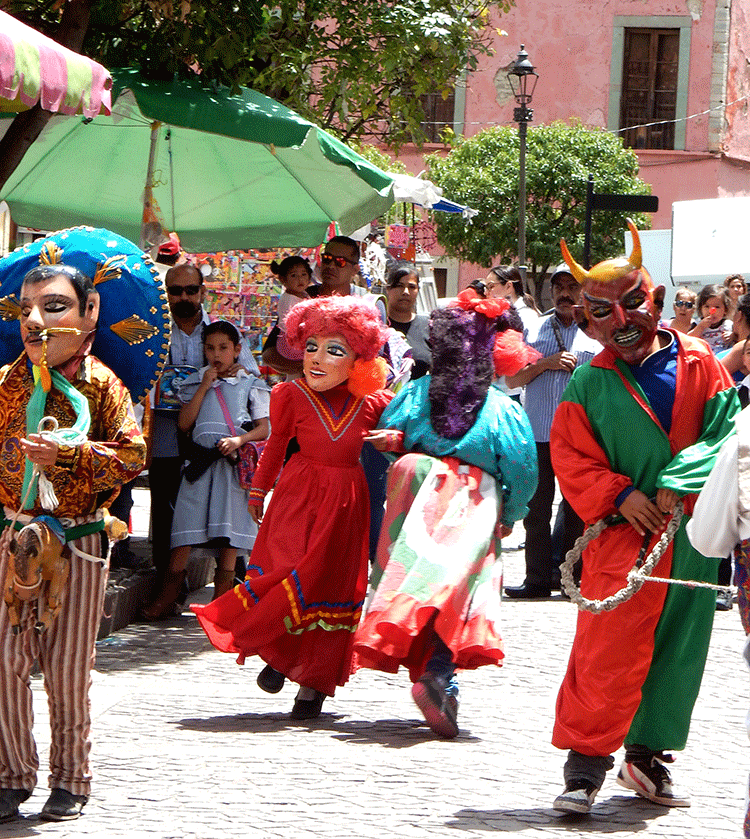
Dancers pranced to beats of drums and high-pitched flutes all day yesterday in a street below the house where we are staying. We’re not sure it is an official holy day, but the neighborhood participants treat it as such.

Flowers adorned the altar in the Capilla Santa Casa de Loreto, dedicated to the Annunciation in the home the Virgin inhabited when the angel Gabriel revealed her impending delivery of El Nino. While Candelaria in January is regarded as the holy day when the faithful bring their small Nino statues dressed in new finery to churches for blessing, in Guanajuato the ceremony is replicated in front of the altar during this festive event marking the anniversary of the consecration of the chapel in 1854. Although some let me peek inside their baskets, we didn’t feel comfortable asking anyone for permission to photograph the lacily attired Ninos they cradled so proudly.

And, of course, music, food and firecrackers warmed up the crowd in advance of the major pyrotechnical displays at 9 o’clock. The experts toiled to assemble a monumental castillo of fireworks throughout the afternoon.

We were viewing the altar when the shrill sounds of the whirling wheels of light first began. Along with many of those heeding the call to exit the church, we watched from the steps. The Mister began filming with the camera.

First lesson learned: Do not hold the camera vertically when shooting because we do not have the software downloaded to rotate it 90 degrees. For this reason, the images of the fireworks were snatched from frames of the video and turned for viewing.

Second lesson: When a lone bombero appears beside you in fireproof clothing, lowers his visor and nervously glances upward, MOVE. Even if relocating means you must stop filming just as the swirling halo of the announcing angel perched atop the castillo rockets upward into the dark night sky.

Cascades of sparkling fireworks showered down upon us from the rooftop of Capilla Santa de Loreto. This display was followed by the finale of explosions of light set off above. The video captures some of the first sparkling showers.

Postcard from Bologna, Italy: Drawn to those bones

The bones above purportedly belong to the bodies of Saint Vitalis (Vitale) and Saint Agricola. The pair’s history is a bit hazy, as the two were martyred in Bologna under the orders of the Roman Emperor Diocletian (244-316) somewhere in the neighborhood of the year 304. As Diocletian claimed to be the son of Jupiter himself, he was not particularly tolerant of people worshipping a supreme being other than his own father.

Catholic Online relays one version of the end of the lives of the saints above:

Vitalis was the slave of Agricola and a dedicated Christian. Arrested and condemned for his faith, Vitalis faced his death with such aplomb that Agricola was converted and accepted his own crucifixion.

The Cathedral in Bologna houses a collection of what are termed “First-Class” relics, including those above. First Class refers to relics that actually were part of the saints’ bodies, versus, say, scraps of their garments.

My fascination with relics stems from the difference of practice of Catholics growing up in Virginia Beach where we had none of which I am aware, and the practice of Catholics in Europe and Mexico where many reliquaries are displayed prominently in churches. The stories about the church and saints I find of interest are the ones nuns never ever mentioned during catechism.

Of course, the United States is not home of many canonized saints, whereas Italy has hundreds. Perhaps the practice of spreading the bones around to different churches arose naturally from the fact that the various extreme methods of exterminating the lives of early Christian martyrs did not always leave their bodies intact.

Rather than try to lamely explain why churches house reliquaries, I thought I’d see how Catholic websites define the practice:

More commonly, the saint’s bones were divided up, so various communities could have a portion of his relics: the skull here, a hand there, other bones elsewhere.

“Relics,” Catholic Answers To Explain and Defend the Faith

The article continues that Saint Jerome explained how the faithful “venerate the relics of the martyrs in order the better to adore him whose martyrs they are.” Relics also “may be the occasion of God’s miracles.”

T.L. Frazier clarifies church policies about relics:

Harkening back to the eighth-century iconoclastic controversy and the seventh ecumenical council at Nicaea (787), the Council of Trent maintained against the Reformers that the honor given to a relic, statue, or icon was honor not to an object (fetishism and idolatry), but to the person it represented. Latria (Greek: worship) must be given to God alone, whereas dulia (Greek: veneration or respect) may be given to holy people or articles.

“No Bones about Dem Bones,” T.L. Frazier

Saint Thomas More lost his head over conflicts with Henry VIII who broke with Catholicism to accommodate his habit of engaging in serial marriages. Pope John Paul II proclaimed Thomas More the patron saint of statesmen and politicians. During this contentious election year in the United States, we sure could use some miraculous relief from ugly rhetoric.

Relics of Saint Thomas More were on a whirlwind tour in the United States, ending up in Washington, D.C., on July 5. Hopefully, they left a residue of miraculous powers to evoke statesmanship-like behavior behind in their wake.

If you know anybody who lives in Centennial, Colorado, maybe ask them to visit St. Thomas More Catholic Church to ask for assistance from its reliquary of the saint. But wait, this one American church possesses more than 60 First-Class relics available for veneration, so all my thoughts about saints’ bones in churches in this country must be wrong.

So now I’m curious. Surely a church as ancient as San Fernando Cathedral and the seat of the Archdiocese must have some reliquaries of their own…. Might have to go on a reconnaissance mission in my own backyard.

Postcard from Ferrara, Italy: Cathedral honors the dragon-slayer

Saint George is the patron saint of Ferrara, so, first, here’s a wandering tale about the saint.

Collecting water for the day was a major chore, but a fierce dragon guarding your water supply really complicates matters. The wise villagers in a kingdom somewhere, perhaps Lebanon or Libya, placated the beast by releasing two sheep to it before fetching pails of water. But the dragon consumed sheep faster than the villagers could raise them, so soon their supply was exhausted.

Some “wise” person, obviously a male, determined the best way to appease the dragon was to feed him young women. A lottery was held to see which young woman would become his supper first, and the beautiful daughter of the king drew the short straw.

The villagers took her to meet her fate, tying her near the dragon’s lair. Fortunately, just in the nick of time, along came a brave Roman soldier who heard the princess cry out for help. The brave soldier slew the dangerous beast and freed the princess.

This tale was one picked up during the Crusades and embellished by soldiers returning home. The hero was reputed to be Saint George, a patron saint of soldiers, a saint who helped protect them not only during warfare but also from diseases they might pick up along the way, such as the plague or syphilis.

The legend of Saint George and the dragon has persisted through thousands of years, mainly because it is such a fairy-tale-type story. Although to truly fit into the Disney-type mold by which many of us were shaped, shouldn’t George then have married the beautiful princess and lived happily ever after?

There are lots of hard-to-believe stories of saints, but this one is considered more legend than fact. As one early pope purportedly said, George was included in the group of saints “whose names are justly revered among men, but whose actions are known only to God.”

But George did earn his sainthood. He became a valued officer serving in the guard of Emperor Diocletian. The emperor, however, demanded all his soldiers renounce Christianity. George steadfastly resisted. The emperor sentenced him to death via several brutal methods we will not describe, but, somehow, George was revived three times. Finally, he was beheaded in April of the year 303.

The grand Duomo is dedicated to Saint George. The façade was begun in the 12th century but took another century or so to complete. Some of its treasures have been moved to the Museo della Cattedrale nearby.

The cathedral with its spacious plazas in front and on one side is an integral part of daily interactions among citizens in Ferrara constantly crisscrossing them. At some point long ago, a shopping arcade of inferior architecture was attached to one side. Fortunately, the arcade is only one story high, so much of the cathedral’s details are preserved for viewing, including the wonderfully funky pairs of wave-like columns running along the side.

These photos are of the Cathedral and some of the contents of its museum.