Postcard from Ostuni, Italy: A white-washed citadel a few olive groves away from the Adriatic Sea

bicycle over ostuni

Experienced travelers as we are, hopping a train for the short ride to Ostuni from Lecce was easy. The flaw in our plan was what to do on arrival. Oh, this is why some people rent cars.

A travel blogger wrote the walk from the station up into town was only a mile or two if cab or bus was unavailable. Neither materialized after what seemed a long wait, so we took off on foot. What the blogger had failed to mention was that the walk was on a stretch of a no-shouldered highway. A sympathetic young woman with a baby on board turned off into a driveway almost immediately to come to the rescue of the two wayward seniors. We gladly hopped in the car. Getting robbed or kidnapped appeared much less likely than getting hit by an automobile. She spoke no English, but went well out of her way to drop us in the center of town.

And everyone in this white-washed town in the heel of Italy was as helpful and friendly, approaching us to offer advice on finding our way around. We were there post-prime-tourist season, so had to navigate our way around the tangle of narrow streets to several restaurants before finding one open for lunch.

But that is both the beauty and fun of Ostuni. Street names change almost every block, and a “street” is often what appears a private stairway. When it came time to try to find the bus back, a trio of men directed us down several flights of unpromising-looking stairs to exactly the right spot where a piccolo autobus transported us and a trio of teens to the station.

The statue atop the column in the middle of a plaza is Ostuni’s patron saint, Saint Orontius of Lecce. The first Bishop of Lecce, he was executed for his Christian faith by axe by a representative of Roman Emperor Nero. But of particular relevance today are the miracles he was credited with centuries later. Residents of Lecce claimed he ended an outbreak of the plague there in 1656, and in Turi it is said he brought an outbreak of cholera to an end in 1851. Better known, Saint Sebastian must be swamped with requests for protection from Covid-19, so maybe light a candle to Saint Orontius as well.

As for the bicycle perched above a rooftop? Pure whimsy.
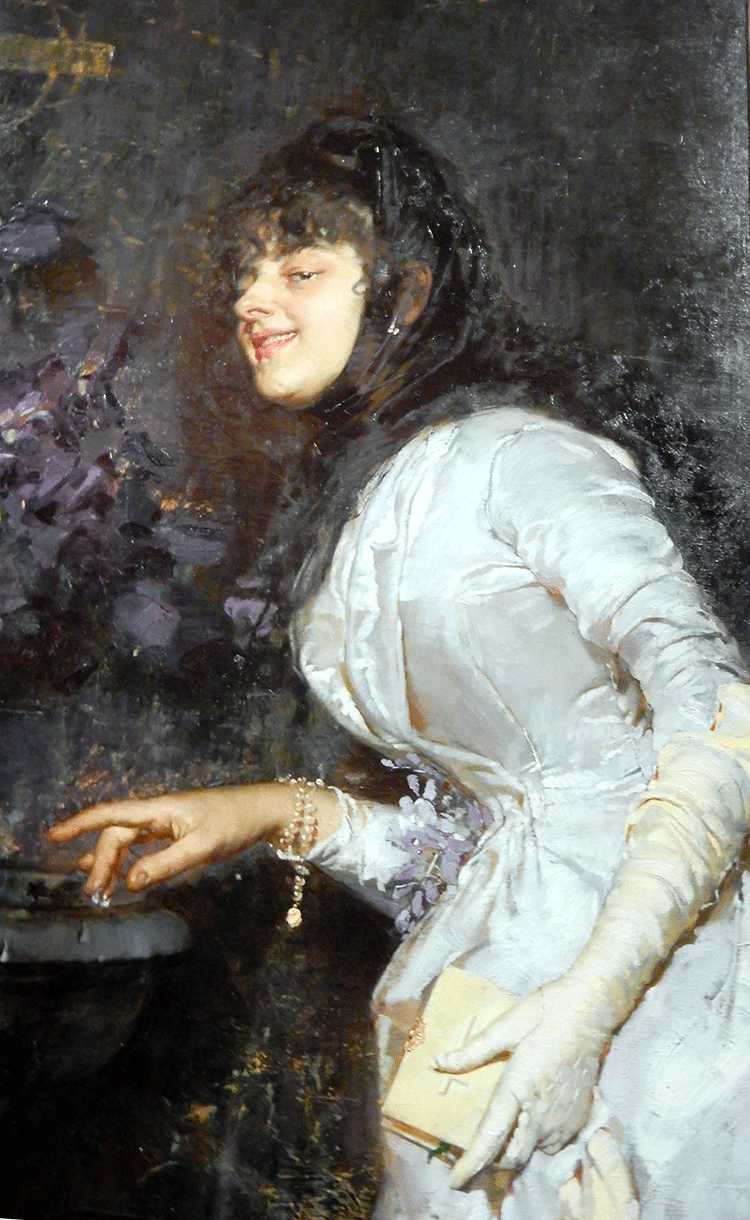
Postcard from Naples, Italy: Snippets shot in final four museums

Detail of “The Devil and the Holy Water,” Salvatore Postiglione, 1887, Gallerie d’Italia – Palazzo Zevallos Stigliano

Inartistically and illogically clumping works from four museums in this one post – 15th-century religious paintings, a Joan Miro retrospective, a house museum, contemporary art. The museums are getting short shrift in treatment because they are the final ones the blog will visit in Naples before moving across the boot of Italy. The grouping does offer a glimpse of how diverse and rich the art offerings found in Naples are.

As is oft the case, our camera lens seems to often focus on the devils lurking in religious art, but what dark thoughts were in the mind of Neapolitan painter Salvatore Postiglione when he conceived of “The Devil and the Holy Water” are unclear to me.

I never had thought of holy water as dangerous before. But, indeed in hindsight, it should have been obvious that the Coronavirus devil was lurking in fonts at the front of Catholic churches everywhere. Catholics always pause to dip their fingers in the communal pool of water and immediately raise them up to touch their face to make a gesture symbolizing the Holy Trinity and baptism.

March brought the draining of the fonts, but how many viral contaminants were shared by the faithful by then? So very, very sad to think of those who might have been harmed by turning to their religious rituals for reassuring comfort….

Postcard from Naples, Italy: Virtual church for times restricted to armchair travel

On the left, Saint Sebastian, the protector against the plague, Monumental Complex Donnaregina

During these days when many a traveler unwittingly has brought back coronavirus as an unwelcome souvenir, we remain grounded and semi-cloistered at home in San Antonio. Spring plans canceled.

With churches locking their doors to try to keep their parishioners safely cocooned in their houses, Sunday seems a good time to share some snapshots from churches taken during a fall trip to Naples.

Am including an assortment of saints to serve most any request. Perhaps Saint Sebastian, the protector against the plague, should be a logical choice? Depictions of saints painfully attaining martyrdom are included to remind us that this confinement is not so bad, particularly as we have internet to let us connect with one another and the world.

And am throwing in the body of one saint-in-waiting, the Venerable Giacomo Torno, lying in an incorrupt state since his death in 1609 as a reminder most aspects of Roman Catholicism remain mysterious and incomprehensible to me, an outsider admiring the art and architecture while always avoiding mass.