Postcard from Morelia, Mexico: A wedding cake turned inside out

Above: Santuario de la Virgen de Guadalupe

Desiring to appeal to the indigenous population, the Catholic Church hired native craftsmen to complete the Sanctuary of the Virgin of Guadalupe on the outskirts of Morelia more than three centuries ago. Dedicating it to the Virgin of Guadalupe indicates the desire to appeal to the indigenous population.

The 18th-century Baroque façade might be plain vanilla, but it’s like a wedding cake turned inside out. The interior serves up a bountiful bouquet of colorful icing doodads, an indigenous translation of Rococo. Stunning polychromed clay flowers cover the walls and ceilings. The spectacular glamming up of the sanctuary was not carried out until 1915.

Continue reading “Postcard from Morelia, Mexico: A wedding cake turned inside out”

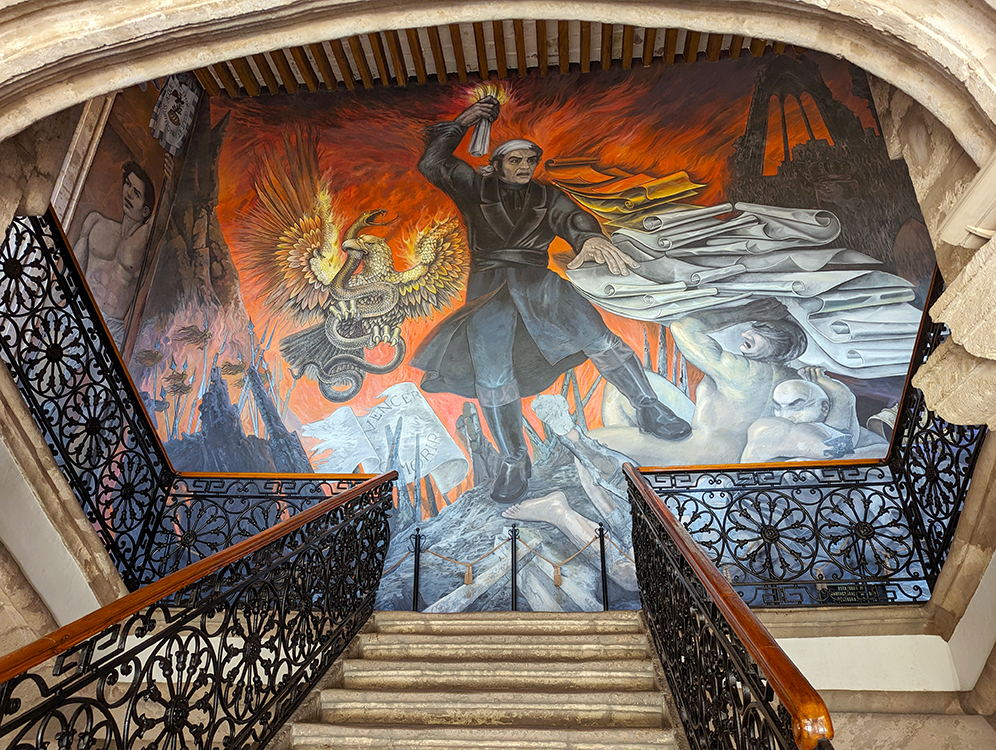
Postcard from Morelia, Mexico: Morelos’ call for justice echoes in this hall

Above: Portion of “Morelos y Justicia” mural, Agustin Cardenas Castro, El Antiguo Palacio de Justicia

Inflamed by the fervor of revolt, Jose Maria Morelos dominates the stairwell of the former governmental headquarters for the Spanish city originally known as Vallodolid on the central plaza of his namesake city. In 1812, the building was repurposed to serve as a mint producing copper coins and postage stamps.

A Belgium engineer hired in 1884 to convert the structure into Michoacan’s supreme court added French architectural detailing to the façade and interior. Particularly distinctive are the pinjante arches, floating double arches with no central support columns.

Continue reading “Postcard from Morelia, Mexico: Morelos’ call for justice echoes in this hall”

Postcard from Morelia, Mexico: Foreign beliefs transform both faith and art

My spirit that is upon you,” Isaiah 59 verse 21, translation of one of the Latin phrases floating around the canvas of “El Obispo Juan de Palafox y Mendoza” by Miguel Cabrera

As in Europe, art served as a primary tool for friars to introduce the mysteries of Catholicism to those of other beliefs. Consequently, religious paintings from that period form the core of the collection of Museo de Arte Colonial. The works are displayed in a house of the Colonial period which was renovated in 1984.

Continue reading “Postcard from Morelia, Mexico: Foreign beliefs transform both faith and art”