Postcard from Rome, Italy: “Graves are all too young as yet to have outgrown the sorrow”

Stop and consider! life is but a day;
A fragile dew-drop on its perilous way
From a tree’s summit.

“Sleep and Poetry,” John Keats, 1816

For someone raised Catholic, visiting the Non-Catholic Cemetery in a city with such an incredible wealth of churches meriting attention seems almost heretical. But I am drawn to cemeteries.

This one has a reputation as a particularly soothing one, one where cats choose to live out all nine of their lives. And, as an act of advance penance, I posted a “genuflection” to Santa Maria Maggiore first.

The Non-Catholic Cemetery is a pilgrimage must for many because here lie the remains of John Keats (1795-1821). Plagued by tuberculosis, the medically trained poet traveled from England to Italy in hope the climate would result in a cure. Some believe he was self-prescribing unsafe dosages of mercury at the time, perhaps to treat venereal disease. The combination proved lethal, and Keats died in Rome at age 25.

Shortly after Keats’ death, his friend Percy Bysshe Shelley (1792-1822) penned “Adonais” as an elegy:

… Go thou to Rome, – at once the Paradise,
The grave, the city, and the wilderness;
And where its wrecks like shattered mountains rise,
And flowering weeds, and fragrant copses dress
The bones of Desolation’s nakedness
Pass, till the spirit of the spot shall lead
Thy footsteps to a slope of green access
Where, like an infant’s smile, over the dead
A light of laughing flowers along the grass is spread;

And grey walls moulder round, on which dull Time
Feeds, like slow fire upon a hoary brand;
And one keen pyramid* with wedge sublime,
Pavilioning the dust of him who planned
This refuge for his memory, doth stand
Like flame transformed to marble; and beneath,
A field is spread, on which a newer band
Have pitched in Heaven’s smile their camp of death,
Welcoming him we lose with scarce extinguished breath.

Here pause: these graves are all too young as yet
To have outgrown the sorrow which consigned
Its charge to each….

“Adonais,” Percy Bysshe Shelley, 1821

The ashes remaining from the scandal-ridden life of this productive young poet joined his friend Keats amongst the young graves scarcely more than a year later.

In the summer of 1822, the Courier, a leading Tory newspaper in London, carried a brief obituary that began: “Shelley, the writer of some infidel poetry, has been drowned: now he knows whether there is a God or no.” From this moment on, the dramatic death of Percy Bysshe Shelley in the Gulf of Spezia was set to become one of the most powerful of all Romantic legends. And also perhaps the most misleading.

“Death and Destiny,” Richard Holmes, The Guardian, January 24, 2004

Shelley had been sailing during stormy weather with two others aboard his small racing schooner, The Don Juan, on a return trip to Lerici from Livorno after visiting Lord Byron (1788-1824), who, too, would perish at an early age. But we have killed off enough romantic poets for one day, and Byron’s bones do not reside within the shelter of these walls.

Shelley’s death left a young widow, Mary Wollstonecraft Shelley (1797-1851), behind. Although their marriage was a rocky one, some claim Mary sentimentally and literally retained Shelley’s heart, which sounds nightmarishly apocryphal save she is the literary birth-mother of Frankenstein.

Why did I not die? More miserable than man ever was before, why did I not sink into forgetfulness and rest?

Death snatches away many blooming children, the only hopes of their doting parents: how many brides and youthful lovers have been one day in the bloom of health and hope, and the next a prey for worms and the decay of the tomb!

Of what materials was I made, that I could thus resist so many shocks, which, like the turning of the wheel, continually renewed the torture?

But I was doomed to live….

Frankenstein; or The Modern Prometheus, Mary Wollstonecraft Shelley, 1818

*And the incongruous presence of a pyramid by the graveyard? Things Egyptian became fashionable in Rome after the conquest of Egypt in 30 B.C. (No, I am not getting waylaid by the story of Anthony and Cleopatra.) At 118 feet-tall, this pyramid of marble-clad brick and cement is the tomb of Gaius Cestius Epulo, a wealthy Roman who died about 15 B.C. The unlikely landmark survived all the subsequent years of development in Rome possibly because of its incorporation into the city’s fortification walls.
Postcard from Mexico City: Visiting the dead in Panteon de Dolores

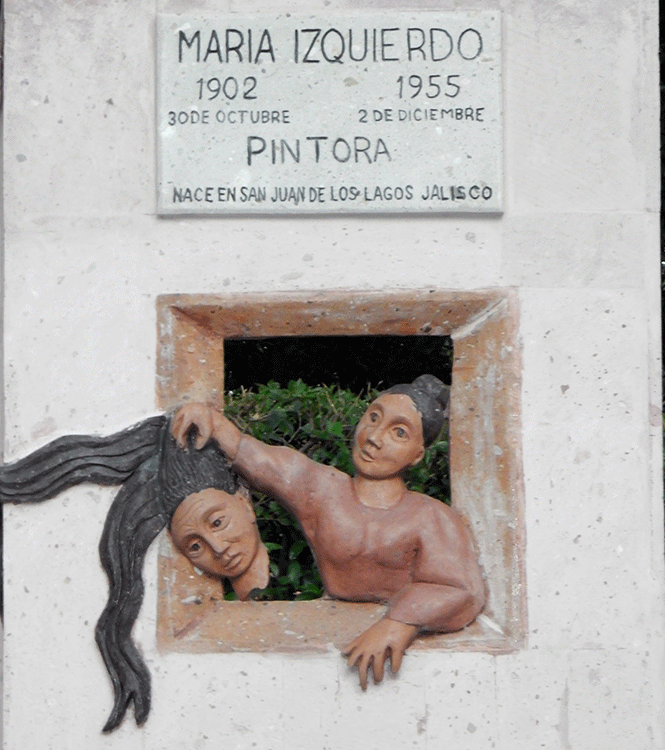
In 1945, at the height of her career, the government commissioned (Maria) Izquierdo to do a mural for a building in Mexico City. (Diego) Rivera and (David Alfaro) Siqueiros, two of Mexico’s great muralist painters, blocked her from getting the job. When she dared to denounce them in public, she received little help and a lot of strong criticism….

Izquierdo began to experience nightmares that left her sleepless. One day, she arose and drew what she remembered… a clear vision of herself, in a window of metaphysical dimension, holding her own decapitated head as her body, still walking, becomes lost in the distance of steps leading to a void. That year, 1947, she painted “Sueños y Pensamento,” a premonitory painting that heralded great pain for her future. It was the last of her great works.

“Maria Izquierdo – Monumento Artistico de la Nacion,” Rita Pomade, Mexconnect, 2007

We journeyed to Panteon de Dolores, home to a population of a million old souls qualifying it as Mexico’s largest cemetery, on All Saints Day. We encountered less than a handful of families celebrating Day of the Dead traditions graveside with their ancestors. Perhaps more ventured out on the following day, All Souls Day?

While many graves were colored with an abundance of marigolds, the majority appeared untended by those left behind on earth. Perhaps the more antiquated term of Hallowmas is a more fitting name to apply to the day in this neighborhood occupying close to 600 acres between two main sections of the sprawling Chapultepec Park. Numerous graves were adorned with a jumbled combination of ancient Day of the Dead traditions with more recently imported Halloween decor – spiders, plastic pumpkins, orange and black plastic festoons and fake spider webs.

There was an ongoing mixture of entertainment, ranging from an annoying clownish play to a talented female vocalist while we were there, staged in the plaza of the Rotunda de las Personas Illustres. At dusk, children appeared in Halloween or Catrina costumes carrying plastic pumpkin baskets for trick-or-treating.

While the dearth of ancient practices was disappointing, change happens. And I need no flowers or incense to encourage me to wander through a cemetery. So many stories shout at you from all directions.

Despite the rejection of her mural, Maria Izquierdo gained admittance to the portion of the cemetery dedicated to the illustrious of Mexico. Perhaps her fellow muralists, Rivera and Siqueiros, forgave her for her earlier criticisms of muralists including political messages in their works before they joined her there. The excerpt above is a link worth tapping to begin to learn about her life. I found myself wandering on the internet to discover more about the fascinating artist who was the first Mexican woman to mount a major solo exhibition in the United States.

But there are others. Composer Agustin Lara, who left the women swooning with his “Senora Tentacion” in 1956.

Rosario Castellanos, who wrote because: “Writing has been a way of explaining to myself the things I do not understand.” And redefined laughter: “We have to laugh. Because laughter, we already know, is the first evidence of freedom.”

Actress Virginia Fabregas.


In addition to those celebrated within the inner circle of the cemetery, there are close to a million others with stories worth telling. Hopefully, the trials, tribulations and joys they experienced are preserved within their families’ oral histories, repeated over and over at holiday celebrations lest the tales be lost.

And then, there are the eerily spooky graves. The angel guarding the rusty doors of a crypt, unhinged as though indicating the residents fled the confined space long ago. The coffin rusting above ground. Occupied, empty or home to a vampire planning to emerge with the rise of the next full moon?

A belated happy Hallowmas from Mexico City.

Postcard from Budapest, Hungary: Striking synagogue enshrines tragedies of surrounding ghetto

Moorish. Byzantine. Gothic. Oriental. The striking architectural mash-up of the Dohany Street Synagogue in Budapest is referred to as Moorish Revival.

Franz Liszt played the 5,000-pipe organ during the 1859 opening of the what is still the largest synagogue in Europe. Upper galleries flanking the center section of the temple were built to accommodate seating for women.

On the site of the former homestead of Theodor Herzl (1860-1904), widely regarded as the father of Zionism, the gracefully arched Jewish Museum opened in 1931 to display a rich collection of religious artifacts.

The Great Synagogue’s role at the center of a thriving community changed dramatically with the German invasion in March of 1944. Under the plan developed by Adolf Eichmann (1906-1962), hundreds of thousands of Jewish Hungarians were deported to extermination camps.

Approximately 70,000 members of the Jewish faith were herded into the ghetto surrounding the synagogue. During the following brutal winter as World War II drew to a close, many died from cold and hunger. With the liberation of Budapest from German control, the courtyard behind the synagogue became a makeshift cemetery for more than 2,000 of those who perished in the ghetto.

Soviet control brought a different set of issues and religious restrictions to the neighborhood.

Freedom to renovate the Great Synagogue and its grounds did not arrive until the 1990s when Hungary finally secured independence from Soviet control.

One of the major contributors to the makeover of the Great Synagogue built the base for her fortune by cooking up cosmetic creams in her kitchen and attractively bottling them for sale. She spent much of her life trying to distance herself from her parents’ roots:

I loved them both so much – their beauty and their character, but I didn’t love feeling different because of their old country ways.

Late in her life, Estee Lauder (1908-2004), whose mother was a Hungarian immigrant, paid tribute to those origins by contributing $5 million toward the renovation of the Dohany Street Synagogue.