Postcard from Tlaxcala, Mexico: Daytripping through Mexico’s smallest state

A birdman caged underground for more than 1,000 years, Cacaxtla’s powerful priest of Quetzalcoatl now can be viewed in an archaeological site outside the town of San Miguel del Milagro, Tlaxcala, Mexico’s smallest state. Dressed in the guise of an eagle and surfing atop a feathered serpent, the priest was not uncovered until the 1970s.

The pyramid containing the best-preserved pre-Columbian murals recovered to date in this hemisphere is still undergoing restoration. The beehive of archaeological activity involves backbreaking labor seemingly not much different from that involved in the original construction. Yes, wheelbarrows are used, but they only cart the workers’ heavy loads to the bottom of the first step. Close to 100 men and women were scurrying on site in what must be a major public works boon to the small town’s economy.

The peaceful, hilly town of Tlaxcala City itself is a refuge for those from Mexico City, meaning tony shops and restaurants are tucked behind some of the humble-seeming facades.

But we pressed on, a lunch destination in mind. We headed to Apizaco to find Chef Francisco Molina’s Evoka, a restaurant many hail as among the most outstanding in all of Mexico. The chef is known for elevating regional ingredients and traditional dishes of Tlaxcala to new heights, and he did not let us down.

Pleased by a trio of amuse-bouche and emboldened by a mysterious mezcal margarita and a mojito de toronjil (melon liqueur, ancho reyes and lemon balm), we decided this was the place to experience one of those insect dishes we had yet to try. Yes, we’ve consumed grasshoppers and chicatanas numerous times, but never escamoles. The caviar-like delicacies prized since the time of Quetzalcoatl are eggs stolen from venomous giant ants inhabiting the root systems of agave plants. The volcan de escamoles emerging from the kitchen is a chaulpa layering the large eggs with beans, wild mushrooms harvested from the slopes of the nearby Malinche volcano, artisanal cheese and avocado. Quite a refreshingly tasty combination.

Our main courses were chicken with cilantro pesto and robalo with adobo sauce steamed in mixotes, packages of agave skin, with an assortment of vegetables harvested from the restaurant’s garden. We finished the feast with a quartet of nieves, scoops of house-made lemon balm and strawberry sorbets and hoja santa and dried corn ice cream.

Definitely worth a detour.


Postcard from Puebla, Mexico: Architectural excellence heightens flavorful experience

Somehow it seems like cheating. The food offered in a restaurant inside a former industrial structure sculpturally rehabilitated by an internationally acclaimed architect seems destined to taste good. And it does.

La Purificadora Hotel and Restaurant inhabit a former purified ice factory dating from 1884. Architect Ricardo Legoretta left industrial touches intact, playing with the interactions of light, open spaces, water, recycled wood, black and white punctuated with accents of “bishop purple.”

We enjoyed two meals at La Purificadora during our month-long stay in Puebla: one to see if it was special enough for my upcoming birthday celebration and again because it was. While not expensive at all by American standards, the tab can add up because the setting makes you want to linger from cocktails through dessert. Chef Enrique Olvera created a menu that balances the traditional heavy chile poblano with some almost-spa-like dishes.

The presentation of most plates is as artistic as the surroundings. My mouth takes great pleasure in amuse-bouche openers: a bright fresh caprese and a piece of seared chile-encrusted tuna among ours. Fried zucchini blossoms filled with goat cheese are not to be missed among the appetizers, but decadent nibbles can be offset by something refreshingly light, such as the fresh watercress salad with mango and watermelon.

The only dish that did not work for us was the combination of appetizers jumbled atop a plate too small to house them. All the elements taken individually are appealing, but not in such close company with one another. Piles of meat infringing on the space of seared ahi tuna is not neighborly, particularly with fried squash blossoms thrown atop the mound.

Grilled asparagus are wonderful as a side dish for the robalo (sea bass) or salmon. Instead of chicken smothered with an overdose of mole poblano prior to serving, a generous pitcher of the rich, nun-invented sauce is provided on the side, freeing up more than enough to share with a side of roasted vegetables.


How could you possibly save room for dessert? By ordering a luscious light palette of color, a raspberry and blueberry terrine with puffs of meringue and a scoop of coconut sorbet.

Yes, this all would be order-worthy in a lesser setting, but the surroundings contribute much to the pleasurable experience.

All this makes me hungry for even a casual café right here in San Antonio in the gallery space under the shimmering Dale Chihuly sculpture in our Legoretta-designed Central Library. Imagine, taking a break from research in Texana to pleasantly partake of something delicious, flavor-enhanced by inspiring architectural surroundings….

Of course, close to home as well, I still need to experience Chef John Brand-developed restaurants of San Antonio’s Hotel Emma, adapted by Roman and Williams and opened this past week at the former Pearl Brewery.

It’s a long way until my birthday, but maybe we need to do a test-run to see if it’s good enough for the next celebration.

Postcard from Puebla, Mexico: Culinary riches emerged from convents

Never thought “get thee to a nunnery” had an appetizing sound to it. But Puebla is different.

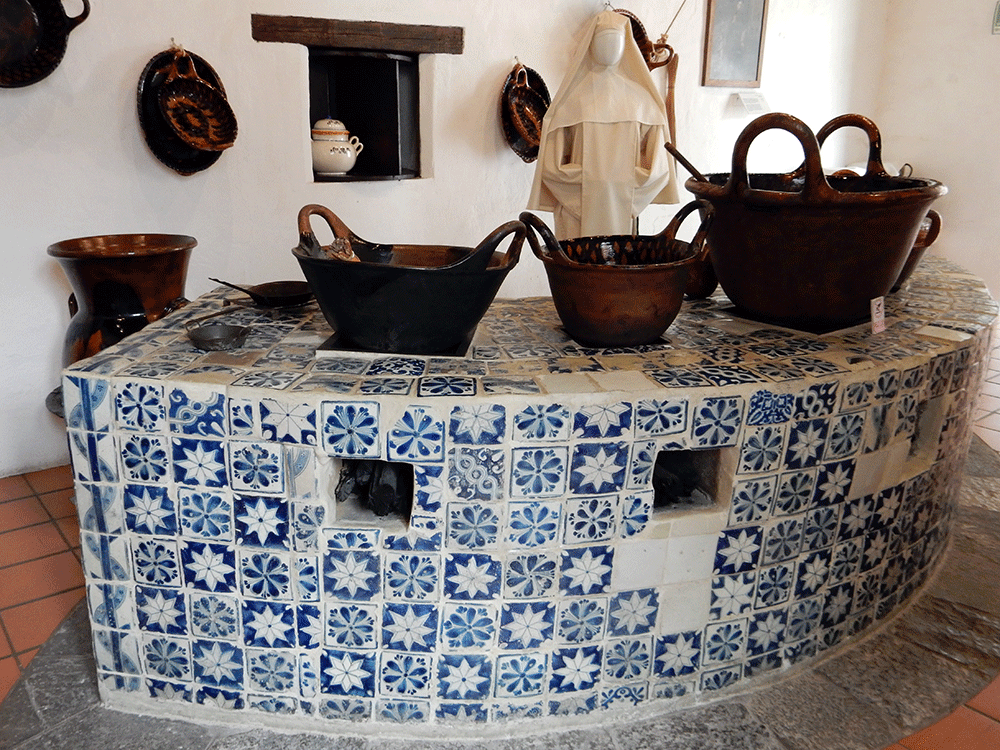
The Talavera-tiled kitchen of the former Santa Rosa Convent is reputed to be the birthplace of the richly flavored mole poblano, and the nuns of the former Convent of Santa Monica are credited with inventing the famous chiles en nogada in 1821 to celebrate Mexico’s newly gained independence from Spain. Reason enough to visit the former convents.

The early history of the building housing the Ex-Convento de Santa Monica is highly unusual. At the beginning of the 1600s, it served as a home for widows and wives whose husbands had abandoned them. Then its role switched as a place to isolate some of the city’s prostitutes; and then the usage seesawed back to a high school protective of young virgin girls in its charge. In the 1680s, it became a convent.

Santa Monica served as a convent for more than two centuries before the nuns had to go underground following the 1917 Constitution of Mexico. The façade of the convent was remodeled to appear as a house, but inside, behind a secret door, a group of nuns remained cloistered.

Supposedly, an antique dealer grew angry when the sisters refused to sell him paintings he desired. Inebriated in a bar, he began complaining about the nuns. A detective overheard him, and the closet convent was raided by police in 1934. The nuns were banished from the premises, and the government converted it to a museum for religious art.

Reviving the city’s reputation for nun-chefs, a new star recently arose in Mexico. Sister Florinda Ruiz Carapia became a fan favorite competing for a cash prize on Mexico’s version of Master Chef. Known as “Hermana Flor,” the humble nun who toils as a cook for seminarians in Puebla, reached the top five. Her popularity only increased because she was striving not for personal gain but to alleviate some of the debts accrued by her order of nuns, according to a story by Mark Stevenson in the San Antonio Express-News.


Perhaps if I tiled my kitchen, I’d miraculously be transformed into a good cook?