After all, you are the Mister’s third great-grandfather and the source of his middle name.
And you’ve been around a long time, a very long time.
Your frame certainly shows it. It appears to have endured a war or two; although I’m not sure wars were what caused its wounds. You are merely an engraving of sorts, but your frame was impressively regal at one time. We’re not sure what time, but I’ve never encountered another frame with such a heavy, brown ceramic interior. When did they make such frames?
Before I removed you from our hall, a temporary relocation of sorts, I thought I should write a few words about you. But all I knew was you were a mayor of New York City, which always impressed me.
In Bayard Tuckerman’s name-dropping family history, A Sketch of the Cotton Smith Family of Sharon, Connecticut, Jacob and his wife sound so perfectly civilized:
They lived first at Albany, where he was Judge of the Supreme Court, and afterwards in New York of which he was three times elected Mayor between 1810 and 1818. The Radcliffs had a country home near Poughkeepsie called Chestnut Hill, and there Juliana continued to have “literary evenings,” which are mentioned in letters of Chancellor Kent, Edward Livingston, Chancellor Livingston and Miss Janet Montgomery as “delightful gatherings where youth and age, fashion and wit, met for pleasure and improvement.”
Your resume looks pretty good. Graduated from Princeton. Sat on the Supreme Court of New York State. You joined with your friend Alexander Hamilton in a partnership founding Jersey City. Was that a good thing? Hamilton never got to see if that was a good idea or not, as he made the fatal mistake of insulting Aaron Burr. I do thank you for having the good sense not to follow suit.
Politics is a messy, incomprehensible thing sometimes. Keep Blagojevich, Senate appointments, and all other recent government scandals in mind as you traipse through the thickets of political absurdity below.
And that’s where Jacob Radcliff and John Ferguson come in. They are by no means exceptional leaders; they were Tammany men at the right time, in an era before absolute corruption pervaded the society’s every activity….
On top of the usual partisan stew of a swiftly growing city, the war of 1812 left party affiliations malleable, with Federalists opposing action (even suggesting secession from the United States!) and staunch Democratic-Republicans generally favoring the conflict. Thus, as you can imagine, it would be difficult to remain balanced in such unstable political waters, even for somebody as savvy and popular a career politician as (DeWitt) Clinton.
In this wily tug-of-war between the Federalists and Tammany candidates, Clinton was again unceremoniously ousted in 1810 and replaced with Jacob Radcliff….
The winds shifted again the next year, and Clinton was placed back in the mayor’s seat in 1811. (Following this so far?)
As war broke out with England in 1812, all political parties and affiliations seemed to disintegrate entirely. As James Renwick says in his biography of Clinton, “On this occasion the old party lines were completely obliterated; no trace of affection for Great Britain remained in any mind, and the very name of federalist only exists to be used as a mode of discrediting a political adversary in the minds of the ignorant.”
As a result, many Federalists jumped ship to join the surging Tammany Democrats. Among their number was former mayor Jacob Radcliff, warmly greeted by Tammany head ‘grand sachem’ John Ferguson.
A perfect storm brewed in 1815 when Tammany for the first time controlled the state senate and enjoyed great gains in local elections. For the first time, Tammany could really do what it wanted. And what it wanted was to get rid of that old stalwart Clinton. Once and for all.
And who better to replace him than the head of Tammany himself, John Ferguson? However, whether by intent or sudden whim, Ferguson stepped down after only three months in office to take on the far-more lucrative job of officer of the Port of New York custom house, according to one source a major center “of federal revenue, political patronage and potential graft.”
And so he was replaced with….Jacob Radcliffagain, now a mayoral appointee representing an entirely different political party from the first time he had the job!…
Meanwhile, Radcliff was caught up in a scandal when, halfway into his term, he was caught distributing a list of potential Tammany replacements for all still-remaining Federalist council members, a politically insensitive move which galvanized the Council and ensured that 1816 would be Radcliff’s last year ever as mayor.
Maybe if you didn’t look quite so pompous. Maybe if it wasn’t quite so obvious that you have been looking down your sharp nose at me all these years. Maybe then I wouldn’t have dug deeper into your resume.
The Bowery Boys website even calls you “politically wishy-washy.” The original flip-flopper.
History is the story of events, with praise or blame.
And, whoa. Speaking of looking down one’s nose.
If that cousin had ever been offered for us to hang in the hall beside you, I certainly would have known better. His reputation preceded him.
This is what he would say about the Fiesta-colored garb I sport on a daily basis:
For an old woman to flant [flaunt] it in a youthful dress, is altogether as prodigious a Disorder as for the Flowers of May to appear among the Snows of December.
He never would have made it out of our closet. I could never have borne his disapproving glare on a daily basis.
Besides, Cotton Mather would have burned me at a stake.
Juliana’s puritanical father, John Cotton Smith (1765-1845), a Yale-educated governor of Connecticut, might not have drowned me but certainly would not have approved either.
But that’s partially his son-in-law’s fault. So eager for votes, Jacob Ratcliff was willing to stoop to courtship of the immigrant population swarming into New York City.
You let those damn Irish Catholics get a foot in the door, and, the next thing you know, only a couple of generations later, one of them marries into your family.
So hard to keep that puritanical bloodline pure.
Note Added June 6, 2013: In 1968, one of the Mister’s first cousins, once removed, purchased and restored John Cotton Smith’s former home in Sharon – Weatherstone.
Her Gracious Majesty, Mayme, of the House of Storey, Queen of the Court of Spring, 1913
Within the sacred shadow of the Alamo, flaunting their gaily colored banners beneath the beguiling front of San Fernando, or trespassing jauntily upon the public thoroughfares about the city hall and the market house, the canvas palaces have claimed the right of “Eminent Domain” in the name of the mighty monarch, King Rex. Once more the hobby-horse, the Ferris wheel and the steam calliope are bidding the staid and sober citizen to yield to the importunities of his “youngest” to throw off for a little the musty garb of dignity….
The San Antonio Light, April 21, 1913, page 5
Fiesta madness is seizing the city and will control it throughout the week to come.
One-hundred years ago it did the same. I hoped, before discarding any dignity I might have remaining (questionable indeed), to round up a story of the events of a century ago from the Mythological Parade led by King Rex to the Burlesque night parade, “the funniest parade of the week, with a suffragette band in line.” The accounts throughout the week are quite entertaining to read, but, alas, I have not time to summarize.
I would recommend if you missed it last year, that you refer to my post from then to get a glimpse of the historical festive pageantry. If short on time, skim to the bottom for the hysterical newspaper description of the mayhem erupting during the first Battle of Flowers Parade – details not reported, or purposefully ignored, in the official history on the official Battle of Flowers website.
While trying to avoid delving into details from Fiesta San Jacinto 1913, the names of two of the Mister’s relatives leapt off the page, crying out for me to notice. One of his grand uncles on his paternal side, Willard Eastman Simpson (1883-1967), designed the elaborate scenery for the coronation ceremonies for the Court of Spring, and one of his grand uncles on his maternal side, Lucius Mirabeau Lamar, III (1898-1978), appeared as one of the “men from Mars” in the opening Fiesta Fete operetta, Much Ado.
Hope you fling yourself into Fiesta with wild abandon.
There we were, sitting beside each other. Phil and I.
I’m talking about Phil Collins. But I just call him Phil now. Because I sat beside him for about one minute.
As you can tell this is leading to one of celebrities’ worst curses: people who don’t know them writing about them.
But, of course, this is different. Because I know him. Because I sat beside him for about one minute. And he politely introduced himself to me and shook my hand.
That, and we have several things in common.
Davy Crockett, for one.
When Phil Collins was a kid growing up in a London suburb, he would often watch an amazing show on his family television. There, in black and white, was Fess Parker as Davy Crockett, King of the Wild Frontier. As he matured, Collins not only acted out the exploits of his new hero, but he often refought the Battle of the Alamo with his toy soldiers.
While I’ve never sure been it’s psychologically healthy to adopt Texans’ fascination with the battle they lost, playing Alamo seems a better alternative than the Davy** Crockett chapter that influenced me as a child in Virginia Beach.
I sat alone in my room, playing the record. Over and over and over.
It wasn’t this one, or, if it was, it was part of a much longer recording. I can’t find the version in my mind online.
Perhaps what I remember didn’t exist except as a compilation in my jumbled file cabinet of a mind. But it was Davy Crockett. Or Fess Parker. And it was a life and death struggle with bears and Indians… and the part that haunted me.
I have no idea how many times I listened to that recording, but definitely many times too many.
Even I knew my mother was exasperated.
I would wet my bed. We’re not talking about a three-year old. I was six.
But I had my reasons.
I ran screaming to my parents one night about the bears in the house – my visiting Great Aunt Mary snoring.
There were Indians in my closet. I finally learned keeping the light on in the closet kept them at bay.
But the light filtering through the louvered door did not help with the Crockett family’s other adversaries.
The women then slacked the rope a little and made it fast round a hickory stump, when my oldest darter took the tongs and jumped on [the alligator’s] back, when she beat up the “devil’s tattoo” on it, and gave his hide a real “rub a dub.”…My wife threw a bucket of scalding suds down his throat, which made him thrash round as though he was sent for. She then cut his throat with a big butcher knife. He measured thirty seven feet in length. (Davy Crockett’s almanack,*** of wild sports in the West, life in the backwoods, & sketches of Texas. 1837, p. 10).
My self-preservation instinct was strong. Who in their right mind would risk getting out of bed with alligators on the prowl? Alligators hungry for a “tongariferous” fight. Bladder be damned if I would.
Not only would I not set foot on the floor when alone in my room at night, I would not let a pinky slip over the edge because…. Snap! Those alligators were fast.
And I had a family to protect – a toucan whose name now escapes me; George the green monkey whose rubbery pink hands and feet were comforting to chew nervously upon when trying to make it through dangers lurking in the night; and Nipper, a huge RCA dog who took up easily half of my single bed. I never once let George’s tail hang over the edge. I would sleep rigidly, never ever tumping one over the edge into the alligator pit.
To dream of an alligator, unless you kill it, is unfavorable to all persons connected with the dream.
The flaw, of course, was no one understood this was why I wet the bed. And, when I finally managed to explain, no one took the danger seriously. Of course, now they have books about this. But that was the late ’50s, and they had not yet been written.
Finally, midway through first grade, a solution was found. A path of folding chairs was set up each night between my bed and the bathroom. Somehow, I was able to summon the courage to imperil myself by crawling across this wobbly bridge to the safety of the bathroom, and, of course, everyone knows alligators would never cross the threshold onto the tile floor.
So, as I was writing, Phil’s interest in perpetually fighting – probably trying to change the outcome – the losing battle at the Alamo seems a preferable Davy chapter in which to be stuck.
And Davy seems to have stuck with both of us, Alamobsessive souls that we are.
I focus on and fret about the Alamo as the city’s front door. I constantly nag, in blog form, the city to enforce its historic ordinance to keep illegal signs from multiplying at night. I have even used some of the historic postcards I have assembled to create protest collages.
Postcards from San Antonio ~ No. 21 ~ “We’ve Lost the Alamo.” 2010 edition of 25. Yes, Numbers 21 and 22 are the ugliest collages ever to reflect the overwhelming commercialization of Alamo Plaza. Even Waldo (Yes, he’s there.) is easier to find than the Alamo. An early 1900s postcard of a parade float, “Save the Alamo,” and “Letter from the Alamo” from a plaque on the grounds are surrounded by some of the plaza’s clutter, including a dinosaur, Stumpy, snow cones, the Odditorium, the t-shirt bearing the unheeded message “Don’t Mess with Texas, San Antonio” and even the Daughters of the Republic of Texas’ own unsightly addition of a pop-up tent pushing their “Live the Drama”‘ guides (Fortunately, this pop-up was removed). http://www.postcardsfromsanantonio.comPostcards from San Antonio ~ No. 22 ~ “They’ve Breached the Walls.” 2010 edition of 25. Mary Bonner’s tasteful woodblock print originally made to help raise funds for the San Antonio Conservation Society is paired with an inscription from the Cenotaph, “In Memory of the Heroes…at the Alamo, March 6, 1836.” The images are overwhelmed by surrounding offers to shop at “Liber-T,” view repulsive world records, obtain henna tattoos or consume ice cream cones and hoagies. Sorry to have left out the coonskin cap. http://www.postcardsfromsanantonio.com
These efforts have had limited effect. And, not surprisingly, these particular collages have not resonated well with art collectors.
Now, legislation has been filed to form a commission to study the state of Alamo Plaza. Good news to some, but the bill would go farther than my Alamobsession wants by giving the commission the mission to “reclaim its original footprint.” I might not love Ripley’s, but I love the Alfred Giles’ Crockett Block.
Plus, if returning Alamo Plaza to its appearance at the time of the battle is taken literally, the Alamo would get a crewcut (Click here for a long-winded post about that particular issue).
“San Antonio: A Descriptive View Book in Colors,” 1913
I don’t know how Phil feels about this. Because how much ground can you cover in one minute?
But I do know, while I was collecting postcards of chili queens on Alamo Plaza, Phil was collecting everything else Alamo. When Phil does something, he doesn’t fool around. He gets serious. He even collected a building off the plaza. This is from his myspace page:
From Bill Wyman’s metal detecting to Alex James’s cheese-making, every self-respecting musician is obliged to cultivate a hobby to relieve the stresses of the rock star life. Collins is no exception, utilizing the basement of his Swiss home for his twin enthusiasms: building model railways and tending to his vast collection of Alamo memorabilia.
“… it’s an all-consuming thing for me. I spend as much time in San Antonio as I can. I rent a little property out there on the walls of The Alamo itself where I’ll dig for artifacts. I’m always looking for stuff to buy and the collection is growing fast. I’ve got a huge number of cannonballs, muskets and bowie knives that were used there, Lady Crockett’s pouch and many documents that were written by the main protagonists. One of my prized possessions is a receipt signed by Commander William B. Travis for 32 head of cattle used to feed the Alamo defenders.
“My kids are convinced that I was present at The Alamo in a previous life. Just recently I attended a convention out there and met a clairvoyant who is married to a man who’s attempting to restore the Alamo compound. She walked up to me and said, ‘’You’ve been here before. In a previous life you were John W. Smith, one of the major couriers who survived the Alamo and become one of San Antonio’s first mayors.’ Oddly enough one of the first documents I bought for my collection was the receipt for Smith’s saddle. So maybe my kids are on to something.”
Phil collected so many Alamo things that photos and information about them now fill a 400-page book, which brings us to another thing we have in common.
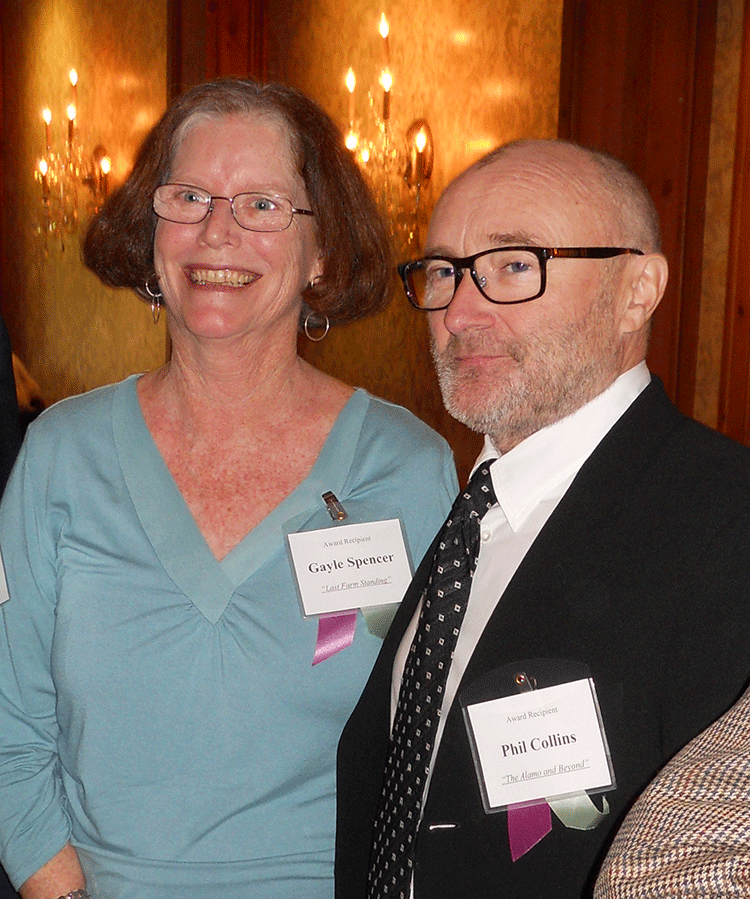
Because I sat beside him for about one minute. And, as you can see, we obviously engaged in animated conversation. Probably because we have so much in common. And I didn’t even get a chance to tell him I’m married to a bluesman.
Somehow, KSAT-TV failed to catch this important connection on camera, which is good because I would not have wanted to end up in the pages of some publication, such as The Star, where they zoom in on the superficial shortcomings of someone my age – the preponderance of wrinkles, protruding bellies and falling bustlines.
Another thing Phil and I share is we have changed careers. I have changed career directions several times and feel free to sprint off in any direction I choose. If I choose to write books, that’s fine. No one objects; no one cares.
But, poor Phil. He’s worked hard his whole life – “I enjoyed Genesis when I was 19” – and wants to pursue his hobbies now:
Reporters repetitively bombard him with “why?” Some fans of the Grammy-winning star express anger at him for retiring from concerts. This, even though, according to his myspace page:
His less prolific work rate is partly down to health reasons. Since 2000 he has suffered from loss of hearing in his right ear. More recently he was diagnosed with severe nerve damage to his hands, making drumming extremely challenging. During recording sessions for his new album, he was forced to tape his sticks to his hands.
Owsers. That sounds totally painful. Give this man a well-deserved break.
Keen to accentuate the positive, he explains that his medical concerns have forced him to take stock of his life. “I never used to think of myself as a workaholic,” he says. “I used to work non-stop because I couldn’t believe my luck that I was able to do all these things that I loved. I was everywhere and I can see why that must have been annoying to some people. Then I reached a point where I no longer felt the need to go zooming around the world and attend the opening of every envelope. Basically I stopped.
“I’ve got a nine-year-old and a five-year-old. I take them to football. I like to take them to school and pick them up. That’s my life now. I love doing the things that other people probably find tedious because they’ve been doing them for so long. I never did those things in the past as I was always working flat out. That was my loss. Now I’m able to do all that and also have time to indulge my passions.”
Besides, somehow I feel this man’s Alamobsession will end up helping shape the future of Alamo Plaza. I’m sure it will accomplish more than my haranguing collages and blog posts.
Oh, and, Phil, if you get tired of staying in hotels when you visit San Antonio, the Mister and I might be able to work out a house swap with you. The Alamo’s less than a mile away from our door. Call me next time you are in town and you’ve got a minute. Who knows what else we might have in common?
*With apologies to William C. Davis, author of Three Roads to the Alamo: The Lives and Fortunes of David Crockett, James Bowie, and William Barret Travis. Hey, at least I didn’t title the post My Life with Phil Collins. Now that would have been a stretch.
** David would be more historically correct, but does not represent the popular culture upon which we – Phil and I – were weaned.
***Oh, dear. I had to stop in the middle of this post to order a copy of Davy Crockett’s Riproarious Shemales and Sentimental Sisters: Women’s Tall Tales from the Crockett Almanacs, 1835-1856, for which I paid a penny, plus $3.99 shipping – quite a bargain unless the alligators return ‘neath my bed. And, as that is an “our” bed, I’m positive the Mister would not relish the thought.
Update on March 25, 2013: John Spong of Texas Monthly spent considerably longer than a minute with Phil Collins.
Phil Collins at age 5, an image (now blog-altered) originally appearing in the San Antonio Express-News
Update on March 27, 2013:
A follower reminded me to look back for this photo of Phil Collins, coonskin-hatted at age five playing Davy, that appeared alongside an article by Steve Bennett in the San Antonio Express-News last May.
Which reminded me of another obvious thing Phil and I have in common – the Battle of San Jacinto. His collection began with a receipt for a saddle purchased by John W. Smith, who was at both the Battle of the Alamo and the Battle of San Jacinto and seems to continue to haunt the collector a bit. My desk currently is haunted by reams of paper pertaining to the families and relatives of John Coker who settled on his land grant on the north side of San Antonio. Jack Coker was a hero of San Jacinto credited with the idea of blowing up Vince’s Bridge, blocking one of the possible escape routes for the Mexican troops.
And, on another note, one of my sisters fessed up that she was the one who told me I’d be safe from dangers lurking in my room if I let no part of me slip over the edge of the mattress. So nice after all these years to finally unload the psychological burden for bedwetting on a sibling.
Update on May 6, 2013: Mary Dearen’s version of the same awards luncheon as published on mywesttexas.com.


 Your frame certainly shows it. It appears to have endured a war or two; although I’m not sure wars were what caused its wounds. You are merely an engraving of sorts, but your frame was impressively regal at one time. We’re not sure what time, but I’ve never encountered another frame with such a heavy, brown ceramic interior. When did they make such frames?
 Maybe if you didn’t look quite so pompous. Maybe if it wasn’t quite so obvious that you have been looking down your sharp nose at me all these years. Maybe then I wouldn’t have dug deeper into your resume.



 Postcards from Barton Springs