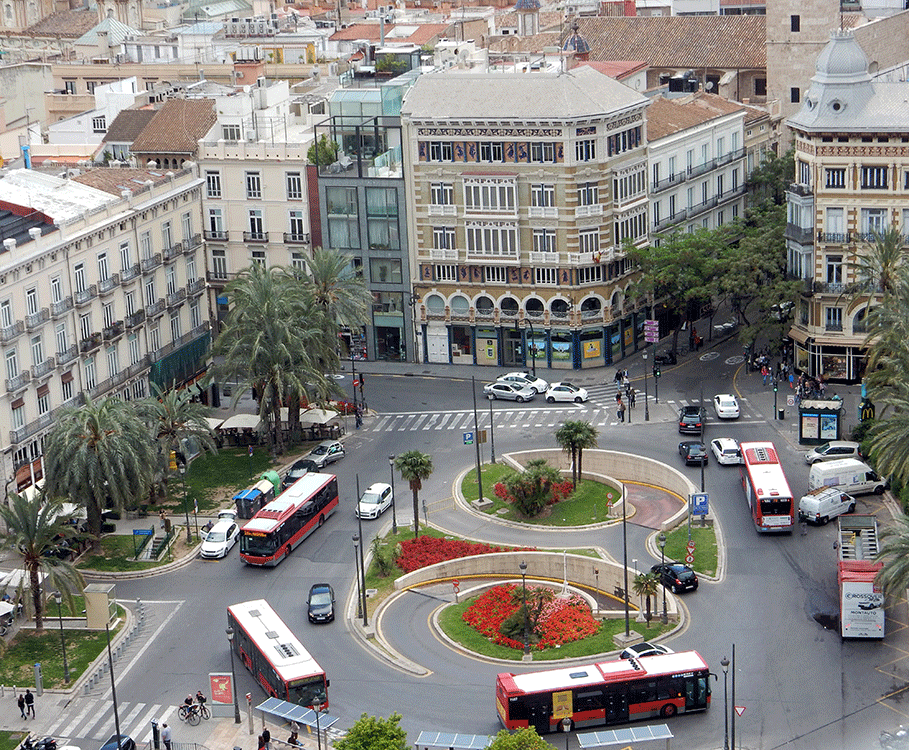
Valencia was a beautiful spot to spend part of our spring this year, and I still am making my way through a pile of photos. Here is a random assortment of more impressions snapped during our wanderings.


Gayle Brennan Spencer – sending random thoughts to and from South Austin
Valencia was a beautiful spot to spend part of our spring this year, and I still am making my way through a pile of photos. Here is a random assortment of more impressions snapped during our wanderings.

The historical novel requires an extra set of choices – what sources to consult, what shape to cut from the big picture – what to do when the evidence is missing or contradictory. Most of these choices are invisible to the reader. You must be able to justify your decisions to the well-informed. But you will not satisfy everyone. The historian will always wonder why you left certain things out, while the literary critic will wonder why you put them in. “Because I could” is not a good reason.
“Can These Bones Live?,” Dame Hilary Mantel, Reith Lecture, BBC Radio, June 24, 2017, The Spectator
How to handle historic fiction. I’ve received all kinds of advice and foolishly continue to reject most of it as too cumbersome.
Recently, a published author told me I needed to classify my novel about Hedda Burgemeister, the woman who shot Otto Koehler more than a century ago in San Antonio, as creative nonfiction. Her approach to citing references, accepted for print as mine might not be, is that, as the lead characters once lived, everything in the book must be footnoted. Meticulously. She also added that everyone’s names must be changed – both to protect the innocent and to protect oneself from lawsuits.
Well, the names in An Ostrich Plume Hat need to stay put because of the very fact they belonged to real people. But I admit, this is just one of Gayle’s new rules.
As for footnotes? I recently completed a manuscript about the Coker Settlement – nonfiction – with hundreds upon hundreds of numbered, well-documented endnotes. It almost killed me. And I’m quite far into writing this unfootnoted novel upon which I have been working for more than a decade as time allowed.
Last week, my solution hit me. Will Cuppy. A few years ago, blogger Bluebird Blvd introduced me to his The Decline and Fall of Practically Everybody. Cuppy wrote about real people. With great artistic license taken. He footnoted his text, but certainly not according to the Chicago Manual for Style. In fact, Cuppy’s footnotes are a pleasure to read and contain some of his most amusing lines.
So I have decided to tread water instead of drowning in footnotes. I’m electing to float somewhere between Cuppy and the Chicago Manual.
I’m creating Gayle’s own rules for documenting historic fiction with unnumbered endnotes. This requires me to honestly identify what is true, what is unknown and what is invented for the sake of the story. This is particularly important in cases where I violate Dame Mantel’s “Because I could” mantra from above.
As of now, Gayle’s rules for endnotes are somewhat fluid, evolving as I strive for consistency. I want to establish credibility with the reader.
Chapter Three’s endnotes include this:
Please pay attention to spare me from typing portions of the following over and over: Resemblance to actual persons, no longer living, locales and events is far from coincidental. For the majority of characters, almost everything included about them was reported in print during their lifetimes. If some of these so-called facts are gleaned from fake news, please direct libelous claims to the appropriate publishers of more than a century ago.
I hope you will go review and evaluate my approach to documenting the first three chapters.
Let me know if you think Gayle’s rules will fly. I need advice and value yours, but please don’t be offended if I am too damn hardheaded to listen to it.

I spied them in a shop window the first day we were in Valencia. Immediately, I wanted one. A mini-Kate. We really don’t have a current photo of an adult Kate hanging anywhere in the house, so why not go 3-D? Mother’s Day seemed as good an excuse as any for this unusual souvenir.
Kate and the Mister pointed out to me that some of the samples displayed in the window did not appear of high artistic quality, but I was determined a mini-Kate was needed. The only way to have convinced me otherwise would have been to tell me 3-D portraits were available in kiosks all over Austin. She texted her friends, and not a one had ever seen the product. Surely, I would be the first person on the block to have a mini-nina.
So Kate agreed, and we made an appointment. She stood frozen patiently on a rotating platform as the photographer clicked away.


The completed sculpture, the Russian proprietor referred to it in Spanish as a puppet, was scheduled to arrive before we left Valencia. I must confess, as both the Mister and Kate feared, I did envision carting mini-Kate around and posing her at landmarks around the city to text her the photos after her departure.
But mini-Kate failed to materialize in the shop until after we moved on to Budapest, so the photographer agreed to ship her to catch up with us there.
Mini-Kate did not fly first class to Budapest. The only protection provided her in the shipping envelope was a skimpy layer of bubble wrap. Her legs were shattered.
Suddenly the fun doll-like figure assumed an ominous aura. We could not tell Kate she was broken. I barely felt comfortable emailing her to make sure she was in one piece in Austin. Her legs didn’t hurt did they?
So the Mister began a series of emails in Spanish with the proprietor in Valencia. Did we sign for it before inspecting inside? The Mister pointed out we did sign for it, but we certainly could not read the fine print of the terms of acceptance in doing so as they were in Hungarian. And, did I still want one?
I did hesitate over the quality. If this statuette had been displayed in the window, unbroken, I would not have thought it remotely resembled Kate. Yes, I did want a fresh one, but could this one perhaps have red hair as clearly seen in the photos and maybe not appear as though someone had just slugged her in the face? I think the polite Mister translator communicated this more genteelly.
The new Kate arrived only two days before we left Budapest, but the project seemed cursed. This version is a little more becoming, but she still has no red hair and is more mini than the first, the size we ordered. More emails required of the resident Mister translator to adjust the pricing because of the discrepancy between the two sizes
There really was no time to take the new mini-Kate for a photo-op on the Danube, but I feared such an outing. Suppose she fell off the bridge? Plus, the Kates are fragile, not tough like Barbie dolls.
I could not bear to just throw the broken midi-Kate away, abandoning her in Budapest. That certainly would be unmotherly. The Mister was pressed into performing surgery.
So there are two residing in San Antonio. A mini-Kate and a patched midi-Kate. Kind of like Kate had a sister instead of being an only child. For now, the pair of Kates are standing tall among the cookbooks – a pretty safe spot given my increasingly lazy cooking habits.
I’m not planning on taking the delicate children on any trips, but we’d rather have the real maxi-Kate join us anyway.
Thanks for working so hard on this, Mister, and to Kate for being such a good sport.
 Postcards from Barton Springs