The Board of Directors of San Antonio’s Inner City Tax Increment Reinvestment Zone (TIRZ) approved $694,002 to fund the Southtown Street Enhancement Project. According to the City of San Antonio’s website:
The project will include curb bulb-outs, making more permanent the existing parallel parking along S. Alamo Street and take the street down to one lane in each direction. The curb bulb-outs will provide several benefits to include narrowed street intersections for shorter pedestrian crossings that will naturally calm traffic speeds, and added sidewalk/curb area that will allow for larger street planting areas outside of the overhead lines.
The tire tracks on this bulb-out "enhancement" on South Alamo Street clearly indicate its effectiveness in calming traffic.
In other words, the bulb-outs function much the way bumpers do in pinball machines, bouncing the cars of unsuspecting tourists and inattentive motorists (of which Southtown evidently has many) back into the roadway where they belong.
The success of the project can be measured by the lines of cars backed up on St. Mary’s and Alamo Streets trying to enter the Southtown business obviously benefiting the most from the installation of the bulb-outs in the King William neighborhood:
Prediction: The completion of Southtown's bulb-outs mean a good year is ahead for Goodyear.
Update on January 6, 2011: Just noticed the bulb-outs on South Alamo Street are no longer naked. White lines also seem to help drivers keep from ramming into the concrete. This crepe myrtle blooming in the spring should be beautiful, but drivers exiting Turner will be unable to see if any vehicles are coming from the south…. Maybe the neighborhood needs a new body shop?
Blame this post on the cowgirl, the one serving as my “gravatar.” She was the first one I stumbled across with part of “San Antonio Song.” Then some postcards in the Anglo Life Series began dishing out portions of the lyrics piecemeal.
Santoniobsessed (apologies for the poor portmanteau), I had to track down the music. Maybe this is the theme song San Antonio needs, I thought. Maybe this could be the After Midnight Blues Band’s greatest hit, I speculated.
Finally found the sheet music written by Tin Pan Alley pioneers, Harry Williams and Egbert Van Alstyne, and published in 1907 by Jerome H. Remick & Co. The pair collaborated on song upon song, many of which endured into the ‘50s and ‘60s to torture young children forced to sit through the Lawrence Welk Show with their parents and grandparents. The songwriters’ sheet music for In The Shade of The Old Apple Tree sold more than 700,000 copies, a record sales level at that time.
Came across this Petula Clark version from Vote for Huggett:
Prepped by Petula, I’ll now punish you with the lyrics of “San Antonio Song.” Remember, this was a huge hit, not just here, but throughout the country, as seen on postcards (too prehistoric for “as seen on t.v.”).
San Antonio Song
Just as the moon was peeping o’er the hill, after the work was through, there sat a cowboy and his partner Bill. Cowboy was feeling blue. Bill says “Come down pal, down into town pal, big time for me and you. Don’t mind your old gal. You know its ‘cold’ pal, if what you say is true. Where is she now” Bill cried, and his partner just replied: [Chorus} San An-to-ni An-to-ni-o. She hopped up on a pony, and ran away with Tony. If you see her, just let me know and I’ll meet you In San An-to-ni-o. You know that pony that she rode away, that horse belongs to me. So do the trinkets that she stow’d away. I was the big mark E. I won’t resent it. I might have spent it plunging with Faro Jack. If she’s not happy there with her chappie, tell her I’ll take her back. No tender foot like him could love her like her boy Jim.
If the lyrics did not convince you to fail to launch a movement for the song’s revival, listening to it surely will. “The Denver Nightingale,” Billy Murray recorded “San Antonio” for Edison the same year the sheet music was written, and the library of the University of California at Santa Barbara has preserved it for us, “San Antonio Song.” Don’t think After Midnight will be rushing to add “San Antonio” to its set list, but, according to Red Hot Jazz, Murray was one of America’s best-selling recording artists during the phonograph era:
Around the turn of the century, Murray joined the Al G. Field minstrels as a blackface singer and dancer. When the troupe traveled East to New York City in 1903, Murray… freelanced for any record company that was willing to pay for his services, and soon became one of the most popular singers in the mid-naught years…. Until microphones were used for electrical recording in the 1920s, recordings had to be done acoustically by the use of a horn. Murray was a master at the acoustic process because certain qualifications were required in order to achieve acceptable results. Soft sounds didn’t reproduce very well, so one had to have a clear, strong voice to achieve acceptable volume during playback. Murray had powerful lungs, excellent intonation, the ability to sing at a rapid-fire speed without taking a breath, and delivered his songs with a distinctive style that’s easy to understand and recognize. In the 1920s, new styles were coming into vogue. Microphones were beginning to replace the early acoustic horns, and the soft whispering style of singing, known as “crooning,” became a favorite. Murray was more used to singing in a full voice instead of toning it down. His popularity waned….
Postcards from San Antonio ~ No 12, “They Rode off into the Sunset.” Couple on horseback at sunset combined with San Antonio cowgirl postcard and song lyrics: “San Antoni Antonio. She hopped upon a pony and ran away with Tony; If you see her just let me know, and I’ll meet you in San Antonio.”
One of the Starmer brothers designed the cover for “That Slippery Slide Trombone” by Williams and Van Alstyne, with lyrics sliding down the slippery slope of sexual innuendos.
Postcards from San Antonio ~ No 20, “And ran away with Tony.” This postcard is part of an “Anglo Life Series” of postcards dating from 1909 and relating to the lyrics from “San Antonio Song.”
Chorus of “The San Antonio Song” written by the Tin Pan Alley pioneer team of Harry Williams and Egbert Van Alstyne in 1907: “San An-to ni An-to-ni-o. She hopped up on a pony and ran away with Tony.”
“Cowboy Blues: She broke my heart…and I miss her rabbit stew.” This collage uses the Starmer-designed cover of “San Antonio Song,” original sheet music by Harry Williams and Egbert VanAlstyne copyrighted in 1907. Part of the chorus serves as a backdrop for the “gal” who got away, pictured here as a huntress.
I’d conclude the music was from some earlier more naive time, still pure enough for replication 50 years later on Lawrence Welk, who “fired Champagne Lady Alice Lon for ‘showing too much knee’ on camera,” but….
Wait. What did Jim mean when he was talking about spending his money “plunging” with Faro Jack? Was that a card game or would that be a trick?
Times were not as naive as I tend to think. “That Slippery Trombone Song” written by the Williams and Van Alstyne team in 1912 was about as subtle as an old blues song peppered with jam and jelly:
That Slippery Trombone Song
Down, down, down in an old Rathskeller, where the strains of ragtime fill the cellar, there’s a musical man. Are you listening? Grandstand trombone “feller,” weepy, creepy, music mellow, from his old trombone would slide, and Lucy would shout as she hustled about just to get up by his side. Oh, Oh, Oh, Oh, Oh, slide me a ragtime slide. [Chorus] Honey, honey, hear that tone on that slippery slide trombone; Um Ain’t it beautiful! Um Tu-ti-frui-ti-ful! Honey, don’t blow “Home Sweet Home.” Stephen, don’t you ever waste a breath to telephone. Slide, slide, when I glide, glide, glide, to the music of your slide trombone. [Verse 2] Up, up, up from an old Rathskeller, why, they both slipped right up from the cellar, on a slippery night. Are you listening? She and that young “feller,” they went out to slip the preacher, but she slipped upon a stone. She fell with a sprawl; he accompanied his “doll” on his slipp’ry slide trombone. Oh, Oh, Oh, Oh, Oh, all that she did was moan.
We wanted this to be just like in the ’70s when bands would load all their equipment up on a truck and go play.
That’s what Hector Saldana of The Krayolas told us during a band break early Sunday evening. Casting aside the extensive national media attention focused on the unpretentious band three decades ago and now during the past year or so, The Krayolas trucked on over to the intersection of Nogalitos and Zarzamora to provide one of those puro San Antonio moments. The band enthusiastically offered those gathered at Los Valles Fruteria, the subject of one of their lighter songs, with two admission-free sets showcasing their diverse musical sounds.
The peppy “La Fruteria” is balanced by such songs as a narco-corrido, “Twelve Heads in a Bag;” a song mourning a soldier whose life was lost in Iraq, “Alex;” and a protest song about Arizona’s new immigration law, “1070 (I’m Your Dirty Mexican).” Hap Mansfield recently described The Krayolas’ Americano sound for the San Marcos Local News:
The Krayolas have been kickin’ out the Tex-Mex pop jams since the late 1970s. Their 2010 release, “Americano,” demonstrates that they’ve still got the chops, but their poetry is 30 years better and deeper. Unafraid of confrontation, the Saldana boys’ recent “1070 (I’m Your Dirty Mexican)” deals with the inherent racism in the controversial Arizona immigration bill. On a lighter note, their recent “Fruteria” may be the happiest Tex Mex pop tune ever.
Click here to catch David Martin Davies’ in-depth interview with the Saldana brothers for KLRN’s Conversations.
Note Added on July 25: The Krayolas are paired with a reading by author John Phillip Santos from The Farthest Home Is in an Empire of Fire as part of the Macondo Writers Workshop. The admission-free event will be held from 7 to 9 p.m. in Thiry Auditorium at Our Lady of the Lake University on Wednesday, July 28.



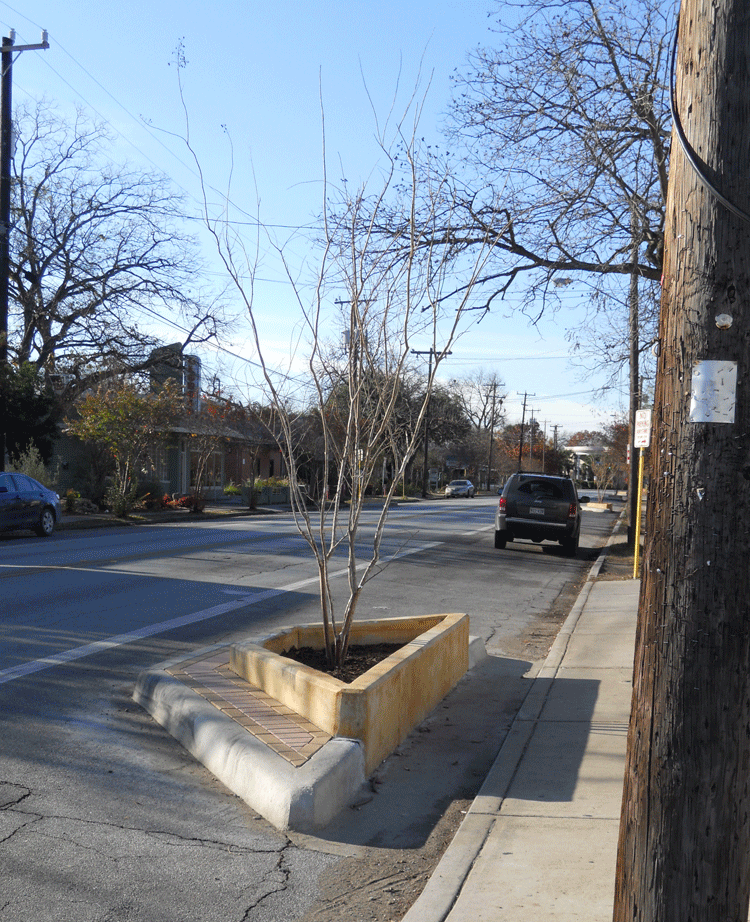 Update on January 6, 2011: Just noticed the bulb-outs on South Alamo Street are no longer naked. White lines also seem to help drivers keep from ramming into the concrete. This crepe myrtle blooming in the spring should be beautiful, but drivers exiting Turner will be unable to see if any vehicles are coming from the south…. Maybe the neighborhood needs a new body shop?


 Postcards from Barton Springs