New River Crossing

When the Drury family decided to convert the former Alamo National Bank Building into the Drury Plaza Hotel Riverwalk, there was a problem with the location.  The 24-story building overlooks the river, but it is on the flood channel.  No River Walk passed by its doors. 

So they paid for and built one themselves.  The Drurys transformed the sidewalks skirting the banks of the San Antonio River from a horseshoe shape into a full circle in the heart of downtown.   And in the stretch of River Walk they added, they spared no expense in following the original Robert Hugman concept of making it varied and interesting along the way.

But eliminating those deadends was not enough.  Across the river from the hotel the River Walk came to a halt at Main Plaza.  The Drurys wanted a footbridge to stimulate foot traffic to and from the recently reconfigured Main Plaza.  (We’re not entering the fray about what one preservationist now calls “Maimed Plaza.”)  I suggested Rick Drury install one of those coin-tornado gravity wells like the Witte Museum has but with a sign reading “Wishing I could cross here” – thereby enlisting kids to convince their parents to part with every bit of change in their possession.

But the Drurys decided to forge ahead and remedy the situation themselves.  The extremely chunky main support post stood forlornly in the river for several years awaiting its reason to exist.  Its bulkiness makes it appear as if it was built to withstand a flood, which of course it was. 

Then a stark-looking bridge was installed with yellow tape at each end prohibiting crossing for months on end.  The bridge is a bit shoehorned in, but again, of course, isn’t the entire Paseo del Rio awkwardly confined in a tight and narrow space?  The intimacy created by this is a major part of what makes the River Walk such an incredibly successful urban park.

But finally the aha! moment has arrived.  It is now clearly evident what the Drurys were awaiting – the installation of copper panels designed by Isaac Maxwell Metal, a studio where architect Judith Maxwell carries on the tradition of fine craftsmanship nurtured by her late husband.  Gentle light shimmers through the pierced panels at night.

While the panels seem overly ornate juxtaposed with the heavy support column (remember, though, its flood-channel location), the metalwork theme is already in place a little upstream in the form of punched-pendant lights the Drurys commissioned.  The panels also reference the spectacular original ornamental metalwork and trim filling the hotel’s lobby up to its soaring 50-foot-high ceiling. 

Finally, thanks to the Drurys (Father David blesses you), one can actually circle the full river bend on foot and emerge at the doors of San Fernando Cathedral.  And parents do not have to empty every nickel and dime out of their pockets for children wishing they could cross there.

P.S.  Don’t forget to bail Gayle out of jail!

Note Added on December 2:  The footbridge that Drury built finally will be dedicated on Monday, December 13, at 10 a.m.
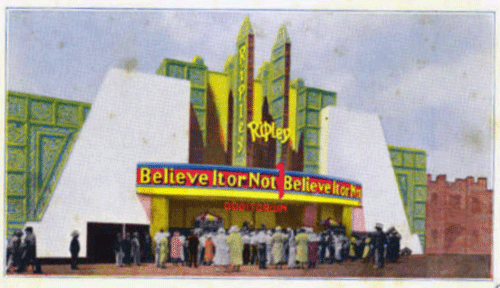
Odd Connection to Texas Centennial

I am not among those who wants to eradicate the current businesses operating around Alamo Plaza, just need to respectfully corral the signage in the historic district.  That is not to say I love what is housed in the historic buildings that line Alamo Street, but the buildings themselves need their dignity preserved. 

What is unbelievable to me is Ripley’s Odditorium actually has a historical connection to Texas, one that dates back at least as far as the Texas Centennial in 1936.  Plucked this proof off of ebay:

 In the words of Robert Ripley, “Believe It or Not!”

 And as a courtesy to the seller of the postcard….

 P.S.  Don’t forget to bail Gayle out of jail!

Leave a Lasting Imprint

Their handprints symbolize the mark they made and, for some, continue to make on San Antonio.  The founders of the San Antonio Women’s Pavilion, which opened in time for HemisFair ’68, left their imprints in tiles designed by Ethel Wilson Harris on a back wall of the pavilion designed by architect Cyrus Wagner.  Writing in San Antonio Current, Jessica Ramos described the building:

The 12,000-square-foot, four-level building’s most eye-catching traits include the city’s tradition of masonry infused with ’60s-inpired open spaces, Mexican brick, hand-carved doors by Lynn Ford, and modulated lighting that includes skylights, clerestories, wooden grills, and Martha Mood ceramic fixtures.  One can squeeze into any nook of the building and still have a view of all of its levels.

Grassroots fundraising efforts made the original construction of the pavilion, dedicated to the contributions of the women to the world, possible.  Ramos wrote:

(Sherry Kafka) Wagner and other prominent San Antonio women, including Nellie Connally, wife of Governor John Connally, Edith McAllister, Mary Denman, Patricia Galt Steves, and Bertha Gonzalez, wife of Congressman Henry B., organized a bottom-up campaign with the intention of showcasing women’s achievements in art, science, business, and government.  They hosted coffee parties to finance the exhibition.  One coffee klatch seeded hundreds, and soon, more than 8,000 women from 49 states and 14 countries became members by donating funds — as little as $1 apiece — to build the pavilion.  What began as plans for a temporary exhibition space soon flourished with an organized wave of support.  The word-of-mouth movement attracted other organizations, which donated thousands of dollars in grants to build a permanent structure.

“You have to remember, this was before the women’s movement,” said Wagner, “this was huge.”

Today’s board of directors of the Women’s Pavilion, including Wagner, are resorting to grassroots efforts again to restore the building as part of the city’s revitalization plans for HemisFair Park.

This is late notice for one of the ways you can help this Saturday.  Drop by the AIA’s Center for Architecture at Pearl Brewery any time between 9 a.m. and 4 p.m. to help cut out bags from recycled convention banners.  According to the Express-News:

Volunteers cut the tote bag and banner patterns, created by local designer and store owner Kathleen Sommers, from the vinyl banners. Those pieces are then delivered to La Fuerza Unida, a sewing cooperative and social justice organization, to be sewn…. Last year, La Fuerza Unida sewed 206 pieces for the Women’s Pavilion.  All the items sold within two hours of the group’s first sale in November.

If it’s too late for you to go tomorrow, mark your calendar for August 21.

The colorful bags and aprons sell from $32 to $46 and represent a great fundraising tool, but, with $12 million to secure for the renovation project, more than that is needed.  So the Women’s Pavilion is looking for helping hands of another kind as well for the Artful Legacy Project.  Each donor of $500 will have a scanned image of her hand and her name engraved into a glass tile.  In collaboration with artists Gini Garcia and Kay Lorraine, the resulting wall installed adjacent to the pavilion will be illuminated at night with fiber optic lights that change colors.

The board of the Women’s Pavilion is a creative and determined one.  Current quotes member Ginger Purdy:   

Before I leave this planet, I am going to bring that building back to life.

P.S.  Don’t forget to bail Gayle out of jail!