Postcard from Palermo, Sicily: Gleaming mosaics of Monreale

Above: Byzantine-style 12th-century mosaics relate Biblical stories inside the Cathedral of Monreale

Tired from a day of hunting in the woods of Monte Caputo above Palermo, King William II (1153-1189), later known as William the Good, lay down under the shady canopy of a carob tree. He was awakened from his nap by a vision of the Virgin Mary, and she requested he build a church on that very spot in her honor.

This meant the tree had to go, but, when it was chopped down, lo and behold, a golden treasure was found amongst the roots. Gold to fund the project. According to legend.

William the Good commissioned a mammoth church and a Benedictine abbey for Monreale. He gifted the church in honor of Santa Maria Nuova, a contributing factor to his reputation as good, forever distinguishing him from his father, referred to as King William the Wicked (1120-1166).

Continue reading “Postcard from Palermo, Sicily: Gleaming mosaics of Monreale”
Postcard from Palermo, Sicily: Byzantine mosaics and Moorish muqarnas

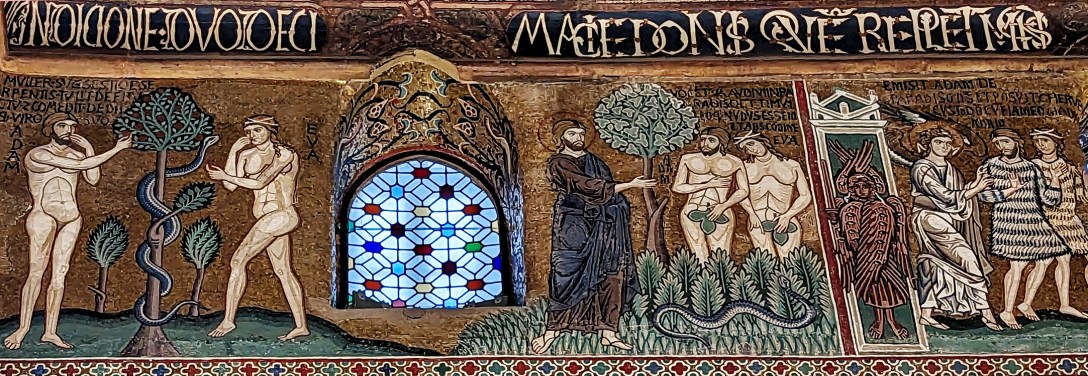
Adam and Eve, 10th-century mosaic in the Palatine Chapel inside the Norman Palace

The Palatine Chapel is the most beautiful in the world, the most surprising religious jewel ever evolved up by the human mind and executed by the hand of an artist…. where the harshness of the Gothic style brought here by the Normans is tempered by the wonderful art of Byzantine ornamentation and decoration.”

Guy de Maupassant, “La Vie Errante,” 1901

The facade of the immense Norman Palace is so cold and boring, I could not bear to take a photo of it. The original stark building was built to serve as the residence of kings installed after the Norman conquest in 1072. But one should never judge a book by its cover….

Proclaimed the King of Sicily by papal bull in 1130, Roger II (1095-1154) had been exposed to the various architectural influences that had ebbed and flowed with invasions of the island for centuries. For the eight-year construction of the royal chapel within the palace, he recycled some rather wild Corinthian columns and tapped both the talents of Moorish builders to craft the honey-combed muqarnas of the vaulted ceilings and Byzantine artists for the exquisitely detailed mosaics of the transept. The mosaics of the nave, a little bit cruder but still stunning, were commissioned from local artisans by William I (1120-1166), known as William the Bad; and William II (1153-1189), known as William the Good.

Continue reading “Postcard from Palermo, Sicily: Byzantine mosaics and Moorish muqarnas”

Postcard from Palermo, Sicily: Zisa Palace bears Moorish imprint

Above: Marble sepulcher marker of Anna, died in 1148, inscribed in Jewish, Latin, Greek and Arabic

The fourth-born son of a king rarely grows up preparing to ascend to the throne. Yet, the deaths of the eldest three sons of Roger II (1095-1154), King of Sicily and Africa, all preceded their father’s. Ready or not, William I of Sicily (1121-1166) inherited the crown.

Of course, that makes things sound simpler than they were. Naturally, he faced challenges, quickly losing Africa to the Moors. Then there problems with popes, Byzantines, Romans, Greeks, scheming relatives and revolting barons. King William managed to stay in power, while refusing Sicilian nobles the participation in government they coveted. While his father was known as Roger the Great, William was dubbed the Bad or the Wicked. Perhaps this was unfair, but the history of his reign was penned by a nobleman with a definite chip on his shoulder.

Continue reading “Postcard from Palermo, Sicily: Zisa Palace bears Moorish imprint”