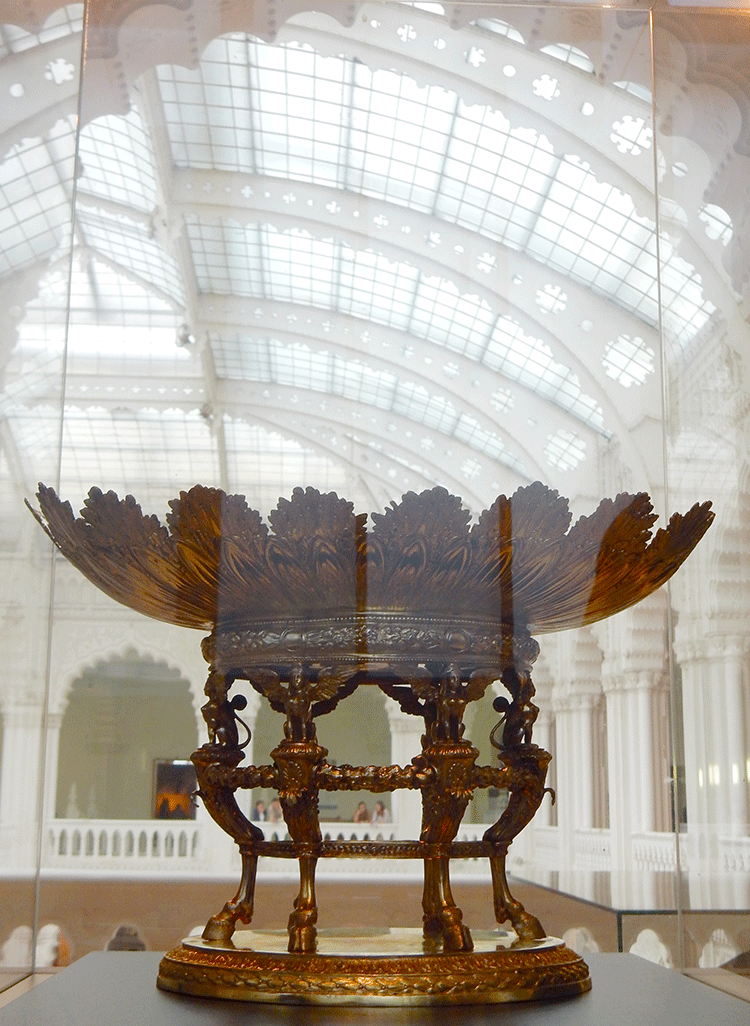
Postcard from Budapest, Hungary: A peak at treasures inside the Art Nouveau jewelbox

Transferring some antiques from the Hungarian National Museum, the Hungarian Parliament founded the Museum of Applied Arts in 1872 in recognition of the importance of decorative arts and design. Acquisitions increased with purchases at major world fairs, including those in Vienna in 1873 and Paris in 1878 and 1889, and gifts from Herend Porcelain Manufactory, Zolsnay, which has been producing luxury hand-painted and gilded porcelain for close to 200 years.

With the growth of the museum’s collection, a new building (see prior post) was required. The grand opening of the Art Nouveau palace in 1896 was attended by Emperor Franz Josef.

War and political changes contributed to the treasures held by the museum from the 1940s to 1960s as items were “rescued” from large houses and palaces by the Ministerial Commission for Endangered Private Collections. The Soviet takeover in 1948 led to the nationalization of numerous independent collections.

Parts of the museum were closed off when we were there this spring, as the building is being both restored and expanded following an international design competition. Renderings of the new wing can be viewed by clicking here.

Postcard from San Cristobal de las Casas, Chiapas, Mexico: Sweeping up the photographic crumbs

Street art and graffiti. Halloween. Fashion. Textiles. Museums. Street scenes. And the 43.

Random leftovers from our two-week stay in San Cristobal de las Casas.

It had been three decades since our earlier visit to this colonial city; we won’t wait long to return.

Postcard from Oaxaca: Weaving new translations of ancient traditions

The magic of the first carpet had our attention. And the second. Brilliant colors, traditional patterns passed from wrinkled hands to nimble young fingers generation after generation in villages in the interior of Mexico.

Santiago Borja’s carpet appears traditional at its heart but melts into modernism at its edges. Weavers from the workshop of Jeronimo Hernandez in Teotitlan del Valle, Oaxaca, completed its execution.

But then something happened on the next wall. The scarf escaping from the flat surface, its fringe fluttering free as though a butterfly freed from its cocoon…

This slideshow requires JavaScript.

…a phrase too obviously transitioning to the title of the exhibition at the Museo Textil de OaxacaCocoon Me from My Feet Up: Traditional and Contemporary Carpets. Curator OlgaMargarita Davila assembled work by 18 artists from four countries “to connect ourselves with the meaning of the fabric we inhabit: our body.”

Bodies resembling dancing Guatemalan worry dolls bob along the top and bottom of a linear weaving by Susan Martin Maffei whose website explains:

Crocheted 3 dimensional trims, quipus and found objects enhance the narrative visuals of many works, influenced by textile forms and embellishments of the many ancient cultures I have explored.

An “unwrapped” piece caught my eye, but then the artist almost cheated to make me a fan – a postcard. He created a postcard to the curator to accompany one of his pieces.

….there is such a contribution to be made by adapting examples from the history of our chosen medium and quietly exploring a simple form or image through line, grid-form or in separate units, repeating and developing it again and again.

Archie Brennan, Tapestry Art Today, Summer 2004

And then, he has such a fine last name.