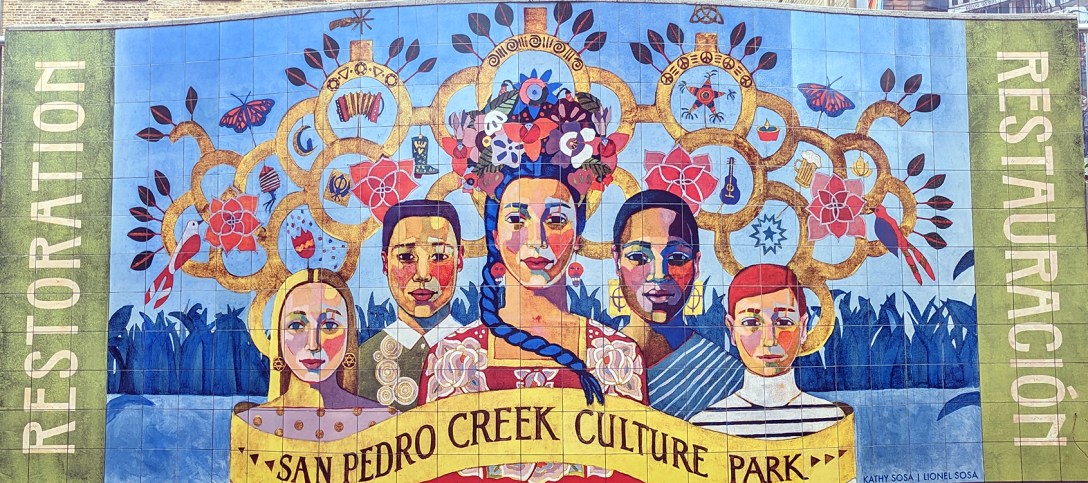
Above: “Restoration,” mural by Kathy and Lionel Sosa
Once upon a time, I logged a lot of hours at City Hall, sometimes parking on a surface lot behind it. Behind it meaning on the other side of an unrecognizable creek. An ugly footbridge, hemmed in by chained-link fencing, crossed a narrow trash-filled concrete-walled ditch – San Pedro Creek. A place creepy enough to leave me feeling I should pay an extra dollar or two to park in front of City Hall.
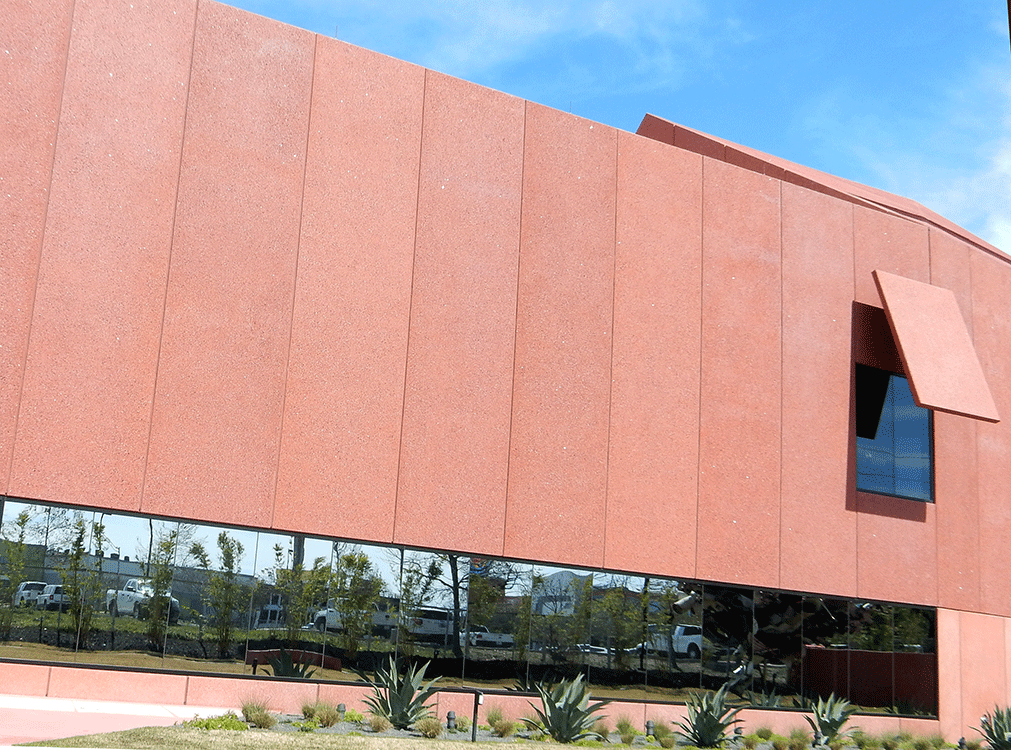
Ruby City, designed by architect Sir David Adjaye Obe
I like to collaborate with artists that see space and structure as integral to their work. It involves a merging of skills and aesthetics to create something that has more potential than either discipline can achieve on its own.
That desire must have made Linda Pace (1945-2007) an ideal client for the architect of international renown, for the passionate collector of art was an artist herself. Writing for The Guardian just prior to the October 2019 opening of the Linda Pace Foundation’s Ruby City in San Antonio, Adjaye noted that Ruby City is an:
…example of how place and history are always important. Linda… had cancer and it had just become aggressive. She knew she was starting to go down. She became fascinated with dreams and their interpretation…. Then she drew this place she called Ruby City. Her drawing looks like a shining city on a hill or a Russian Orthodox church. For her it was a vessel, a hope…. a hope that her disappearance would have an impact.
I became fascinated by it. Red had become so important to her that I wanted to use that as a start point. From discussions we had, I looked at San Antonio and the missionaries who came to the region and the structures they built, the incredible monasteries. I also looked at pre-colonization America and Mesoamerican culture and their relationship to making architecture out of mud and raising these incredible citadels all over that part of Texas and New Mexico. The commonality for me between the monasteries and citadels is that they’re both about religion but also about death and communing with the afterlife – and they’re habitation spaces. Those ideas, mixed with her idea of the form, became an idea about architecture articulating light as a revealer of different facets of her art collection….
So the Ruby City building is about Linda, Texas and the collection.
“Heart of Darkness,” Cornelia Parker, 2004
Ruby City from sculpture garden
detail of “Dreaming Red,” collage by Linda Pace
“Stones Against Diamonds,” video installation, Isaac Julien, 2015
Hong Kong orchid tree in Chris Park
Ruby City viewed from Chris Park
Kim Jones
Ruby City stairway
Alejandro Diaz
“Mirror Mirror (igloo),” Linda Pace, with (background) “Your Whole Fucking Culture Alienates Me,” Andrea Bowers, 2006
“Colour Motoric Entrance,” Olafur Eliasson, 2004
“Accordion,” Christian Marclay, 1999
Ruby City viewed from Camp Street
“5,000 lbs. of Sonny’s Airplane Parts,” Nancy Rubins, 1997
Ruby City sculpture garden
“A Meditation on the Possibility of Romantic Love or Where You Goin’ with that Gun in Your Hand, Bobby Seale and Huey Newton Discuss the Relationships Between Expressionism and Social Reality Present in Hitler’s Paintings,” Daniel Joseph Martinez, 2007
detail of “Dreaming Red,” collage by Linda Pace
chairs in the sculpture garden
Linda Pace left behind a collection of more 900 works of art in the hands of the foundation that bears her name. The immense collection will be displayed in rotating exhibitions in the new Ruby City and her former studio and Chris Park across the street. Entrance to the campus and galleries is admission-free.
For now, Ruby City addresses the back service vehicle parking lot of an inartistic branch of the United States Post Office, but that dismal view will be dramatically changed as part of Phase Two, now in the planning stages, of the San Pedro Creek Project.
In this place of herons where the grasses sway in starlight I have flowed since the dawn of evermore.
John Phillip Santos, historical text carved in limestone
The stretch of San Pedro Creek between the tunnel inlet at I-35 and Houston Street beside a new office tower climbing toward the sky might only be a little more than four blocks long, but the transformation from drainage ditch to park seems miraculous to me.
Yes, I watched the earlier magic worked on the Museum and Mission Reaches of the San Antonio River Improvements Project, but there was absolutely nothing natural-creek-like remaining following decades of flood-control projects in this neighborhood.
Some dismiss projects like these as “legacy projects” fluffing up politicians’ egos with taxpayers’ dollars. Politically charged, the design process for a project this complex is rarely perfect. There are budget cuts, and still the enormous projects tend to run over-budget.
But, as with the original Paseo del Rio project, they can prove visionary. Development along the Museum Reach demonstrates how quickly highly blemished urban corridors become desirable.
John Phillip Santos historical text
Adriana M. Garcia “De Todos Caminos Somos Todos Uno”
new Frost Bank Tower
Joe Lopez “Bellos Recuerdos del Teatro Alameda y Tiempos Pasados”
Diana Kersey “Bridges of Understanding”
John Phillip Santos historical text
Adriana M. Garcia “De Todos Caminos Somos Todos Uno”
John Phillip Santos historical text
“Rain from the Heavens”
Diana Kersey “Bridges of Understanding”
John Phillip Santos historical text
Joe Lopez “Bellos Recuerdos del Teatro Alameda y Tiempos Pasados”
Diana Kersey “Bridges of Understanding”
Katie Pell “Red Arch, Green Arch”
Adriana M. Garcia “De Todos Caminos Somos Todos Uno”
Diana Kersey “Bridges of Understanding”
Joe Lopez “Bellos Recuerdos del Teatro Alameda y Tiempos Pasados”
Adriana M. Garcia “De Todos Caminos Somos Todos Uno”
Diana Kersey “Bridges of Understanding”
While flood-control is an underlying purpose of the San Pedro Creek Improvements Project, the incorporation of site-specific art reflective of the city’s history and culture gives the new pedestrian passageway a distinctive San Antonio feel.
Bexar County is the primary funder of San Pedro Creek Culture Park, and the San Antonio River Authority is project manager.
looking south from Houston Street
Work is underway on the next phase heading southward from Houston Street. As you can see from the photo, this narrow stretch probably is even more challenging.
In my mind, the photos above illustrate that the complications and difficulties encountered along the way are so worth it. Those involved are leaving a legacy that will enrich the quality of urban life for generations to come. Looking forward to walking the next phase and those to come.



 Postcards from Barton Springs