Postcard from Oviedo, Spain: A few pieces from Museo de Bellas Artes

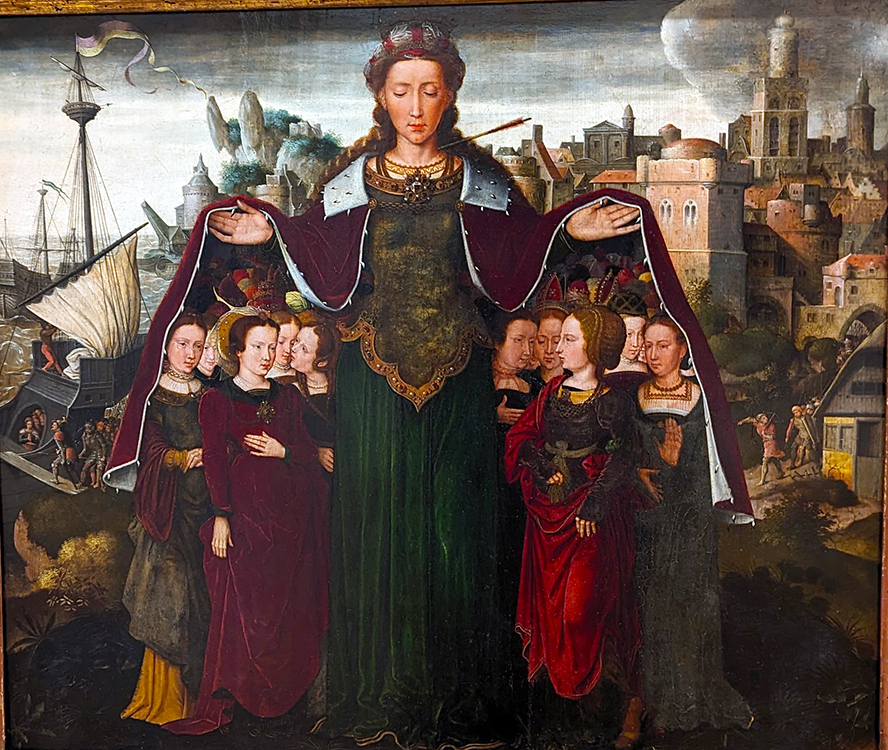
Above: “Saint Ursula and the 11,000 Virgins,” Pieter Claeissens, 1560

Pieter Claeissens’s painting hanging in Museo de Bellas Artes de Asturias attracted my attention because of my unfamiliarity with Saint Ursula. According to legend, 11,000 handmaidens of Princess Ursula set sail with her from southern England on a journey to marry the pagan to whom her father had betrothed her. The ship was blown off course, so Ursula and her entourage decided on an extended pilgrimage to Italy first. Huns had taken over Cologne by the time they finally arrived there, and, for some reason, the Huns failed to appreciate having all those virgins in their midst and slaughtered them.

Continue reading “Postcard from Oviedo, Spain: A few pieces from Museo de Bellas Artes”

Postcard from Valladolid, Spain: Plateresque architecture competes with sculpture within

Above, Isabelline Plateresque details surround the courtyard of Colegio de San Gregorio in the complex serving as Museo Nacional de Escultura.

The National Sculpture Museum is housed in three historic landmarks clustered together in one block in Valladolid.

With the nationalization of convents and monasteries in 1836, the government of Spain seized a wealth of artistic treasures in need of housing. Many of those from the region of Castile first went on display in Valladolid in 1842 in the Colegio de Santa Cruz. In 1933, the collection was designated a national one and was moved to the Colegio de San Gregorio.

The exterior of the 15th-century building is characterized by intricate sculptural reliefs in the Isabelline Plateresque style. The gorgeous façade demonstrates a complete lack of a uniform theme – resulting in a fascinating hodgepodge of biblical and secular components with an abundance of putti and floral and vine-like flourishes intertwined among them.

Continue reading “Postcard from Valladolid, Spain: Plateresque architecture competes with sculpture within”

Postcard from Burgos, Spain: A few parting impressions

Above, pollarded plane trees framing Paseo del Espolon

The Scarecrow, who was in the lead, walked forward to the tall tree where there was an opening to pass into, but just as he came under the first branches they bent down and twined around him, and the next minute he was seized by the long branches and raised from the ground and flung headlong among his fellow travelers.”

The Wonderful World of Oz, L. Frank Baum, 1900

Remove the brilliant blue sky from the picture, and these trees appear as frighteningly eerie as those in The Wonderful Wizard of Oz. The severe winter haircut, pollard, of these relatives of American sycamores lining Burgos’ beautiful Paseo del Espolon reaps a huge reward for pedestrians. The trimming encourages the trees to produce a dense canopy of green leaves shading all who pass below throughout the summer, and whimsical-shaped topiaries soften the impact during the winter months.

Continue reading “Postcard from Burgos, Spain: A few parting impressions”