Reviving Dia de los Muertos

When I first moved to San Antonio, the places to see flowers and foods placed on graves to encourage visits from their inhabitants were the old San Fernando Cemeteries. Most of the wrinkled pilgrims picnicking with their deceased loved ones on All Saints and All Souls Days, November 1 and 2, appeared poised to repose alongside them. The remnants of the Dia de los Muertos traditions enduring from when San Antonio had been part of Mexico were dying with them.

Bedoy’s Bakery, founded in 1961, credits Father Virgil Elizondo with encouraging the bakers to dust off traditional old recipes for dead bread, pan de muerto. I used to buy the breads around Halloween, but felt guilty when we selfishly ate them without offering to share them with the dead.

In the past decade or two, artists in San Antonio began adding contemporary twists to ancient Day of the Dead traditions, and now the city sponsors a full-blown fiesta for Dia de los Muertos in La Villita. Altars, processions and even a concert by Girl in a Coma were part of this year’s event, held a bit early because the city’s Day of the Dead calendar is getting more crowded.

While a far cry from the celebrations we witnessed outside of and in San Cristobal de las Casas last November, San Antonio’s spirited version represents traditions worth reviving and refreshing for new generations.

Although I cannot comprehend why the marketing department at Coca-Cola is not all over sponsorship opportunities for this event. In Mexico, Coca-Cola dominates the graveyard market in San Juan Chamula, Chiapas:

One would think a people who have rejected so many standards held by outsiders would not consider taking even one sip of a Coca-Cola. But expelling evil spirits from the body is key. Spitting helps, but burping is best. And what is better at inducing burping than a few shots of rapidly consumed Coke….

But, what marketing genius convinced the Chamulans a half-century ago to incorporate Coke into not only their Sunday church-going regimen, but everyday life? I mean, Chamulans need to continually maintain their guard against those invasive evil spirits, burping them out on a regular basis.

And whoever the lucky holder of the local bottling franchise is really struck a home run with this. The market is larger than just the living. On Dia de los Muertos, even the dead are served Cokes to quench their parched throats from so much time spent underground and to burp away any evil spirits hanging around the cemetery.

Just think how large Coca-Cola’s market share would soar if this practice spread to the dead everywhere.

Here are some posts from last year in Chiapas, Mexico:


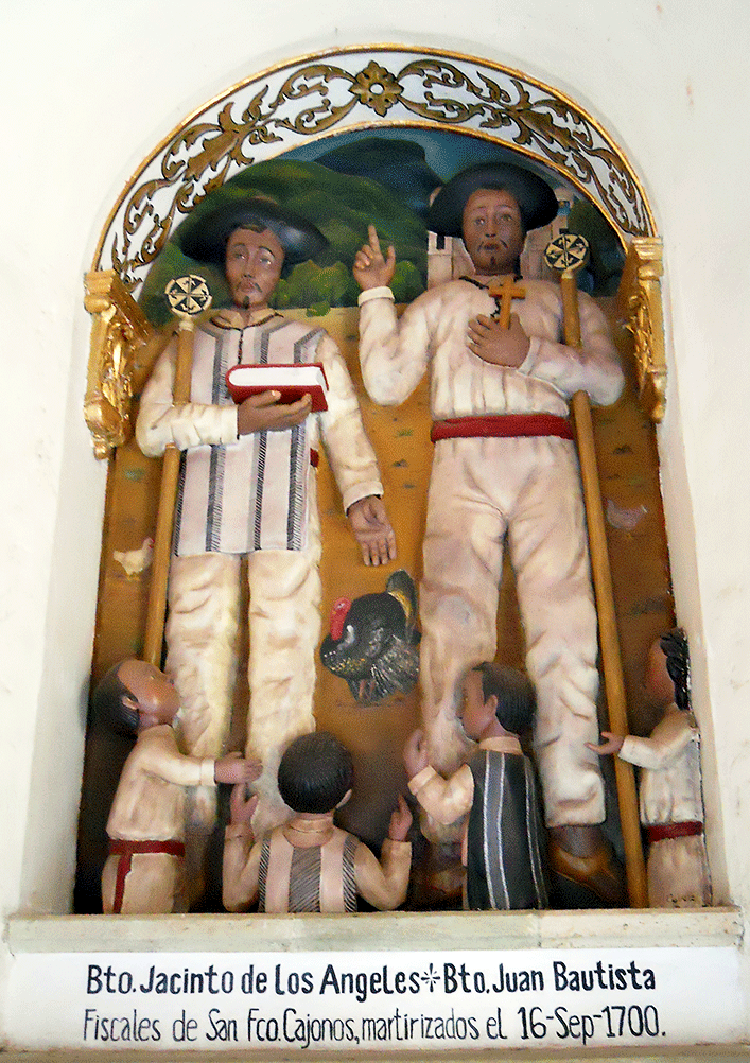
Holy card from Oaxaca, Mexico: Zapotecans in line for sainthood

DSCN2359

A long list is found on one of the walls of La Compania de Jesus Church in Oaxaca. A list of those waiting. Those whose lives in Mexico were so full of sacrifice Rome surely will notice and promote them on the road to sainthood.

I’m pulling for the child martyrs of Tlaxcala, the land of corn tortillas. Poor Christobalito, Antonio and Juan were, after all, children. Antonio and Juan were clubbed to death, but Christobalito’s own father, a confirmed pagan, condemned him to be beaten with clubs and then set ablaze for his faith. The trio was beatified by Pope John Paul II in 1990, but they hardly seem on the fast-track. They have been waiting in line a really, really, really long time. Ever since the late 1520s.

But in Oaxaca, a pair of Zapotecs stand out, although newcomers to the waiting list by comparison to the ninos above.

Back in 1700, Dominican priests in Oaxaca would commission converts to serve as “attorneys general,” assigned to police the purity and practices of those living in rural areas. Jacinto de los Angeles and Juan Bautista of San Francisco Cajonos, “the town in the clouds,” were so honored. Overhearing those worshipping the harvest god, Huitzilopochtli, talking about a clandestine evening gathering in his honor, the attorneys reported back to the Dominican friars. Intervention was planned, and Jacinto and Juan led a group to break up the idolatrous meet, seizing the men’s musical instruments.

Unfortunately for Jacinto and Juan, their Zapotec brethren did not take kindly to what they viewed as tattle-tale turncoat interference. A mob seized the two from the sheltering confines of the convent. The pair refused to recant their faith, even under torture.

They survived being thrown off Tanga Hill in the village of San Pedro, but clubs still were viewed as a popular way to deal with Christians anyway. The mob clubbed them and cut them with knives before cutting open their chests and feeding their hearts to the dogs. (I don’t make these things up. Read the Vatican’s version here.)

Whatever parts were left were gathered later by the faithful, who put them in the church of Villa Alta until 1889. The remains were moved to a chapel in the Cathedral of Oaxaca, a chapel almost always locked for their protection.

DSCN1067

A bad thing happened to what should be set aside as their day. Jacinto and Juan attained martyrdom on September 16, but, unfortunately, 110 years later Father Hidalgo absconded with their day on the calendar. His cry for independence from Spain changed what would be their feast day to Mexican Independence Day, a celebration far overshadowing their sacrifices.

But an exhausted-looking but determined Pope John Paul II rescued them from obscurity, beatifying them in 2002 as examples “of how, without regarding one’s ancestral customs as myths, one can reach God without renouncing one’s own culture but letting oneself be enlightened by the light of Christ, which renews the religious spirit of the best popular traditions.”

While their hearts probably wouldn’t be fed to the dogs, one wonders what kind of reception church spies would receive in someplace like San Juan Chamula today. “Hey, they are sacrificing chickens in your church.” “Hey, do you know that elder over there has four wives?” They would be so expelled from town.

But, the good part of this story is how Jacinto and Juan are revered in their hometown. Their stories didn’t rise up on the Vatican radar without help. A trio of maize and chickpea farmers championed their cause at the grassroots level. According to a story by Stephen Henderson in the Los Angeles Times, they researched the story at City Hall and then chronicled the testimonies of more than 30 locals who claimed prayers to Jacinto and Juan were answered with miracles. This represents 1/10 of the entire town.

The task took decades of dedication, but it paid off. A group of Cajonos proudly accompanied the glass-encased heartless remains of Jacinto and Juan to Mexico City for the papal ceremonies taking them one step closer to sainthood. Plus, the pair was given a new feast day of their own – September 18.


The Pope-blessed glass-encased relics can still be glimpsed sitting on the altar in that side chapel in the Cathedral of Oaxaca, a destination for Zapotecan pilgrims.

Postcard from Zinacantan, Chiapas, Mexico: Roosters Rule the Roost

Densely clustered deep plum and royal blue embroidered flowers blanket the huipiles of women running errands in San Cristobal de las Casas from the nearby Tzotzil town of Zinacantan. They were my favorites spotted on the streets.

As with San Juan Chamula, male leaders operate the small town of Zinacantan somewhat autonomously, charging a toll to outside visitors. But here the women are not subjected to polygamous marriages.

The feathers young women spend months weaving into their bridal outfits do symbolically spell out their standing in the marriage. The feathers aren’t brilliant parrot or peacock feathers but are those of the humble hen. Unable to fly, hens don’t flee the coop. Chickens stay close to home, subject to the rooster’s whims.

This slideshow requires JavaScript.

Several churches abut plazas at the heart of Zinacantan. The church of San Lorenzo dates to 1546. We are not sure why Saint Lawrence was popular, but he is the patron saint of chefs.

As punishment for having distributed the church’s wealth to the poor instead of Roman authorities in the year 258, Lawrence was slowly grilled upon an iron grate. He is alleged to have quipped to his tormenters, “Turn me over; I’m done on that side.” Perhaps Nana (Katherine Ann Conway Brennan, 1887-1972) was prescient in naming my father Lawrence (Lawrence Conway Brennan, 1918-1988), for no one enjoyed grilling a thick sirloin steak, fork in one hand and Bourbon in the other, more than Dad.

San Sebastian has a more obvious connection to a second church built about 200 years later. Some believe the saint who was martyred about the same time as Saint Lawrence miraculously appeared to construct this church in Zinacantan with his own hands, a feat he accomplished in only three days.

Others claim he reappeared in Mexico only to be pierced by arrows shot by Spanish soldiers, as he originally had been in Rome. He died, once again, on the site of the church and was buried there. Saint Sebastian is a patron of athletes and soldiers and a protector against the plague, particularly beneficial when Spanish soldiers are spreading European diseases among the native population with no immunity to them.