UTSA Art Collection gives ‘Voz’ to Latino experience

Collectively, these artistic works constitute a powerful testimonio of the history, experience and transformations of Latino/a individuals and their place in the communities of these lands.

Out of their vision and craft, these artists have created works that imagine art as a practice of political and spiritual uprising, art as a testament to the abiding power of memory and heritage to help understand ourselves, of the central place of landscape and portraiture in capturing the stories of our legacy, and of the role of mythic imagination as a force that can be refined to re-imagine ourselves into the future.

Amidst all of the differentiation of visions, perhaps there is a deeper narrative visible here, of a people broadening the scope of the ideas and images of themselves as Americans rooted in a still contested landscape, in an increasingly globalized world.

Seen as a whole, the VOZ exhibition can be viewed as a powerful affirmation of the role artists and their work are playing in helping to unfold and reveal the destiny of a people, a story embodied in the three-hundred yearlong history of the city of San Antonio.

John Phillip Santos

More than 200 works drawn from the art collection of the University of Texas San Antonio are included in “VOZ,” on display at Centro de Artes at Market Square as part of San Antonio’s Tricentennial Celebration.

For three hundred years, San Antonio has been a place where different languages, customs and traditions have merged to form a unique cultural history.

Like all stories of a particular place and time, the work on these walls is informed by pride, joy and a tenacity that reverberates in the voices that celebrate the Latino experience.

Arturo Infante Almeida, exhibition curator

Six of the featured artists will join Almeida and Santos for a panel discussion moderated by Dr. Ellen Riojas Clark at 6 p.m. on Thursday, April 5.

The not-to-be-missed admission-free exhibition runs through June 10.
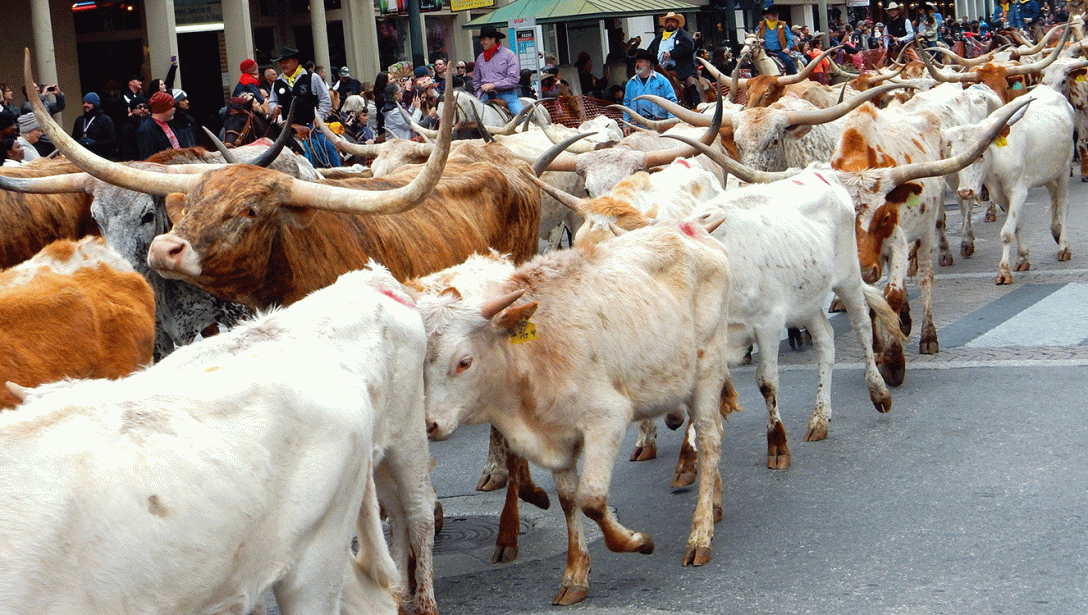
Morning walk turns into thematic parade through San Antonio’s heritage

The sky spat a fine mist on us when we set out for a morning walk. We probably would not have headed out at all were I not obsessed by the prospect of seeing longhorns herded through downtown in the San Antonio Livestock Show & Rodeo’s Western Heritage Parade and Cattle Drive, enlarged this year as part of San Antonio’s celebration of its 300th birthday.

The tricentennial meaning of the “300” on the banner was lost on some of the spectators standing next to us. Child: “Wow. There are going to be 300 cows.” Dad: “No, it means this is the 300th year of the cattle drive.”

While this was not the 300th annual parade of longhorns, cattle have been part of San Antonio’s history since Native Americans tending livestock for San Antonio’s string of missions became America’s first cowboys. Many of the Spanish terms the charros used to describe their work and equipment became embedded in the English language, as in the word “rodeo” itself.

Longhorns are not foreign to downtown, with a strong connection to Alamo Street and its plaza:

In 1876 salesman Pete McManus with his partner John Warne (Bet-a-Million) Gates conducted a famous demonstration on Alamo Plaza in San Antonio in which a fence of Glidden’s “Winner” wire restrained a herd of longhorn cattle. Gates reportedly touted the product as “light as air, stronger than whiskey, and cheap as dirt.” Sales grew quickly thereafter, and barbed wire permanently changed land uses and land values in Texas.

“Barbed Wire,” Texas Handbook Online

Sheep, goats, hogs, cows and horses often clogged the streets as farmers and ranchers brought them in from the countryside to sell to city dwellers. City folks began to tire of the inconvenience of this practice as the 21st century dawned.

Driving wild stock through our streets should be prohibited at once. Yesterday afternoon a drove of about thirty horses went up Houston street, and came near killing a child, while general travel was greatly obstructed.

San Antonio Daily Express, March 12, 1891

Hoping this herd of longhorns will not be the last to parade past the Alamo.

Much like barbed wire transformed the days of the open range, a wall some propose to enclose San Antonio’s Alamo Plaza would bring an era to an end. For many San Antonians, the Alamo and its plaza represent more than a battle site frozen and time. Their evolution before and after 1836 is an integral part of our heritage. The plaza historically and currently lies at the heart of many of San Antonio’s annual celebrations.

Texans in other parts of the state often fail to realize how tightly this plaza is woven into our urban fabric. The revised Master Plan for the Alamo now appears to recognize that concern:

An early concept of structural glass walls was shared at a public meeting, however, the final Master Plan includes no walls. The plan does propose archaeology that would reveal the original Alamo wall footings so that visitors may see what remains of the original Alamo walls.

Although this assurance is followed by:

These and other design concepts will be fully explored in future phases of the plan.

Stay vigilant.

This year’s San Antonio Stock Show & Rodeo runs February 8 through 25.