Postcard from Noto, Sicily: Palazzi with regal airs

Above: The ballroom of Palazzo di Nicolaci di Villadorata

Tuna fish, and evidently a lot of it. Riches earned in the lucrative fishing industry of the 17th-century enabled the upper-middle-class Nicolaci family to buy their way into nobility in Noto. After the 1693 earthquake wiped out the fortunes of much of Noto’s high society, Corradino Nicolaci purchased land and the accompanying title of Baron of Bonfala in 1701.

Corradino’s son, Baron Giacomo (1711-1760), supervised the 1720 design of a four-story palace with more than 90 rooms, which took 40 years to complete. While the ground floor was relegated to food storage and stables, the second-floor piano nobile was decorated lavishly for entertaining guests – a necessity later as another member of the family succeeded in acquiring the title of Prince of Villadorata in 1774.

Continue reading “Postcard from Noto, Sicily: Palazzi with regal airs”

Postcard from Siracusa, Sicily: Sturdy columns of Greek temple recycled by several religions

Above: Façade of the Duomo di Siracusa, or Cattedrale della Nativita di Maria Santissima

The chapel where some of Santa Lucia’s relics, featured in a recent post, are housed in the Cathedral of the Nativity of Mary Most Holy. A statue of her reigns up high on its façade to the right of the Virgin to whom the church is dedicated. Up on the left is San Marciano of Siracusa with San Pietro and San Paolo flanking the entrance down below.

Over the past 2,000 years, the history of Saint Marcian of Syracuse has become somewhat muddied. One version is that he was a follower of Peter the Apostle, who dispatched him to Sicily to preach in the year 40. His conversion rate was so high that the ruling Romans deemed him dangerous, and he was put to death. San Marciano became known as the first bishop of the city and is the patron saint of the archdiocese.

The “new” façade of the cathedral dates from after the 1693 earthquake and reflects the style categorized as High Sicilian Baroque. But the rest of the building has much deeper roots. The site was occupied by a 5th-century BC temple of Athena, possibly constructed under Dionysius I. Thirty-six substantial columns surrounded the outer perimeter of the temple – columns so substantial they withstood the devastating earthquake and can still be viewed on the north side of exterior and within the cathedral itself.

Continue reading “Postcard from Siracusa, Sicily: Sturdy columns of Greek temple recycled by several religions”

Postcard from Siracusa, Sicily: Protector of eyes and the quill

Above: Santa Lucia holy card superimposed over silver milagros displayed in Cattedrale della Nativita di Maria Santissima

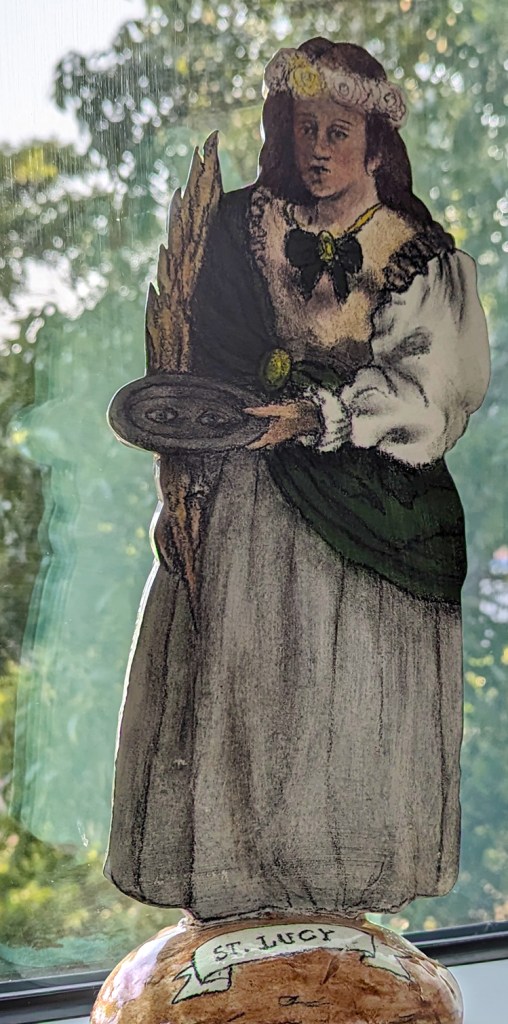
She stands guard on the windowsill by my desk as I write. As the patron of eyesight and authors, Saint Lucy (283-384) has long been a favorite of mine. Both near-sighted and far-sighted, I’ve worn glasses since the second grade. And certainly my writing needs all the help it can get.

Having lost sight in my right eye a year ago, it seemed serendipitous that one of the spots the Mister planned on staying, Siracusa, turned out to be her hometown. A church dedicated to the saint, Chiesa di Santa Lucia alla Badia, was a block away from our rental – a proximity presenting an opportunity to soak up some of Santa Lucia’s goodwill to protect the left.

Continue reading “Postcard from Siracusa, Sicily: Protector of eyes and the quill”