While legions of tourists line up for the Cathedral in Toledo, you can wander a few blocks away and they almost vanish. Only a handful appeared as we peacefully explored San Juan de los Reyes Monastery.
A battle between the Juanistas and the Isabelists led to the construction of the monastery, and I’ll try to explain why. Life among the Iberian royals was complicated. Sometimes they fought their way to power, and other times they married to merge kingdoms.
Henry IV of Castile (1425-1474) had no heirs and wanted to peacefully sidle up to Portugal, so he talked the Pope into annulling his first marriage to free him to marry the sister of King Alfonso V (1432-1481) of Portugal. Things were going along fine for a while, but an heir didn’t appear for more than six years. Royal gossips believed the king impotent, but then Juana (1462-1530) was born. The snickering about her paternity never ceased.
In the meantime, Henry’s younger half-sister Isabel (1451-1504) snubbed proposals from Alfonso. Instead of the King of Portugal, she married her second cousin, Ferdinand of Aragon (1452-1516).
Well, when Henry up and died in 1474, many in Spain viewed young Juana’s pedigree as questionable. Isabel and Ferdinand’s marriage, on the other hand, conveniently unified the kingdom of Castile and Aragon.
The rejected suitor Alfonso did not like this turn of events. What better way to get control of his neighbor then to promote Juana as Henry’s heir to the throne and marry her, his 14-year-old niece?
So then the whole peninsula was conflicted between the Juanistas and the Isabelists, which, of course, convinced King Alfonso and King Ferdinand to pull out their armor and lead their followers into a big battle at Toro on the Duero River in 1476. Militarily, the outcome was questionable. The flanks were divided geographically, and the troops of one king were victorious on the right flank and the other on the left. Nightfall and fog created chaos, and everybody not killed went home declaring victory.
Which leads us to the monastery.
In a masterful public relations move, Isabel commissioned the monastery In Toledo as a monument to “victory” at the Battle of Toro, a victory securing her crown as Queen of Castile. Merging Flamboyant Gothic with Mudejar styles, this place needed to be nice because the queen announced it would be the final resting place of the royal couple.
By the time San Juan de los Reyes was finished, Ferdinand and Isabel had acquired a lot more land and wealth. The Cathedral in Granada seductively offered appropriately sumptuous quarters for permanent royal rest; San Juan appeared modest in comparison. So the Catholic monarchs presented the monastery to Franciscan monks.
Aside from a major fire during the French invasion in 1808, the monks were good stewards of their monastery. But the property was seized by the government in the 19th century.
The Monument Commission carried out what the monastery’s literature calls “a subjective Neo-Gothic restoration project, with traces of historicist Romanticism” at the end of the 19th century. And then, miraculously, the government returned San Juan de los Reyes to the Franciscans in 1954.
Not sure how they find you, but I assume the inboxes of all bloggers are filled with pitches from public relations firms. As someone who has been engaged in public relations, I am sympathetic. But I think I have only bitten once, accepting one book to review. Not that the reach of my blog could make many waves for their clients anyway.
The topic of ghostwriting caught my attention this week though. Through the years, I have been called upon to ghostwrite speeches, a guest lecture for a college class, letters to the editor, scripts for parades, op-eds for publications, tweets and, yes, even an essay for a book. I’ve never thought that much about it.
Someone whose expertise lies elsewhere or who is simply too busy with other work commitments engages someone else to learn his or her voice and craft words into something they are willing to endorse publicly. No one expects politicians to prepare all their speeches, or the volunteer presidents of nonprofits to understand the mission and message as well as their staffs.
Writers often obscure their identities when writing fiction, particularly if it is in a different genre. What about Carolyn Keene? If she had ever been anything but a ghost, the length and productivity of her career would appear miraculous. She published her first Nancy Drew book in 1930 in time for my mother to read it as a young girl and is still churning out mysteries today.
Girl Online flew off the shelves during its first week of publication. According to the Christian Science Monitor, that number shattered all records for a debut novel in the United Kingdom.
The book was released at the end of November under the byline of blogger Zoe Sugg, which is why it sold so well. Zoe is a hot commodity. Her blog and youtube channel, Zoella, enjoy legions of followers. Glam Media handles the ads on her blogs, and products compete for placement.
Zoe’s certainly perky, but you don’t have to read or watch much about “beauty, fashion and life” to leap to the conclusion she might benefit from help in writing a novel. But with the not at all surprising revelation Girl Online mainly was written by someone other than Zoe herself, criticism erupted. Both those who use ghostwriters and those who write anonymously are under attack.
So the following reaction to the Zoella imbroglio popped into my inbox, and, given my ghostly past, I found it interesting. The defense of ghosts post is written, or is at least appears under the byline of, Michael Levin, author of more than 100 books and CEO of BusinessGhost:
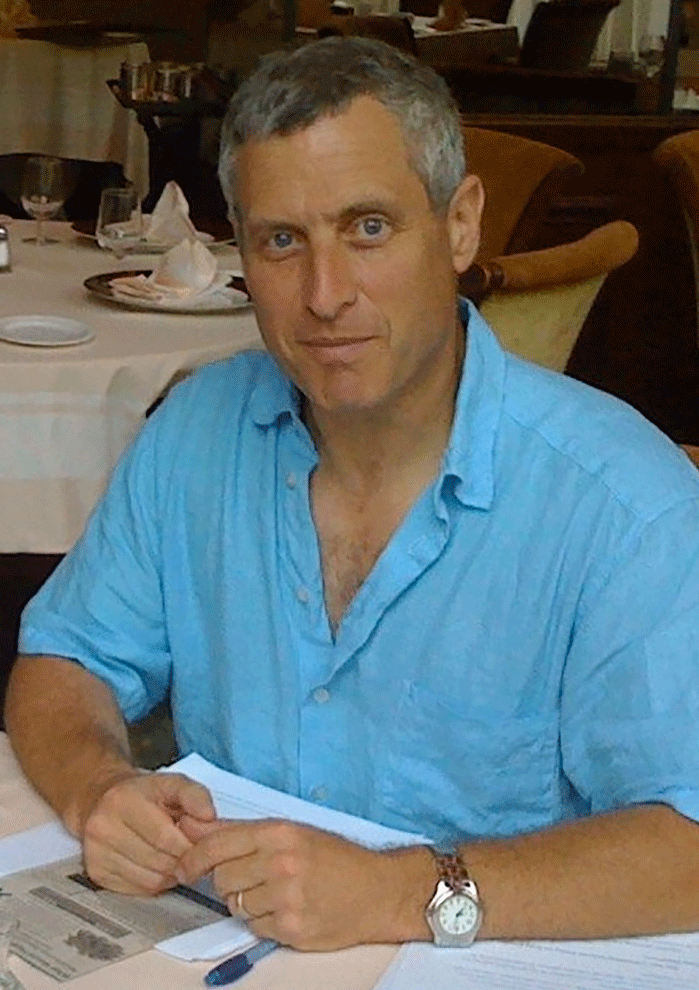
Michael Levin
Stop Criticizing Ghostwriters (And Their Clients!) By: Michael Levin
Zoe “Zoelle” Sugg, a young woman who has developed a massive following in the online world for her fashion and beauty videos has just come under fire for allegedly using a ghostwriter to help her write her novel.
Her publisher, Penguin, all but threw her under the bus, failing to speak up in her time of need.
The novel only happens to be the fastest selling novel in the history of that publishing firm.
Her integrity has been shattered and her v-logging (regular video accounts of her life and thoughts, her primary means of communicating with her fans) has been temporarily suspended.
For what crime?
Books are hard to write. The learning curve is steep.
How do you choose and organize material in a manner that catches and holds the attention of readers for hundreds of pages?
It ain’t easy.
I know this is true because I run a ghostwriting and publishing company with more than 240 books to our credit.
That represents 240 individuals who needed a book, had developed through leadership in their respective fields, but didn’t have the time or desire to write it themselves.
We interviewed them, drafted chapters in their own voices, edited those chapters in accordance with their comments, and published the books.
As a result, readers have access to their ideas, which result in better lives, since we only do positive books.
Their finances, careers, health and fitness, relationships, and spiritual lives are stronger as a result of the books we created.
Did the authors commit a sin by hiring us?
Did we commit a sin by ghostwriting the books?
Did Zoella do a bad thing?
Let’s get real.
Most people who need books are better off having someone else “write” them.
They should be doing the things they do that make them useful to society, whether it’s being an entrepreneur, a CEO, a doctor, a chef, or a member of the Baseball Hall of Fame.
I tell prospective clients, “We only work with people who are too busy to talk to us.”
Meaning that our clients are so successful and in demand that they don’t have the time to sit in a spare bedroom staring at a laptop screen and tapping out, “It was a dark and stormy night.”
…Society works best when people practice their unique ability and then offload all other tasks onto others better qualified.
I ghostwrite.
God gave me certain gifts: the ability to write well and quickly; the ability to absorb large amounts of information and put them into a sensible order; and the ability to dial into the sound of another person’s voice and write in that voice.
Nothing wrong with any of that. As a result, our clients get books that extend their reach, brand them in the marketplace, and help them serve more people and make more money.
Their readers gain valuable ideas from books that are easy to read and understand.
And we get paid.
Sounds like a good thing to me.
Except for folks like Malcolm Gladwell or Lawrence Wright, staff writers for the New Yorker who also write books, a very high percentage of authors use ghosts or cowriters.
Even some very famous novelists, truth be told.
So let’s stop banging on Zoella, who may or may not have worked with a ghostwriter, but even if she did, she did nothing wrong.
We ought to be celebrating the fact that young people are buying and reading books instead of demonizing an author who doesn’t deserve the abuse.
Maybe we ghosts should hire a PR firm to increase our profile.
Here’s a proposed tagline: “I don’t want to boast, but I hired a ghost.”
OK, fine. If you need a tagline, call someone better qualified to write one for you.
But if you need a book, call a ghost.
We won’t tell a soul.
Evidently, Levin took his own advice and hired a public relations firm to enhance the image of ghostwriters and their clients or this wouldn’t have popped up in my inbox.
At first glance, I totally agreed with Levin, but his arguments leave me feeling conflicted. Saying everybody does it does not make it right. Suppose I had hired a ghost-mathematician to take my algebra finals? That would be called cheating.
Why don’t celebrity writers add “with major assistance from” so-and-so under their bylines? They really aren’t fooling many people and shouldn’t be trying to pull the wool over their eyes anyway.
The honesty would be refreshing.
If Zoe had done so, she probably would have sold the same number of books. Plus, her fans wouldn’t feel betrayed.
Perhaps the industry deserves its tarnish. The rich and famous who buy words to put into their mouths should openly admit it on the cover of their books.
There would still be plenty of work for wordsmiths like Levin, but ghostwriters could come out of the closet.
The same curious people will want to read their products, but celebrities would no longer be haunted by the fear of being outed by ghostbusters.
Thanksgiving is my favorite holiday. My family does not just come to dinner; they start arriving Monday. We party all week long, and I never have to touch the naked turkey. My sisters generously fly in to take care of the enormous, slippery, uncooperative bird and assign the vegetables to me. I only cooked the innards in the plastic bag inside the turkey once (an extremely stupid place to store them), but it seems seared in the family’s collective memory.
Turkeys always bring a smile to my face, though, because of that great WKRP episode that should be shown on the first day of any introductory public relations course. The longer version on youtube is worth watching, but the link below is whittled down to 30 seconds for those of us with short attention spans:
Unfortunately, this show aired in 1978, after the grand media opening I was allowed to orchestrate for the first (and last) Fall Festival on the River Walk. I had spent several months contacting festival organizers and attractions from throughout South Texas to send mascots and representatives to ride in an opening parade. This was no easy task; it required much begging and pleading. I can still hear echoes of the Cuero man’s drawling voice beginning each sentence he uttered over the phone to me with: “Now little girl….”
This parade was a low-budget, one-barge affair. Conflicts arose immediately. Having majored in international relations with hopes of bringing peace to the world working at the United Nations, one would have thought college would have left me better prepared to keep peace among South Texans. But, for some reason, the sparkling-crowned Miss South Texas was highly offended to be sentenced to ride on the same barge as Miss Vacant Lot of the World from Victoria, not to mention the rest of the barnyard on board. Ruby Begonia, the racing turkey from Cuero, was frightening the swimming pig from Aquarena Springs…. it’s too painful to go on….
When the barge finally pulled away from the patio in front of The Kangaroo Court, I sat down on the stairs of the David Straus Memorial Footbridge, my throat parched from the tense negotiations. I took a large gulp from the cup in my hand. Alas, it was not beer, but a gift from the Caveman from Natural Bridge Caverns and his goat (whose name was something like Hi-Ho-Heidi-Ho?) – fresh, warm goat’s milk.
Oh, how I wished that cautionary WKRP episode had aired first.
One would think I would have been fired for this public relations fiasco, but my boss, Claire Regnier, had done something even worse to try to attract attention to Paseo del Rio in those early days when the sidewalks were often devoid of humans. She had talked a zookeeper into bringing a hibernating alligator to ride a barge with Wendy and Captain Hook. Ah, but it was a warm winter day. The sun shone on the alligator’s back, and his tail soon began to twitch, then flail. To the horror of those on the banks, Wendy shrieked and made an ungraceful leap from the barge. No gangplank needed.
Leaving you with the turkey tribulations endured by the residents of La Conner, Washington, where they lack the wisdom of South Texans who know turkeys are for racing, and the hope you enjoy your Thanksgiving week as much as I plan to….
Update on November 21: Following the foraging option for vegetables might get me fired from side dishes as well….




 Postcards from Barton Springs