Postcard from Paris, France: Purging art to ‘cleanse’ culture

French stamp depicting a figure being restrained by two soldiers, symbolizing resistance.

Above: “The Pinch of Snuff (Rabbi),” Marc Chagall (1887-1985), mid-1920s

This painting, in which a rabbi sells his soul to Satan for a pinch of tobacco, was acquired by the Mannheim Kunsthalle in 1928. In 1933, Mannheim became the scene of an intense campaign of purge and defamation of modern art orchestrated by the Nazis…. the painting was dragged through the streets of the city with the message: ‘You who pay taxes should know where your money is being spent.'”

“‘Degenerate’ Art: Modern Art on Trial under the Nazis,” Curator Notes, Musee Picasso Paris, 2025

One evening at the end of May, we were fortunate to slip into a last remaining timeslot for viewing “‘Degenerate’ Art: Modern Art on Trial under the Nazis” at Musee Picasso Paris. It was packed with procrastinators, rendering the air-conditioning incapable of keeping the day’s lingering heat at bay. Yet, we all found ourselves crowding close to the artwork in an attempt to devour every word of the informative curator notes.

Most of the featured art had been included in a major exhibition of 600 works mounted by the Nazi regime in Munich in 1937. The purpose of this was not to shine light on exemplary art; instead, it was designed to condemn entartete kunst, or degenerate art, and the evil artists who spawned it.

Continue reading “Postcard from Paris, France: Purging art to ‘cleanse’ culture”
Postcard from Bilbao, Spain: Art scarcely has a chance to shine

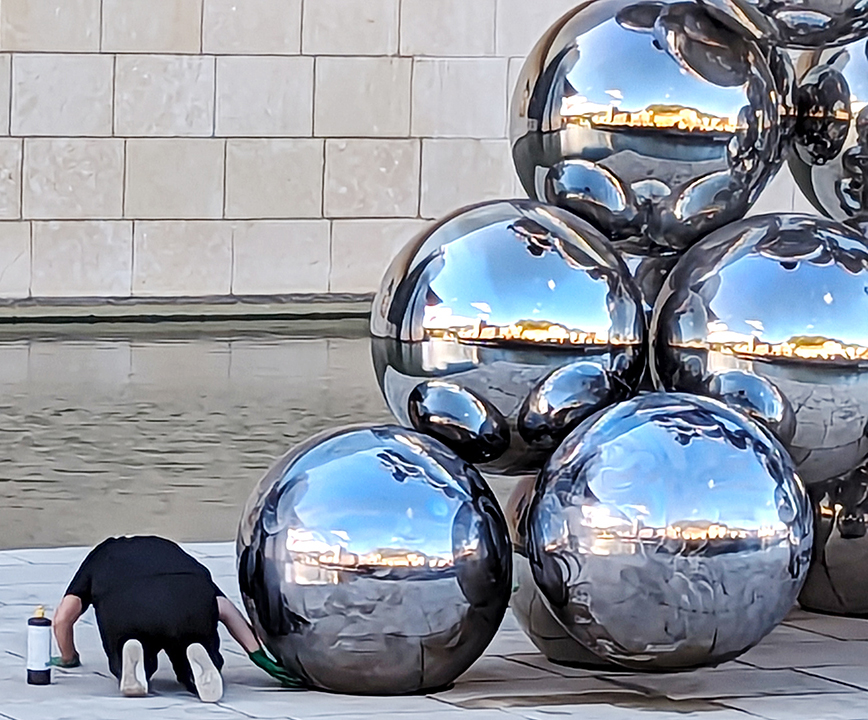
Above: Detail of “Tall Tree and the Big Eye,” Anish Kapoor

Guggenheim Bilbao has turned 25. While 25 years is but a small blip on my age chart, I feared it might prove too long to wait to visit architect Frank Gehry‘s monumental project. People described it as a ship, a giant flower, a fish with shimmering titanium scales. Would it simply seem dated, as much contemporary architecture does after a decade?

My answer is no! It’s a massive, awe-inspiring, sculpture – its scale rendering it overwhelming both inside and out. The deconstructive shapes seem not unlike the Pablo Picasso sculptures of women featured in a major exhibition while we were there. Or Richard Serra’s curvilinear weathered-steel sculpture, “A Matter of Time,” drawing people inside like a giant human mousetrap.

Even spectacular, large-scale artworks encounter difficulties asserting themselves inside the soaring sensuous interior. This is a building one would pay to explore even if there were no art inside.

Maybe that should not be a conflict up for debate. So often architecture is dumbed down by budget, with function superseding inspirational design.

Continue reading “Postcard from Bilbao, Spain: Art scarcely has a chance to shine”

Postcard from Bilbao, Spain: Picasso’s sculptures reflect women he loved

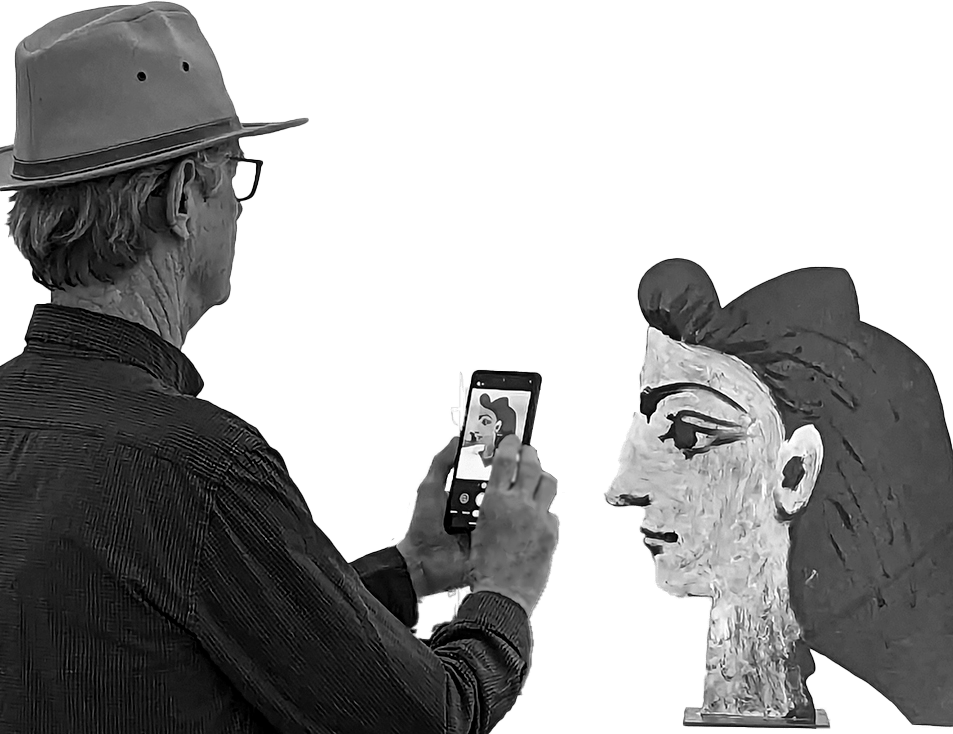
Above: Museum-goer interacting with Pablo Picasso’s “Head of a Woman” made from sheet metal

Art is not the application of a canon of beauty but what the instinct and the brain can conceive beyond any canon. When we love a woman we don’t start measuring her limbs.” 

Pablo Picasso

And Pablo Picasso (1881-1973) loved a number of women, many of whom served as temporary muses appearing in his work until his romantic attentions turned elsewhere.

He once famously said, “For me, there are two kinds of women: goddesses and doormats.” Some of his goddesses soon found themselves in the role of doormats.

Continue reading “Postcard from Bilbao, Spain: Picasso’s sculptures reflect women he loved”