Artemis of Ephesus, Goddess of Fertility, 2nd Century
In the mid-1700s, Charles III of Bourbon (1716-1788), King of Naples, began exploring the towns buried by Vesuvius and combined some of those finds with works of art he moved from palaces in Rome and Parma he inherited from his mother, Elisabeth Farnese (1692-1766), Queen of Spain. His son, Ferdinando IV (1751-1825), moved the treasures into a building that originally was a 16th-century riding school and later the university. Today the structure serves as the National Archaeology Museum or Museo Archeologico Nazionale di Napoli (MANN).
The mosaics from Pompeii were my favorite part of the museum, but, unfortunately the galleries containing the largest mosaics were closed temporarily for renovation. No photos appear here of the outside of MANN because it was completely covered by scaffolding, possibly removed by now.
While ancient Romans favored wearings togas, tunics, stolas and pallas, many of their gods tended to frolic shamelessly in a bacchanalian existence, cavorting and coupling in fashions far from puritanical.
Atlas holding the celestial sphere, 2nd century
Giant head of a horse, Donatello, bronze, 1456-1466
Meridian Line
Dionysus and Eros
Athena Farnese, 430
Atlas holding the oldest known representation of the celestial sphere, 2nd century
Pan and Daphnis
cockfight mosaic
Apollo Citharist
fresco from Pompeii of the god Priapus, who threatens thieves with rape, is found in the Gabinetto Secreto
mosaic from the House of the Faun in Pompeii
Nilotic Landscape, mosaic from the House of the Faun in Pompeii
Artemis of Ephesus, goddess of fertility, 2nd century
cockfight mosaic
Nilotic Landscape, mosaic from the House of the Faun in Pompeii
Sarcophagus with depiction of drunken Hercules joining Dionysus in a procession, 2nd century
Pan
Medusa from Casa dell Vestali in Pompeii
Bacchus
Kneeling Barbarian, 1st century
Eros with Dolphin, 2nd century
detail of Memento Mori, Pompeii, with death atop the butterfly representing the soul balancing on a wheel of fortune
Table support, 2nd century, Villa Madama. “On it is depicted the Homeric myth of Scylla gripping Ulysses’ sailors. The sea-monster that emerges from the woman’s body, her arm thrown haphazardly over her head, encircles in the loops of her fish-like tail the lifeless body of a man. Meanwhile the three dogs’ heads that emerge from her stomach wreak destruction on other shipwrecked sailors who struggle in the waves. A centaur is depicted on the opposite side… a small cupid seated on her back….”
This is evident throughout the impressive museum, but even more so in the Gabinetto Secreto, or Secret Cabinet. In this gallery clearly marked with a warning as to its mature content, one finds the more pornographic-seeming artifacts from Pompeii and erotic objects of the Borgia Collection. The only one of the above images shot in the Secret Cabinet is that of the enormously endowed god Priapus, kind of an X-rated scarecrow threatening evil-doers with rape.
View of Mount Vesuvius from Vomero neighborhood in Naples
Although a gorgeous backdrop on the Sea of Naples, Mount Vesuvius is not sleeping. The only active volcano on the mainland of Europe erupted as recently as 1944, showering ash and rocks upon the Allied forces establishing an airbase nearby.
But the volcano is most known for its spectacular explosion in the year 79, an event reputed to have killed as many as 16,000 citizens of the Roman Empire.
At peak intensity, the eruptive column reached a height of 30km (about 18 miles) or more as the mountain ejected 150,000 tons of material per second…. The air-fall of ash, pumice and occasional rock fragments, accumulating at about 15cm an hour, eventually covered Pompeii to a depth of almost 3m (close to 10 feet)….
The mountain had not finished its work, however, and only now, in the final six hours or so of the eruption, did it became truly lethal….
“A fearful black cloud,” Pliny reports, “was rent by forked and quivering bursts of flame, and parted to reveal great tongues of fire, like flashes of lightning magnified in size. …Soon afterwards the cloud sank to earth and covered the sea ….”
It took perhaps five or six minutes to reach Pompeii from the lip of the crater: a dense, rolling, ground-hugging mass of gas, ash and rock (the pyroclastic flow), preceded a few seconds in front by a scorching blast like that from a flamethrower…. At its hottest, where temperatures reached anything from 400 ° to 800 ° C, the ‘black cloud’ carbonized wooden timbers, doors and shutters, and killed those it struck instantly, as brains boiled and skulls exploded in the flash. Others, where the heat was less, were asphyxiated as they breathed in hot gas and incandescent ash….
In the 24 hours plus that the eruption had lasted, it is estimated that Vesuvius had unleashed thermal energy 100,000 times greater than that of the atomic explosion at Hiroshima.
Strangely, the destruction of Pompeii and other towns around the base of the volcano preserved the ruins for thousands of year. Ancient cities frozen in time.
I was fortunate to have visited Pompeii in college, but much has been uncovered, restored and opened to public since then.
The flaw is that the 163-acre archaeological park is no secret. The number of tourists swarming through the treasured ruins is creeping toward 4-million annually. Photographs such as the lead one for an October story in the New York Times, “Can a Restored Pompeii Be Saved from ‘Clambering’ Tourists?,” scared us away. Paige McClanahan writes that nearly 450,000 people overwhelmed Pompeii in the month of July.
In contrast, only about 300,000 tourists visit Herculaneum a year. So instead, we opted for the much smaller town, a little closer to Naples, not as spectacular but not over-crowded.
The first official explorations at Herculaneum were begun in 1738, yet only a small portion of the once-wealthy port town has been excavated. While the archaeological zone is modest in size compared to Pompeii, the affluence of its residents is evidenced by abundant use of marble throughout.
House of the Alcove
bath house
The College of the Augustales
Salacia mosaic
Neptune and Salacia mosaic
bath house
For centuries, it was believed that almost the entire population of the town had been evacuated by sea before the worst of the eruption. But in the 1980s, digs uncovered skeletal remains of hundreds, huddled together under the arcades of the then-seaside boat houses, buried under ash while waiting ships that failed to save them.
We left them unmolested, as the hoards of tourists in Pompeii left us unmolested to explore Herculaneum at our own pace in peace.
There appears no shortage of ancient Catholic churches in Naples. Yet even by the 16th century, their walls, floors and underground catacombs were oversubscribed by the faithful demanding interment inside. Something needed to give.
Clever undertakers found a solution. They began digging up older remains, the ones of souls long forgotten, to free up space for the newcomers. The ancient bones were carted away discreetly to shallow graves in an enormous system of caves – natural caverns extended by ancient Greek and Roman tunnels and quarries for building materials for the city.
Then came the plague of 1656, decimating the population. The spiraling number of corpses led to their mass disposal atop the existing shallow graves in the caves.
The anonymous pile might have been forgotten were it not for an end-of-the-century flood washing all the bones out and depositing them helter-skelter on the streets below. The bones were returned to the cave, which then was deemed a more official location for disposing of deceased paupers.
An 1837 cholera epidemic swelled the number of residents unceremoniously dumped together in disorderly fashion. The charnel house became known as the Cemetery of the Fountains – Cimitero delle Fontanelle.
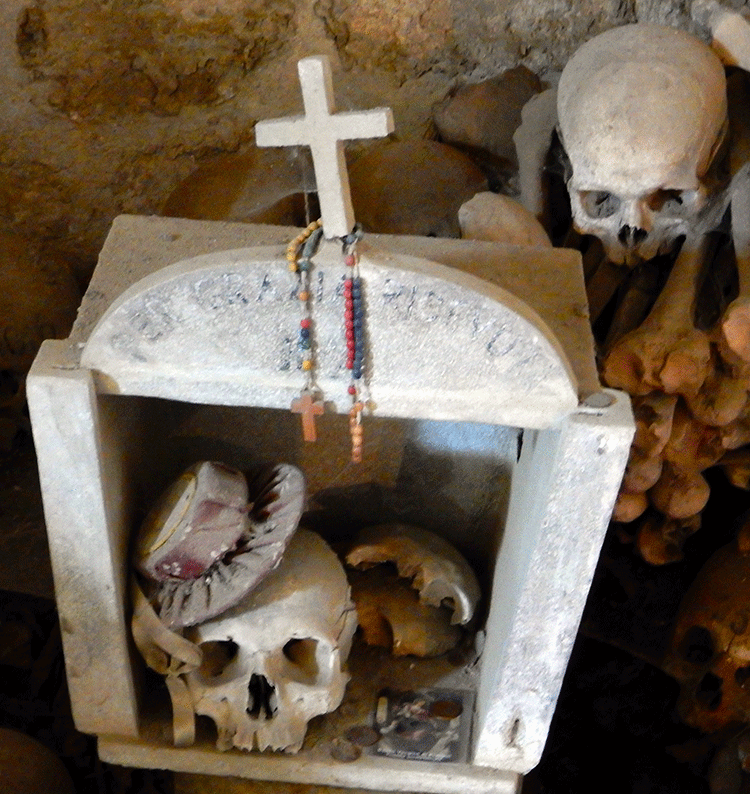
Caring souls tend to some of the bones in the Cimitero delle Fontanelle in Naples, Italy.
In 1872, a priest took pity upon all of the remains of the departed, many tossed inside without receiving their last rites. He had them sorted and arranged in a more orderly fashion, which attracted renewed interest among compassionate Catholics.
A cult arose, as people began to lovingly adopt skulls – capuchelle – of the abandoned souls – pezzentelle – in return for protection. They assigned the unknown names that appeared to them in dreams. They cleaned them, brought them small tokens of their affection, and kept them company.
Then, in 1969, the Archbishop of Naples decreed the practice fetishism and closed the entire ossuary to visitors. The deprivation of visitation rights to ancient adopted kin proved unpopular.
The cemetery was restored in early 2000 but was only unlocked for visitation a couple of times a year. Following protests including an overnight occupation, the cavernous space was reopened on a daily basis in 2010.
Only spotted one caregiver inside. She dashed down the entire length, her boyfriend lagging a ways behind. She stopped mid-right in the last chapel. Obviously, she only had eyes for but one skull amongst the abundance. She stooped to present something to her capuchelle, murmured a word or two, and then dashed back out as quickly as she entered. Her fidanzato rushed to keep up.
As you wander in the dimly lit chambers with bare rock walls and soaring ceilings, the space feels as hallowed as that of any ornately gilded church nave. The named capuchelle do indeed began to assume personalities of a sort, indicating that no two skulls are alike. They all are individuals; each with a story.
As in Mexican cemeteries on the first days of November, by the time you leave, keeping company with the dead no longer appears as bizarre. Eerie, yet somehow soothing.
And there are 30,000, 40,000, maybe even 50,000 more skulls stacked up, waiting for adoption.
Update on October 28, 2020: AtlasObscura has released a video touring Fontanelle.




 Postcards from Barton Springs