Postcard from Lecce, Italy: Lavish Baroque details grace Basilica di Santa Croce

basilica di santa croce

Lecce’s natural supply of a soft stone must have been a Baroque architect’s dream come true. Sculptors could carve leaves, flowers, winged creatures and lacey curvaceous Solomonic columns to their hearts content. Baroque architecture dominated Lecce in the 17th and 18th centuries, with the Basilica di Santa Croce perhaps standing as the queen of Lecce’s distinctive elaborate style inside and out.

Santa Croce was built between 1549 and 1646 by the Order of Celestines, a branch of Benedictines founded by Pope Celestin V (1215-1296). The pope was a reluctant one, serving for less than six months before resigning. His edict confirming a pope’s right to abdicate legitimized the retreat of Pope Benedict XVI more than eight centuries later.

Some of the building materials for Santa Croce were salvaged from the temple and homes of Jewish families in Lecce who were expelled by order of the Kingdom of Naples in 1510. Much of the decoration viewed above is the work of Giuseppe Zimbalo (1620-1710). While the atlantes, men, and creatures supporting the balustrade appear whimsical, they are a symbolic celebration of the Holy League’s naval victory over the Ottoman Empire in the 1571 Battle of Lepanto. More than 400 ships participated in the battle, and the death toll at the end was a loss of approximately 7,500 Christians and 30,000 Turks. A devastating defeat for the Ottoman Empire.

The hunched atlantes represent some of the 10,000 Turks captured; the animals guarding them represent the allies who took part in the victorious coalition organized by Pope Pius V (1504-1572) with major financial and naval support from Philip II of Spain (1527-1598). The cute-looking griffin below represents the Kingdom of Genoa; the dragon the Boncompagni family.


Postcard from Ostuni, Italy: A white-washed citadel a few olive groves away from the Adriatic Sea

bicycle over ostuni

Experienced travelers as we are, hopping a train for the short ride to Ostuni from Lecce was easy. The flaw in our plan was what to do on arrival. Oh, this is why some people rent cars.

A travel blogger wrote the walk from the station up into town was only a mile or two if cab or bus was unavailable. Neither materialized after what seemed a long wait, so we took off on foot. What the blogger had failed to mention was that the walk was on a stretch of a no-shouldered highway. A sympathetic young woman with a baby on board turned off into a driveway almost immediately to come to the rescue of the two wayward seniors. We gladly hopped in the car. Getting robbed or kidnapped appeared much less likely than getting hit by an automobile. She spoke no English, but went well out of her way to drop us in the center of town.

And everyone in this white-washed town in the heel of Italy was as helpful and friendly, approaching us to offer advice on finding our way around. We were there post-prime-tourist season, so had to navigate our way around the tangle of narrow streets to several restaurants before finding one open for lunch.

But that is both the beauty and fun of Ostuni. Street names change almost every block, and a “street” is often what appears a private stairway. When it came time to try to find the bus back, a trio of men directed us down several flights of unpromising-looking stairs to exactly the right spot where a piccolo autobus transported us and a trio of teens to the station.

The statue atop the column in the middle of a plaza is Ostuni’s patron saint, Saint Orontius of Lecce. The first Bishop of Lecce, he was executed for his Christian faith by axe by a representative of Roman Emperor Nero. But of particular relevance today are the miracles he was credited with centuries later. Residents of Lecce claimed he ended an outbreak of the plague there in 1656, and in Turi it is said he brought an outbreak of cholera to an end in 1851. Better known, Saint Sebastian must be swamped with requests for protection from Covid-19, so maybe light a candle to Saint Orontius as well.

As for the bicycle perched above a rooftop? Pure whimsy.

Postcard from Lecce, Italy: The road time flies upon offers no turning back

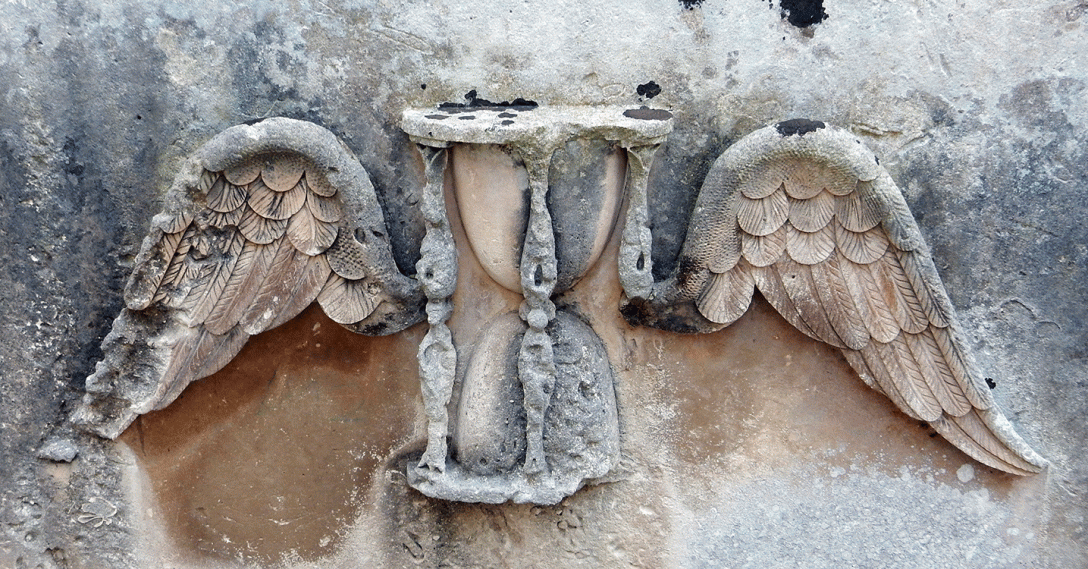
“Via Irremeabile d’ell Eternita” labels a columned entrance to the Cimitero di Lecce. Loosely translated by the blogger who knows no Italian beyond words frequently encountered on menus, it means the road to eternity has no return.

Although we walked down that road, we fortunately were able to turn around. Noted for my taphophilia, my love of cemeteries is restricted to wandering in and out of them, not an eagerness to take up any permanent residence.

While the Cimitero di Lecce is not as impressive as the monumental ones of Bologna, Turin and Genoa, symbols most often associated with freemasonry make exploring it interesting.

Freemasonry mystifies me. As do its symbols, many drawn from ancient Egyptian art.

Interpreting with the same level of expertise as applied to the Italian above, the skulls and crossbones are not meant to intimidate but are a symbol of the new life to come. The eternal flame symbolizes enlightenment. There is the unblinking, all-seeing eye. A winged disk might represent a soul that has left its body on its way up to heaven; an acacia branch immortality. The owl, perhaps originating from the one always perched on the shoulder of the Goddess of Wisdom Minerva, represents knowledge and ability to see in the darkest night.

For all of these, there are antithetical dark meanings assigned to the symbols by those who regard freemasonry as akin to worship of the devil.

Historically, masonic membership was prevalent. Among famous masons were George Washington, Benjamin Franklin, Sam Houston, David Crockett, Theodore Roosevelt, Wolfgang Amadeus Mozart, Henry Ford, Winston Churchill and Antonio Lopez de Santa Anna. Its symbols are engraved in the design of our own dollar bill. Even the Mister’s Boerne-raised grandfather was a mason with a mantlepiece full of the wise owls he favored.

When the lights are permanently turned out for me and I am left standing in the middle of the road with no turning back, I would gladly welcome the appearance of a little owl to guide me along the dark path that lies ahead.