Postcard from Bilbao, Spain: Art scarcely has a chance to shine

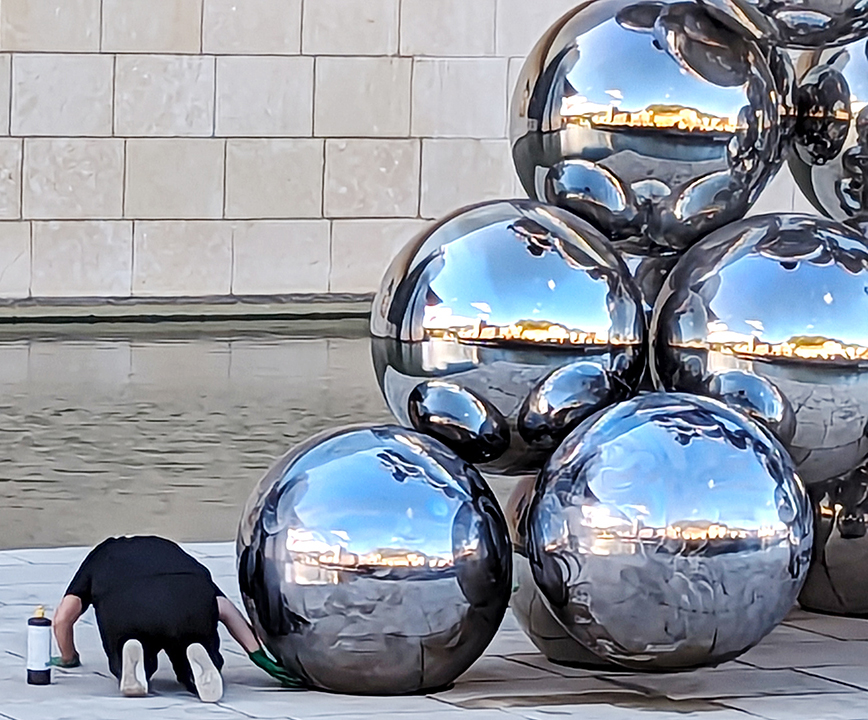
Above: Detail of “Tall Tree and the Big Eye,” Anish Kapoor

Guggenheim Bilbao has turned 25. While 25 years is but a small blip on my age chart, I feared it might prove too long to wait to visit architect Frank Gehry‘s monumental project. People described it as a ship, a giant flower, a fish with shimmering titanium scales. Would it simply seem dated, as much contemporary architecture does after a decade?

My answer is no! It’s a massive, awe-inspiring, sculpture – its scale rendering it overwhelming both inside and out. The deconstructive shapes seem not unlike the Pablo Picasso sculptures of women featured in a major exhibition while we were there. Or Richard Serra’s curvilinear weathered-steel sculpture, “A Matter of Time,” drawing people inside like a giant human mousetrap.

Even spectacular, large-scale artworks encounter difficulties asserting themselves inside the soaring sensuous interior. This is a building one would pay to explore even if there were no art inside.

Maybe that should not be a conflict up for debate. So often architecture is dumbed down by budget, with function superseding inspirational design.

Continue reading “Postcard from Bilbao, Spain: Art scarcely has a chance to shine”

Postcards from Naples, Italy: Palazzo adapted to showcase contemporary art

Mimmo Paladino, 2006 rooftop installation at MADRE

The 19th-century Palazzo Donnaregina, referred to as “an example of historical stratification,” was purchased in 2005 by the Campania Regional Government for rehabilitation as a contemporary art museum. Much of the work was completed under the guidance of Alvaro Siza Veira, a Portuguese architect. By 2006, two floors of MADRE – Museo d’Arte Contemporanea Donnaregina – opened to the public. Daniel Buren’s brightly colored and illuminated installation in the entryway of MADRE sets the tone for the contemporary contents.

When we were there this past fall, there was an impressive exhibition of work, “Whisper Only To You,” by a South Korean artist, Yeesookyung. During her residency in Naples, she incorporated pieces of Capodimonte porcelain into the design of her large shapely vessels.

The master potter was trying to create the perfect piece each time, and he would discard even the ones with the slightest flaw. So I chose to create new forms from them, because perhaps, I don’t believe completely in that kind of perfection. To me, a piece of broken ceramic finds another piece, and they come to rely on one another. The cracks between them symbolise the wound.

Yeesookyung, interviewed in The Business Times, 2013