Postcard from Mexico City: Visiting the dead in Panteon de Dolores

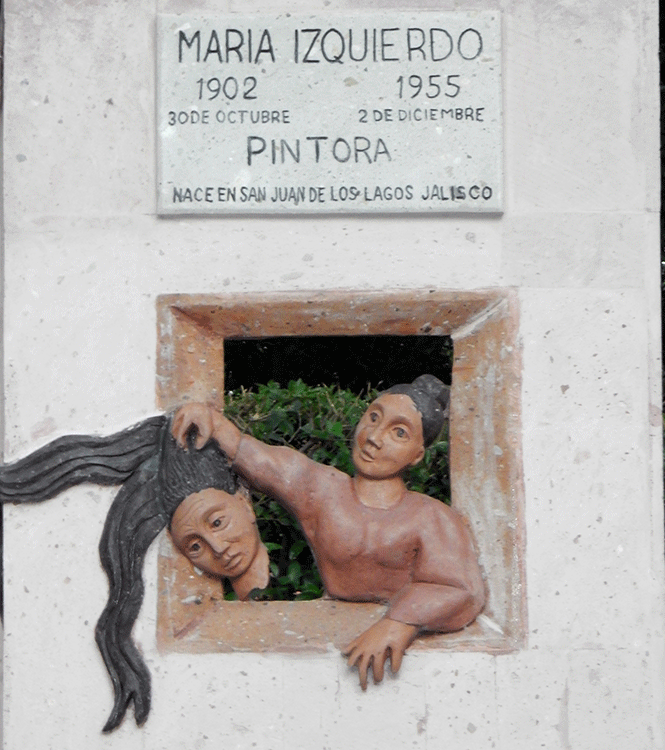
In 1945, at the height of her career, the government commissioned (Maria) Izquierdo to do a mural for a building in Mexico City. (Diego) Rivera and (David Alfaro) Siqueiros, two of Mexico’s great muralist painters, blocked her from getting the job. When she dared to denounce them in public, she received little help and a lot of strong criticism….

Izquierdo began to experience nightmares that left her sleepless. One day, she arose and drew what she remembered… a clear vision of herself, in a window of metaphysical dimension, holding her own decapitated head as her body, still walking, becomes lost in the distance of steps leading to a void. That year, 1947, she painted “Sueños y Pensamento,” a premonitory painting that heralded great pain for her future. It was the last of her great works.

“Maria Izquierdo – Monumento Artistico de la Nacion,” Rita Pomade, Mexconnect, 2007

We journeyed to Panteon de Dolores, home to a population of a million old souls qualifying it as Mexico’s largest cemetery, on All Saints Day. We encountered less than a handful of families celebrating Day of the Dead traditions graveside with their ancestors. Perhaps more ventured out on the following day, All Souls Day?

While many graves were colored with an abundance of marigolds, the majority appeared untended by those left behind on earth. Perhaps the more antiquated term of Hallowmas is a more fitting name to apply to the day in this neighborhood occupying close to 600 acres between two main sections of the sprawling Chapultepec Park. Numerous graves were adorned with a jumbled combination of ancient Day of the Dead traditions with more recently imported Halloween decor – spiders, plastic pumpkins, orange and black plastic festoons and fake spider webs.

There was an ongoing mixture of entertainment, ranging from an annoying clownish play to a talented female vocalist while we were there, staged in the plaza of the Rotunda de las Personas Illustres. At dusk, children appeared in Halloween or Catrina costumes carrying plastic pumpkin baskets for trick-or-treating.

While the dearth of ancient practices was disappointing, change happens. And I need no flowers or incense to encourage me to wander through a cemetery. So many stories shout at you from all directions.

Despite the rejection of her mural, Maria Izquierdo gained admittance to the portion of the cemetery dedicated to the illustrious of Mexico. Perhaps her fellow muralists, Rivera and Siqueiros, forgave her for her earlier criticisms of muralists including political messages in their works before they joined her there. The excerpt above is a link worth tapping to begin to learn about her life. I found myself wandering on the internet to discover more about the fascinating artist who was the first Mexican woman to mount a major solo exhibition in the United States.

But there are others. Composer Agustin Lara, who left the women swooning with his “Senora Tentacion” in 1956.

Rosario Castellanos, who wrote because: “Writing has been a way of explaining to myself the things I do not understand.” And redefined laughter: “We have to laugh. Because laughter, we already know, is the first evidence of freedom.”

Actress Virginia Fabregas.


In addition to those celebrated within the inner circle of the cemetery, there are close to a million others with stories worth telling. Hopefully, the trials, tribulations and joys they experienced are preserved within their families’ oral histories, repeated over and over at holiday celebrations lest the tales be lost.

And then, there are the eerily spooky graves. The angel guarding the rusty doors of a crypt, unhinged as though indicating the residents fled the confined space long ago. The coffin rusting above ground. Occupied, empty or home to a vampire planning to emerge with the rise of the next full moon?

A belated happy Hallowmas from Mexico City.

Postcard from Budapest, Hungary: Nightmares from the past haunt the city

Unlike the haunted houses that spring up around Halloween, the Terror House of Budapest is open year-round. And, instead of play actors pouncing out of shadows to try to make you scream, this house is filled with the ghosts of real people staring back at you from black and white photos and old newsreels.

Andrassy Boulevard is one of the most impressive in the city, and the Neo-Renaissance building at Number 60 added handsomely to the streetscape when completed in 1880. But a new tenant occupying the building beginning in 1937 proved a case of “there goes the neighborhood.” A branch of the Hungarian National Socialist movement made it the group’s headquarters, the House of Loyalty for the Arrow Cross Party.

With Hitler’s rise, the Hungarian government adopted the yellow star to mark its Jewish citizens. Many were rounded up for deportation to death camps in Germany; others were herded into crowded ghettos in the neighborhood of the Dohany Street Synagogue. In the basement of the House of Loyalty, hundreds were tortured and killed. As a shortcut, instead of shipping Jews out to concentration camps, citizens were lined up on the banks of the Danube, shot and plunged into the icy water.

When the Russian forces finally defeated the Germans occupying Budapest near the end of the war, many greeted the Soviets as liberators. The honeymoon was brief. The Soviets settled in comfortably at the Andrassy address, its headquarters for the Department for Political Police. The basement continued to be a convenient location for torture and hangings.

While hundreds of thousands of Hungarians managed to flee the country, thousands were imprisoned and transported to labor camps in the Soviet Union. A shadow army of informers and spies infiltrated workplaces, universities and churches. One building was no longer enough to accommodate the organization’s needs; the whole block was commandeered for their activities, with the basements connected to form a warren of prison cells. From the end of the war until 1953, more than 35,000 Hungarians were confined to jail. Between 1945 and 1956, close to 400 were executed for political reasons; 152 were executed in the year after the failed 1956 revolt.

The intimate spaces of The Terror House today echo with videotaped testimonies of survivors, with subtitles in English. The museum was opened in 2002 as a memorial to the victims and to preserve these two painful periods of Hungarian history.

The number of millennials stopping to hear the witnesses to the horrors was impressive, hopefully ensuring a new generation will not let history repeat itself under their watch.

I, however, overdosed from the sad stories quickly and did not linger to listen. Holocaust denial is not in my DNA. Like many adolescents, reading Anne Frank had a lasting impact. In high school German class, we watched the black and white flickering reels showing the previously unimaginable scenes of piles of bodies and emaciated survivors found in the concentration camps at the end of World War II. In college, Hollins Abroad summer tour stopped for a visit to Dachau where the ovens stood as evidence to the fate of many. Passing through the highly armed checkpoint between East and West Berlin petrified me as guards slid wheeled mirrors under the bus to make sure no hitchhikers were hiding in a desperate bid for freedom.

Having already visited the Synagogue, the Terror House marked the end of any desire to revisit this period of history. I did not even want to view the shoes along the banks of the Danube representing those who were shot on its banks, but we encountered shoes elsewhere in our wanderings. Almost every museum has a section dealing with those turbulent times and the propaganda or opposition posters relating to them.

And then we made one more stop. One too many for me. The Holocaust Memorial Center. The contemporary building adjacent to a synagogue is dedicated to the persecution of both the Jewish and Roma people of Hungary. The dark interior rooms are filled with more photos and videos of victims. I just wanted out, so much so that I did not even pull out the camera.

The visit plunged me into a temporary depression. I related to some of the older people we encountered in our wanderings. Glumly hunched over. No sparkle in their eyes. Downturned mouths reticent to break into smiles. Suffering from hangovers brought on by the horrors of past decades.

Even though this itinerary was stretched over a month, it was much too intensive. I do not recommend you duplicating the entire agenda. I suggest visiting one or two of the memorials/museums for a smaller dose of real life horror stories, a reminder of what can happen when madmen are in charge.

Unless you are a Holocaust denier. Then the full dose is required as shock therapy.

Reviving Dia de los Muertos

When I first moved to San Antonio, the places to see flowers and foods placed on graves to encourage visits from their inhabitants were the old San Fernando Cemeteries. Most of the wrinkled pilgrims picnicking with their deceased loved ones on All Saints and All Souls Days, November 1 and 2, appeared poised to repose alongside them. The remnants of the Dia de los Muertos traditions enduring from when San Antonio had been part of Mexico were dying with them.

Bedoy’s Bakery, founded in 1961, credits Father Virgil Elizondo with encouraging the bakers to dust off traditional old recipes for dead bread, pan de muerto. I used to buy the breads around Halloween, but felt guilty when we selfishly ate them without offering to share them with the dead.

In the past decade or two, artists in San Antonio began adding contemporary twists to ancient Day of the Dead traditions, and now the city sponsors a full-blown fiesta for Dia de los Muertos in La Villita. Altars, processions and even a concert by Girl in a Coma were part of this year’s event, held a bit early because the city’s Day of the Dead calendar is getting more crowded.

While a far cry from the celebrations we witnessed outside of and in San Cristobal de las Casas last November, San Antonio’s spirited version represents traditions worth reviving and refreshing for new generations.

Although I cannot comprehend why the marketing department at Coca-Cola is not all over sponsorship opportunities for this event. In Mexico, Coca-Cola dominates the graveyard market in San Juan Chamula, Chiapas:

One would think a people who have rejected so many standards held by outsiders would not consider taking even one sip of a Coca-Cola. But expelling evil spirits from the body is key. Spitting helps, but burping is best. And what is better at inducing burping than a few shots of rapidly consumed Coke….

But, what marketing genius convinced the Chamulans a half-century ago to incorporate Coke into not only their Sunday church-going regimen, but everyday life? I mean, Chamulans need to continually maintain their guard against those invasive evil spirits, burping them out on a regular basis.

And whoever the lucky holder of the local bottling franchise is really struck a home run with this. The market is larger than just the living. On Dia de los Muertos, even the dead are served Cokes to quench their parched throats from so much time spent underground and to burp away any evil spirits hanging around the cemetery.

Just think how large Coca-Cola’s market share would soar if this practice spread to the dead everywhere.

Here are some posts from last year in Chiapas, Mexico: