Postcard from Oviedo, Spain: Sacred relics attract peregrinos and thieves

Above: Central detail of the main Gothic altarpiece, dating from the early 1500s, in Santa Iglesia Catedral Basilica Metropolitana de Oviedo

He who goes to Santiago and not to the Savior visits the servant and forgets the Lord.”

Back in the year 40, the apostle James was preaching in Zaragoza when the Virgin Mary miraculously floated down on a cloud to assist him with his efforts to convert pagans living under Roman rule to Christianity. Soon after establishing a chapel in her honor, James traveled all the way back to Jerusalem. His preaching incurred the ire of the King of Judea, Herod Agrippa (11 BC-44 AD), who had him beheaded in the year 44. Avenged as, according to Acts Chapter 12, Verse 23, King Herod Agrippa met his maker within the same year:

…an angel of the Lord struck him, because he did not give glory to God. And he was eaten by worms and died.”

The head of Santiago, as James is known in Spain, is said to be entombed below the altar of the Armenian Apostolic Cathedral of Saint James, the church built on the site where he was martyred in Jerusalem. But what became of the rest of his body? As Santiago is the country’s patron saint, let’s go with the miraculous version. A band of angels arrived on a cloud to retrieve it, placed it in a simple boat and guided it to shore in northern Spain.

Continue reading “Postcard from Oviedo, Spain: Sacred relics attract peregrinos and thieves”
Postcard from Valladolid, Spain: Iglesias and a maligned queen

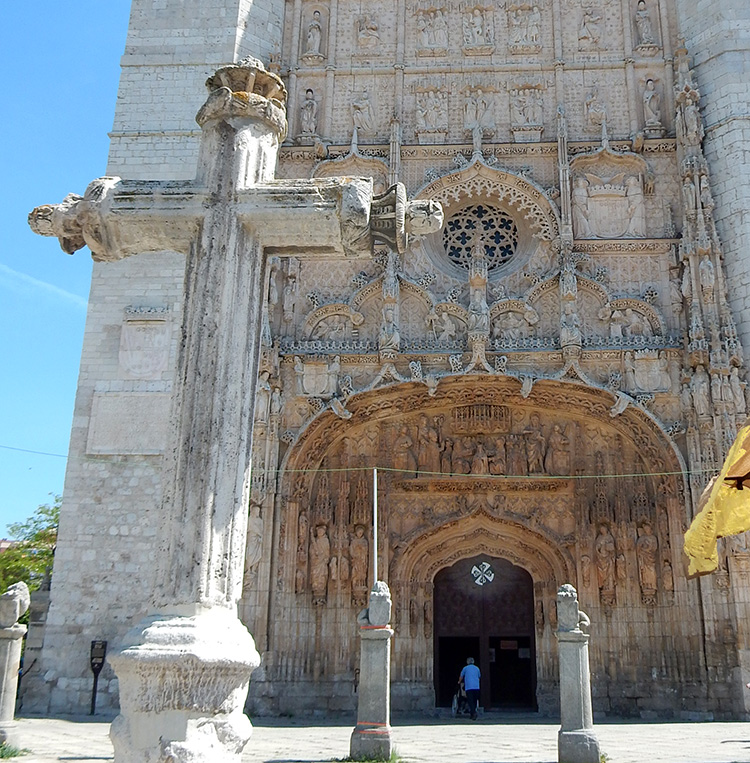
Above, Iglesia de San Pablo

Valladolid was flourishing in the 15th century when Isabella I, Queen of Castile, married King Ferdinand of Aragon in the city – an elopement with private ceremonies, as they were second cousins. With the city a favored spot for the Catholic royal family members to hold court, Pope Clement VIII elevated it to a bishopric, the center of an archdiocese.

Bolstered by this recognition, city fathers launched efforts to build a suitable cathedral, the largest in Europe. Architect Juan de Herrera (1530-1597) was commissioned for the design of Nuestra Senora de la Asuncion. Despite Herrera’s death, completion appeared possible with the official establishment of Valladolid as the capital of Spain by King Philip III (1578-1621) in 1601.

The rosy future dissipated as a royal advisor standing to personally benefit through his real estate holdings persuaded Philip of the need to move the capital back to Madrid in 1606. The cathedral budget was slashed – about 60 percent.

Continue reading “Postcard from Valladolid, Spain: Iglesias and a maligned queen”

Postcard from Burgos, Spain: A ‘work of angels’

Above: Santiago, Saint James, stands guard under the eight-pointed star of the Spanish Renaissance lantern dome, cimborrio, of the Cathedral of Saint Mary of Burgos.

It seems more like the work of angels than of men.”

King Philip II of Spain (1527-1598)

King Philip II’s glowing description of the gleaming white dome that crowns the intersection of the horizontal arms of a cross with the main nave in the Cathedral of Saint Mary of Burgos seems appropriate. Designed by Juan de Vallejo and Francisco de Colonia, the octagonal dome was completed in 1568 to replace an earlier lantern, less than 50 years old, that collapsed rather spectacularly in 1539. The Latin inscription above Santiago at the base of the dome translates to: “In the midst of your temple I will praise you and give glory to your name because you do wonders.”

As the exterior of the Cathedral makes obvious, the interior’s tall golden altarpieces, soaring domes, choir, chapels and cloisters are overwhelming in scale.

Continue reading “Postcard from Burgos, Spain: A ‘work of angels’”