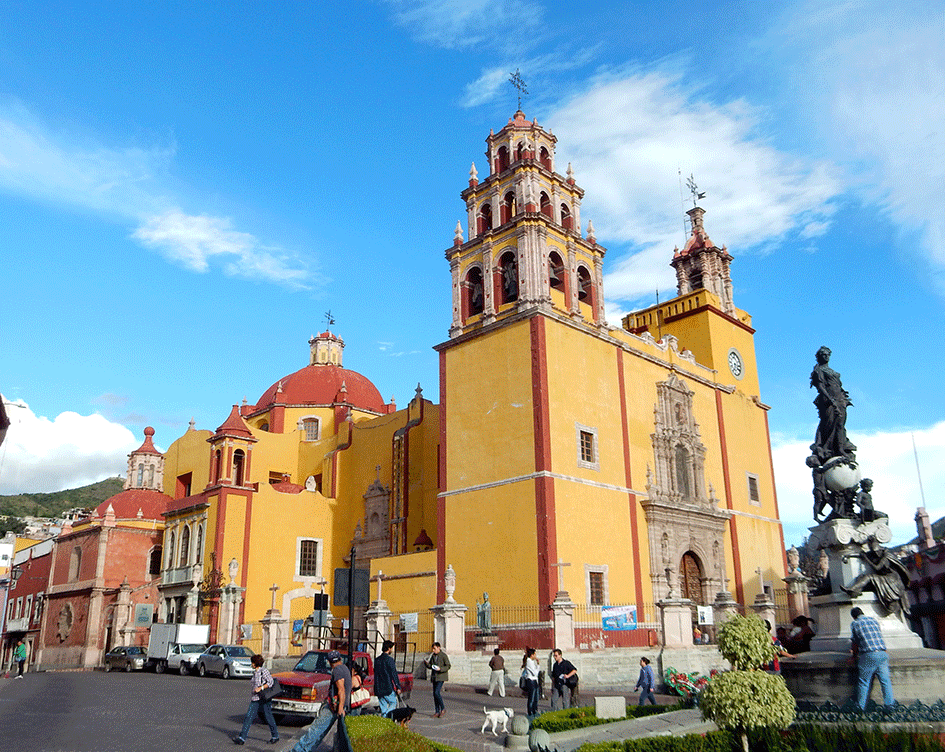
Postcard from Guanajuato, Mexico: Basilica of the City’s Patron Saint

No matter from what direction one approaches, the rich hues of the Basilica of Our Lady of Guanajuato make it stand out against the city’s blue skies. Built between 1671 and 1696, the church houses an Andulusian statue of the Virgin and Child encased in glass on its altar.

The statue was a gift from King Felipe II (1527-1598) of Spain presented to the city in 1557 in recognition of all the riches sent from the mines to enrich the crown. The Virgin represents the city’s patron saint and is believed to be the oldest image of the Virgin sent to the Americas. Along the way, her scepter was replaced with a rose, particularly appropriate as the basilica fronts the Plaza de la Paz.


Tucked around the images and statues of the saints inside are reminders of the prayers of those who visit. A silver arm or leg left in hope of a mended limb. A heart milagro for assistance for an organ beginning to falter with age or a young heart broken. Photos of babies in need of cures. Ribbons of wishes for the safe return of family members who have crossed the border to seek work in el norte.

Postcard from Toledo, Spain: A Cathedral fit for a royal capital

When Alfonso VI (1040-1109) of Castile captured Toledo from the Moors in 1085, he made the hilltop city his capital. Although royals moved their seats around Spain and Portugal, the city benefitted from the rule of numerous kings.

Construction of the city’s Gothic Cathedral, dedicated to the Assumption of Mary, was begun in 1227. The main six-story central carved altar, bookended by royal tombs, was added around the year 1500.

Felipe II (1527-1598) stroke a blow signaling the city’s decline in importance when he moved the capital permanently to Madrid in 1561.

Although Toledo’s population is around 80,000, every day thousands of visitors jostle through the crowds filling the narrow streets in the historic part of the city to tour the Cathedral. Fortunately, there is ample room inside to accommodate a crowd. The main nave alone is both longer and wider than an NFL football field.

When we were in the Cathedral, most of the area near the main altar was roped off for temporary seating for an evening organ concert. Disappointing yes, but, holy Toledo, the pipes resounding through that enormous space must have been magnificent.

Postcard from Segovia, Spain: Castilian castle commands bluff despite those painful pointy-toed shoes

There was a lot of fighting going on in what we now call Spain, Portugal and the rest of Europe in the old days. Boundaries constantly were changing; kingdoms were proclaimed and reclaimed over and over.

My feet were never meant for pointy-toed shoes, but what were those medieval designers thinking? I mean, Jimmy Choo’s highest spiked heels are so much kinder to women’s feet than the armor those soldiers were forced to endure.

Realize one would want every body part protected during battle, but how could one move without assistance in such absurdly curved and pointed shoes? And, with every finger armored, how could one wield a sword? I guess the more the protection inhibited movement, the more protection one would need?

Fortunately for the rulers ensconced at Alcazar, geography played a role in preventing mobile-impaired soldiers from having to maneuver more than possible.

The castle seems so familiar, so, well, Disney-like. But Alcazar definitely came first, its turrets and spires serving as inspiration for Walt centuries later.

Ruins of an ancient Roman fortress became the base for a Moorish post, which in turn was the foundation for a monumental stone compound, the primary home for Spanish royalty and its parliament.

King Alfonso VIII (1155–1214) began the first permanent construction of Alcazar, with Juan II (1405-1454) adding the major tower during his reign. Felipe II (1527-1598) updated things to keep up with the latest European architectural whims of royals by adding the slate-covered pointy spires.

Things went south from that point. King Felipe II moved the seat of government to Madrid, and the former home of royalty suffered the indignity of serving as a prison for two centuries.

King Carlos III (1716-1788) repurposed it into the Royal Artillery School. But that meant storage of highly explosive materials within the fortress walls, which added to the spectacular fireworks display when a fire broke out in 1862.

Royalty briefly was out in Spain, but, when reestablished (a major oversimplification of history), Alfonso XII (1857-1885) began restoration of this monument to Spain’s past. Although the young monarch died of complications from tuberculosis and dysentery at age 28, Alcazar still reigns over Segovia and the surrounding countryside.