Wrote so many things about Guanajuato two years ago that few words are necessary. Here is a batch of photos mined there during our meanderings there this past fall.
jarra de claret
Basilica of Our Lady of Guanajuato
Museo Palacio de los Poderes
El Pipila
Teatro Juarez
Father Hidalgo prepping for Diez y Seis
street corn
Iglesia de San Diego
Templo de la Compania de Jesus
Basilica of Our Lady of Guanajuato
Teatro Juarez
Templo de San Francisco
Capilla Santa Casa de Loreto
Casa del Conde Rul
El Clave Azul Mezcal Bar
Diez y Seis de Septiembre lights
Templo de la Compania de Jesus
Universidad de Guanajuato
castillo erected for fireworks to celebrate the Festival of the Virgin of Loreto
My favorite photo here is the rooftop overflow “parking lot” for El Nino Medico. The toy cars left with prayers for El Nino in his glass quarters in Templo de la Compania de Jesus always mount up, sometimes to the point of almost burying him. There were so many stuffed inside this trip that the faithful began parking them on top of his quarters. I am including a photo after the illegally parked cars have been towed away once again by church guardians.
rooftop overflow parking lot for cars and trucks left for El Nino Medico
It’s hard to resist focusing on Guanajuato’s landmark people perched up high. Muses grace the roofline of Teatro Juarez. Father Hidalgo, famed for his grito igniting the revolt against Spain, stands near the city’s presa, or dam.
The giant statue of El Pipila lords over the city. As pipila means a female turkey, the nickname given to Juan Jose de los Reyes Martínez Amaro (1782–1863) probably was not meant as flattery. But El Pipila earned respect as a hero of the Mexican Revolution when he strapped a large stone on his back for protection against weapons above to storm the Spaniards holed up in Alhondiga de Granaditas. He slathered the granary’s large wooden door with tar and set it ablaze, allowing the citizens of Guanajuato to overtake the forces inside.
The woman representing peace who presides over Plaza de la Paz, the city’s main plaza, was commissioned by President Porfirio Diaz in 1903. Her peaceful reign soon was interrupted. President Diaz did not care for his opponent in the 1910 election so he locked him up in jail. When Diaz declared himself victorious, the citizenry sensed the election results were rigged. Diaz was forced from power, and years of civil war marked by frequent violent changes in presidents followed.
Wish the threat of locking opponents up and talking about rigged elections did not sound familiar.
A long list is found on one of the walls of La Compania de Jesus Church in Oaxaca. A list of those waiting. Those whose lives in Mexico were so full of sacrifice Rome surely will notice and promote them on the road to sainthood.
I’m pulling for the child martyrs of Tlaxcala, the land of corn tortillas. Poor Christobalito, Antonio and Juan were, after all, children. Antonio and Juan were clubbed to death, but Christobalito’s own father, a confirmed pagan, condemned him to be beaten with clubs and then set ablaze for his faith. The trio was beatified by Pope John Paul II in 1990, but they hardly seem on the fast-track. They have been waiting in line a really, really, really long time. Ever since the late 1520s.
But in Oaxaca, a pair of Zapotecs stand out, although newcomers to the waiting list by comparison to the ninos above.
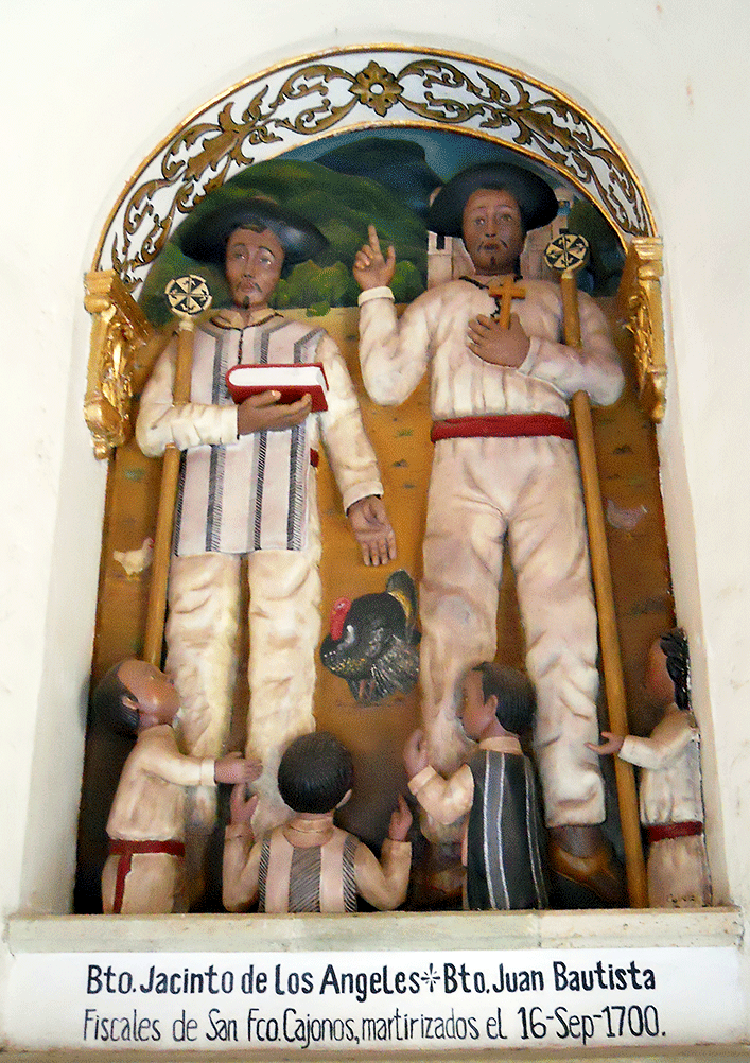
Back in 1700, Dominican priests in Oaxaca would commission converts to serve as “attorneys general,” assigned to police the purity and practices of those living in rural areas. Jacinto de los Angeles and Juan Bautista of San Francisco Cajonos, “the town in the clouds,” were so honored. Overhearing those worshipping the harvest god, Huitzilopochtli, talking about a clandestine evening gathering in his honor, the attorneys reported back to the Dominican friars. Intervention was planned, and Jacinto and Juan led a group to break up the idolatrous meet, seizing the men’s musical instruments.
Unfortunately for Jacinto and Juan, their Zapotec brethren did not take kindly to what they viewed as tattle-tale turncoat interference. A mob seized the two from the sheltering confines of the convent. The pair refused to recant their faith, even under torture.
They survived being thrown off Tanga Hill in the village of San Pedro, but clubs still were viewed as a popular way to deal with Christians anyway. The mob clubbed them and cut them with knives before cutting open their chests and feeding their hearts to the dogs. (I don’t make these things up. Read the Vatican’s version here.)
Whatever parts were left were gathered later by the faithful, who put them in the church of Villa Alta until 1889. The remains were moved to a chapel in the Cathedral of Oaxaca, a chapel almost always locked for their protection.
A bad thing happened to what should be set aside as their day. Jacinto and Juan attained martyrdom on September 16, but, unfortunately, 110 years later Father Hidalgo absconded with their day on the calendar. His cry for independence from Spain changed what would be their feast day to Mexican Independence Day, a celebration far overshadowing their sacrifices.
But an exhausted-looking but determined Pope John Paul II rescued them from obscurity, beatifying them in 2002 as examples “of how, without regarding one’s ancestral customs as myths, one can reach God without renouncing one’s own culture but letting oneself be enlightened by the light of Christ, which renews the religious spirit of the best popular traditions.”
While their hearts probably wouldn’t be fed to the dogs, one wonders what kind of reception church spies would receive in someplace like San Juan Chamula today. “Hey, they are sacrificing chickens in your church.” “Hey, do you know that elder over there has four wives?” They would be so expelled from town.
But, the good part of this story is how Jacinto and Juan are revered in their hometown. Their stories didn’t rise up on the Vatican radar without help. A trio of maize and chickpea farmers championed their cause at the grassroots level. According to a story by Stephen Henderson in the Los Angeles Times, they researched the story at City Hall and then chronicled the testimonies of more than 30 locals who claimed prayers to Jacinto and Juan were answered with miracles. This represents 1/10 of the entire town.
The task took decades of dedication, but it paid off. A group of Cajonos proudly accompanied the glass-encased heartless remains of Jacinto and Juan to Mexico City for the papal ceremonies taking them one step closer to sainthood. Plus, the pair was given a new feast day of their own – September 18.
The Pope-blessed glass-encased relics can still be glimpsed sitting on the altar in that side chapel in the Cathedral of Oaxaca, a destination for Zapotecan pilgrims.



 Postcards from Barton Springs