
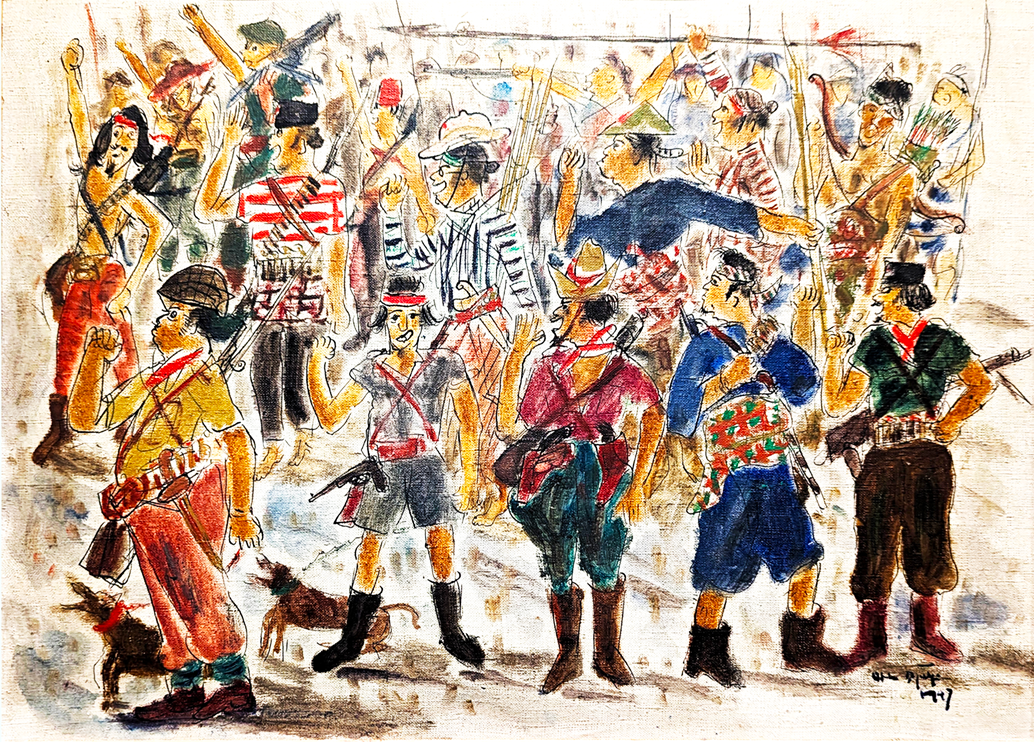

Above: “Revolution,” Otto Djaya (1916-2002), oil and ink on canvas, 1947
The fighters depicted in Otto Djaya’s painting ‘Revolution’ (1947) are all dressed and equipped for revolutionary action. The figures’ various styles of dress represent the great variety of local costumes worn in the different regions of the archipelago. Their makeshift equipment references the ragtag make-up of the Indonesian revolutionary army, which Otto depicted with a sense of humor…. Otto clearly aimed to break with the Dutch concept of ‘volkstypen,’ meaning ‘ethnic types:’ A koelie is always an indigenous Javanese or Chinese person, whereas an ambtenaar (official), a priester, and certainly a regent is always of Dutch descent.”
“Fighting Colonial Claims to Power,” Kerstin Winking, Stedelijk Museum website
Before the Japanese occupation during World War II, the archipelago now known as Indonesia had been a profitable colonial outpost for the Dutch for almost 350 years. Following the Allied defeat of Japan, revolutionary forces declared independence, taking advantage of the Netherlands’ weakened state after years of war and German occupation. The Netherlands balked at recognition, so a bloody four-year war ensued.
Yet, in 1947, in the midst of this revolt, the curator of the Stedelijk Museum of Modern and Contemporary Art and Design boldly mounted an exhibition focused on the work of two brothers, Agus and Otto Djaya, newly arrived in Amsterdam from their native land, the Dutch East Indies. Members of the revolutionary army, the pair harnessed the power of art as a weapon to persuade the Dutch to recognize Indonesian independence. Some of their works brazenly represented Dutch colonialism as a monster.
This, in a museum originally funded by private donors who had made their fortunes through colonial exploitation. I’ve tried, but it’s impossible for me to imagine the public outcry and political fallout caused by this exhibition. Think of Queen Wilhelmina (1880-1962), only just returned to The Hague following her wartime exile in England. Exhausted after ruling through two world wars and facing intense criticism for the potential loss of the oil-rich Dutch East Indies, the ailing Queen Wilhelmina abdicated in favor of her daughter Juliana (1909-2004) in 1948.
Continue reading “Postcard from Amsterdam, Netherlands: Bold art opens window to other cultures”

 Postcards from Barton Springs