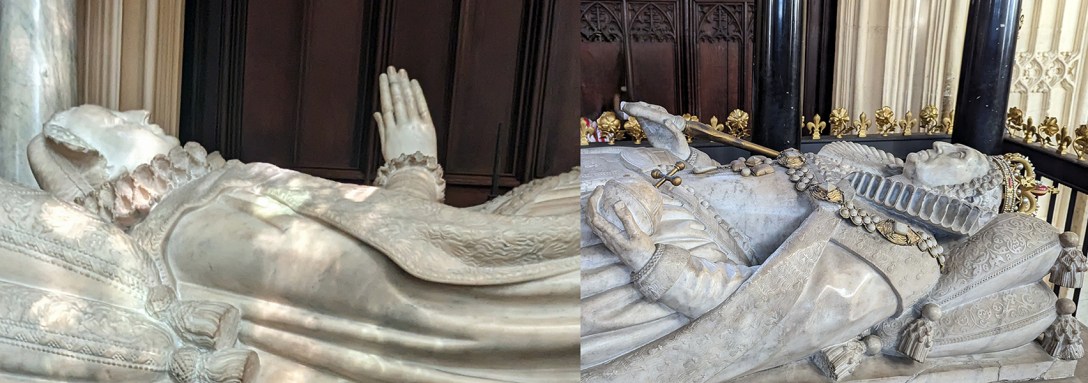
Postcard from London, England: ‘Strange bedfellows’ for eternity

Above left: Monumental effigy of Mary Queen of Scots (1542-1587). Above right: Queen Elizabeth I (1533-1603). Lady Chapel, Westminster Abbey

There is no other shelter hereabouts: misery acquaints a man with strange bedfellows.” 

The Tempest, William Shakespeare, 1611

In recent years, you’ve been exposed to an immense quantity of footage showing the interior of Westminster Abbey: the wedding of Prince and Princess of Wales in 2011; the funeral of Queen Elizabeth II (1926-2022); and the coronation of King Charles III and Queen Camilla in 2023.

With no need to cover that aspect, this taphophile is jumping straight to the everyday role of Westminster – a splendid monumental cemetery housing the remains of more than 3,300 elite, a veritable who’s-who of a thousand years of British history. Grave markers underfoot lie ignored, overwhelmed by the sculptural and polychrome effigies and memorials climbing ever higher up the church walls.

If ghosts rise in the night, what bedlam must reign. According to the Westminster website, the remains of 13 kings, four queens regnant, 11 queens consort, and two more queens are interred there. Blood might run thicker than water, yet British bluebloods frequently spilled that of their kin.

Continue reading “Postcard from London, England: ‘Strange bedfellows’ for eternity”

Postcard from Oviedo, Spain: Sacred relics attract peregrinos and thieves

Above: Central detail of the main Gothic altarpiece, dating from the early 1500s, in Santa Iglesia Catedral Basilica Metropolitana de Oviedo

He who goes to Santiago and not to the Savior visits the servant and forgets the Lord.”

Back in the year 40, the apostle James was preaching in Zaragoza when the Virgin Mary miraculously floated down on a cloud to assist him with his efforts to convert pagans living under Roman rule to Christianity. Soon after establishing a chapel in her honor, James traveled all the way back to Jerusalem. His preaching incurred the ire of the King of Judea, Herod Agrippa (11 BC-44 AD), who had him beheaded in the year 44. Avenged as, according to Acts Chapter 12, Verse 23, King Herod Agrippa met his maker within the same year:

…an angel of the Lord struck him, because he did not give glory to God. And he was eaten by worms and died.”

The head of Santiago, as James is known in Spain, is said to be entombed below the altar of the Armenian Apostolic Cathedral of Saint James, the church built on the site where he was martyred in Jerusalem. But what became of the rest of his body? As Santiago is the country’s patron saint, let’s go with the miraculous version. A band of angels arrived on a cloud to retrieve it, placed it in a simple boat and guided it to shore in northern Spain.

Continue reading “Postcard from Oviedo, Spain: Sacred relics attract peregrinos and thieves”

Postcard from London, England: Art restores power to the station

 Above: “Life in His Mouth, Death Cradles Her Arm,” Naufus Ramírez-Figueroa, 2016. Photo grab from video.

St. Paul’s Cathedral

Architectural Challenge Number One, 1940s: Design an industrial complex on a site directly across the Thames from one of London’s most cherished landmarks – Saint Paul’s Cathedral. Sir Giles Gilbert Scott (1880-1960) was an accomplished architect by the time he was tapped to tackle the Bankside Power Station. Unlike his earlier two-chimneyed Battersea Power Station, Bankside featured a single soaring chimney front and center, prompting some to refer to it as the cathedral of industry.

Architectural Challenge Number 2, 1990s: Convert a massive decommissioned power station into a frame for modern art. An international competition attracted 168 submissions, with the Swiss architectural firm of Herzog & de Meuron selected for the adaptive reuse project. The firm’s respect for and desire to preserve the external features of the brick power station impressed the selection committee of the Tate Modern.

Continue reading “Postcard from London, England: Art restores power to the station”