Postcard from Sorrento, Italy: An Amalfi town overwhelmed by people like us

Our Lady of “Please Save Us and the Entire Amalfi Coast from this Latest Wave of Invaders”

Mythologically speaking, Sorrento was founded by a grandson of Ulysses and Circe, but the geographical features making it a natural fortress – a deep gorge and steep cliffs fronting the coast – placed it in high demand by all powers interested in staking out turf in the neighborhood for thousands of years.

And now the invaders are tourists. Obviously, we are among them. But visitors slipping in two by two is a far cry from the hoards cruise ships docking in nearby Naples deliver to Sorrento, viewed as the stepping stone for exploring the beauty of Italy’s Amalfi Coast. The pedestrian streets of Sorrento are lined with shoppes, as opposed to stores that would offer anything of interest to the city’s less than 17,000 residents.

The small-town streets are clean and orderly compared to the scene in Naples, but are swarming with, well, people like us. Sorrento is a place where we could enjoy a morning cappuccino in a small café for three times the price we would pay in Naples. The setting is dramatic, and the views of the Isle of Capri and Naples are beautiful. But wait, we had a wonderful view of the Isle of Capri from our apartment in Naples.

Sorrento is blessed with several handsome baroque churches, and my favorite part of the jaunt by boat over there from Naples was a visit to the Basilica Sant’Antonino. Little Saint Anthony of Sorrento (555-625) was a Benedictine monk who became a hermit. The citizens of Sorrento coaxed him into serving as abbot of their Saint Agrippinus Monastery. Saint Michael appeared to persuade him to take up their offer.

The most miraculous deed credited to Antonino during his lifetime involved a whale. A mother arrived pleading to him for help, as her son had been swallowed by a leviathan. Antonino was able to reach deep inside the creature’s mouth and pluck the boy out, safe and sound.

After his death, the grateful people of Sorrento built a crypt to house his remains and then erected a basilica above in his honor. His work was not yet done though. The saint is credited with protecting the city from a Moorish naval invasion, the bubonic plague and cholera. The walls of the crypt are lined with cases of silver milagros left by those requesting his intervention in healing various parts of the body and reliquaries of bones of other saints to multiply the potency found within. Retablos depicting some of Saint Antonino’s dramatic rescues of endangered sailors at sea are abundant.

Sorrento takes great pride in its limoncello, ceramics and lacework. We strongly recommend the perfect panini produced in the little kitchen at A’Marenna.

Oh, and the city appears taken with Sophia Loren, particularly after her mambo scene in Scandal in Sorrento.

Sophia Loren and Vittorio de Sica mambo in 1955 film Scandal in Sorrento

We enjoyed dipping our toes into the Amalfi scene at Sorrento, but by late afternoon found ourselves eager to return to the bustling chaos of Naples.

Postcard from Naples, Italy: A month there. No regrets.

When people asked where we were headed next and we answered Naples, their reactions reflected the city’s reputation. People tend to associate it with crime. Garbage. While there are people who travel there now specifically because of Elena Ferrante’s Neapolitan quartet of novels, I must confess her descriptions of the gritty, rough neighborhoods of her childhood almost deterred me.

People also asked if we were mainly going to use Naples as a base for exploring the Amalfi coast. For visiting Pompeii. But, no, we were not. We were planning to spend a month primarily exploring the city itself.

I am asking you to stop now. Throw out all your preconceived ideas about the city for the upcoming blog posts.

Yes, there are some gritty, grimy areas, as there are in most big cities. Garbage does accumulate in narrow streets filled with bars where young people party late in an overwhelming volume that would prove challenging for most municipalities. But there are also miles of clean pathways skirting around the bay. There are enormous pedestrian-only pristine plazas. There are layers built upon layers of buildings climbing up its high hills. Some handsome; some not.

The city feels so real. So alive. A place operating not simply to appeal to tourists, but to function as a place where people live. A place with an engaging quirkiness and surprising discoveries around every corner.

And the Bay of Naples is drop-dead gorgeous. Mount Vesuvius and the islands of Capri and Ischia frame the shimmering water. No one told me that in advance, so I was unprepared for the beauty encountered everywhere.

Staying up in the Vomero neighborhood high above the city might seem like cheating in a way. An escape hatch from the hub-bub. How high is it? Not far as the seagull flies, but it amounted to a climb of about 60 stories. We only used the twisting-stairways once. But we descended into the city almost every single day via the inexpensive funiculars to explore her museums and churches. To admire the Baroque architecture. And to experience her restaurants. Pizza, pasta and fresh seafood everywhere.

Below is a random sampling showing some of Naples’ beauty and some of her warts.


Maybe Naples will grow on you as it did on us.


Postcard from Malaga, Spain: All the saints and those Limbo babies, too

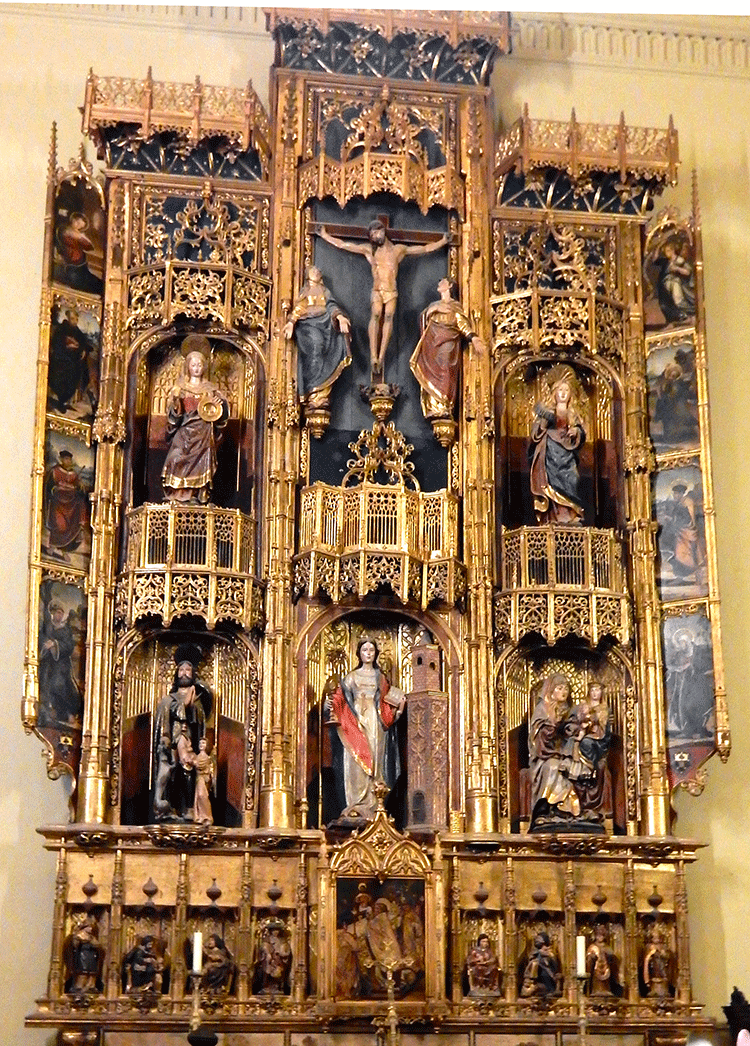
Gothic altar in the Chapel of Santa Barbara in the Cathedral of Nuestra Senora de le Encarnacion in Malaga

Layers upon layers of of saints climb the numerous gilded altars found in the Malaga Cathedral. Saints carved in wood by Pedro de Mena (1628-1688) grace the choir stalls. Today is all of their days. November 1. All Saints Day, and, for Catholics, a Holy Day of Obligation.

When I was young, the thrill of a night of trick-or-treating with its late night sugar high always was followed the next day by attendance at Mass. Unlike many holidays, it was particularly hard to comprehend why almost none of my friends had to go to church on November 1.

My godmother, Aunt Gen (Genevieve Louise Brennan Savage, 1907-2004), tried her best to explain things, but the nuns really never talked to us much about saints. Like Santa Barbara, whose own father carried out her martyrdom for her belief in the Holy Trinity. Although he was struck by lightening and consumed by fire on his way home after the act.

But the major impact for me was November 2, All Souls’ Day. You might not know this, but there are all of these bazillions of poor souls stuck in Purgatory – not so evil that they were condemned to hell but instead hanging around in an uncomfortable state trying to slip through the gates to heaven. Our prayers were supposed to free some of them and send them soaring above the clouds.

Even more concerning for me was Limbo. Limbo was where the little babies throughout the world who died unbaptized were supposed to go. Through no fault of their own, they were sentenced to remain suspended, constantly fluttering their wings in some mysterious twilight zone.

Those little poor souls were the ones for whom I would join my hands, palms sweating in those uncomfortable white gloves, squeeze my eyes tightly together and plead. God took a while to process my prayers from almost 60 years ago. In 2007, the Catholic Church finally liberated them all, burying the whole Limbo concept.

Sorry for the detour. Back to Malaga and its Cathedral. After all it’s a Holy Day of Obligation.

The foundation for the Cathedral of Nuestra Senora de le Encarnacion was laid in 1530 atop the Almohad Mosque. Taking more than a century to complete, the church is viewed as a chronicle of the transition of religious Gothic architecture into the Renaissance. The facades reflect extensive Baroque updating.

In addition to photos taken in the Cathedral, this post includes images from the Parroquia de los Santos Martires Ciriaco y Paula. The two were executed, with great difficulty requiring several attempts, for their Christian beliefs at the dawn of the 4th century. While their executioners set their remains ablaze, an unexpected torrential rain quenched the flames and faithful carted them off for more respectful last rites. It is believed the two somehow resurfaced to miraculously help expel the Moors about a millennium later, so they were proclaimed the patron saints of Malaga.

My prayers have lapsed, but I trust there are a multitude of people inclined to remember as many saints as possible today. Tomorrow, please pray doubly hard, just in case any little babies somehow remained stuck in Limbo.