

The river is an amazing resource.
Justin Boyd
How do you take the essence of something as sweeping as the Mission Reach of the San Antonio River and compress it into a to-go size box?
Artist Justin Boyd does this in a multimedia format incorporating sound and video recordings and natural and manmade found objects in “Days and Days,” an exhibit on display through February 10 at the Southwest School of Art.
Although not as immense as trying to condense a broad landscape into a small box in a gallery, I struggled with adjusting my writing style to a television format in collaborating with the crew at KLRN-TV for this piece for ARTS. Whittling and weaving Justin’s dialogue into a story presented difficult and complicated choices for me, and, in turn, for David Bibbs at KLRN.
Here’s the result on ARTS | January 18, 2013 on PBS.
Although our paths never had crossed, Justin and I walk the same stretch of river often. But he has added new layers to my thoughts – the river representing time and its passage – as I meander southward along the river’s banks.
While celebrating the restoration of the Mission Reach as part of the San Antonio Improvements Project, Justin’s art is conscious of the litter man continually discards:
The impact we have as humans on the landscape…. This impact is so heavy…. Manmade objects are sitting right next to natural objects….
When you are down here everyday, you can’t help but reflect on how we are affecting our landscape.
January 28, 2013, Update:
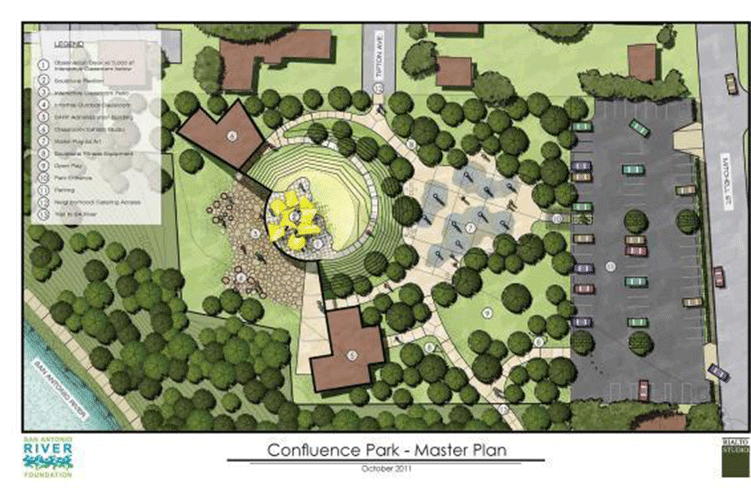
The photo above was shot at the point where the waters of San Pedro Creek (left) join the San Antonio River. The San Antonio River Foundation recently announced, according to the San Antonio Express-News, the commission of a pair of designers from the firm of Ball-Nogues Studio to design amenities for this point, to be known as Confluence Park:
With vague hopes of developing “some type of gathering place for the community,” the foundation spent about $300,000 on the park site several years ago and deeded it to SARA, said foundation executive director Estela Avery, wife of James Avery.
Plans gathered steam late last year, after Ball-Nogues Studio was invited to offer designs. The award-winning studio has created installations around the world that meld art and function, including works in California, New York, France, Italy and Hong Kong.
In recent months, designers Benjamin Ball and Gaston Nogues have collaborated with local water experts, botanists and others to create tentative concepts for the site at 310 W. Mitchell St.
“We’re working with an idea for a pavilion that will be enshrouded in vegetation, that’s also three windmills,” Ball said.
“We also have some features we’re calling ribbons, which are a man-made geology for the site. We’re trying to create some sense of discovery when you’re moving through the site so that you’re creating different vistas, different moments,” he said.
Added Nogues, “There’s going to be quite an extensive rainwater catchment system, which is going to mimic a cistern.”
Nogues appreciates the river restoration, noting that the Los Angeles River “suffered a similar fate” as the San Antonio River when its natural channel was lined with concrete decades ago. Most concrete has been removed here in the past few years during the river’s ecosystem restoration.
“It’s really an inspiration for what the Los Angeles River could become as well,” Nogues said.
Foundation interim project manager Stuart Allen said design details are pending, but the park’s purpose is firm.
“We want this park to be a really unusual destination,” Allen said.
“It’s going to be a park geared toward teaching about ecosystems, sustainable living, water transport mechanisms and watersheds. The park will be designed around forms that collect water and direct them to an underground cistern. The water will be recirculated back into the park.”
Fundraising received a major boost from a gift of $1 million for an educational endowment fund from James and Estela Avery.
January 31, 2013, Update: Nancy Cook-Monroe writes about Confluence Park and the announcement of the Avery gift to the River Foundation:
This one, with a water catchment system, solar panels and windmills, will be all about teaching sustainability, stewardship and environmental science. Its centerpiece will be an artistically designed educational pavilion. Other elements will be laced with double meanings, such as a “foraging fence.”
“It doesn’t keep neighbors out but invites them to enjoy decorative and edible plants,” said planning architect Gaston Nogues of Ball-Nogues Studio in Los Angeles.


 Postcards from Barton Springs