Best Restaurant in Valladolid, Plus Warning

Every trip we make, we depend on other people’s food reviews.  I always pledge I will come back and leave extensive feedback on Chowhound.  But those good intentions get buried quickly under work waiting on my desk.

As a start, the best meal on our trip to the Yucatan was not in Merida but in little Valladolid.  While the patio courtyard of El Meson del Marques offers an extremely pleasurable dining experience, a new restaurant opened in November – Taberna de los Frailes – next to the Monastery and Church of San Bernardino de Siena.  The contemporary restaurant steps beyond the traditional recipes of the Yucatan.

Dining under a shady palapa in the back, our group sampled filete de pescado fresco en salsa verde mexicana (in this case an oregano-based salsa);  salmon zarandeado; and mero maya.  The mero, fresh grouper, had been marinated in the region’s sour orange juice and was presented in four coiled spirals, perfectly cooked.  What kept everyone’s forks hovering above my plate, though, was a mound of black risotto with complex layers of flavor popping out in every bite.   The dish sent us scouring the market the next day to purchase some of the rich relleno negro seemingly at its base.

At 160 pesos (about $13), the fish dishes were not the least expensive in Mexico, but they were more than worth the tab.  The service was professional, except our server neglected to inform us when we ordered that the restaurant has a chocolate souffle that needs 25 minutes to prepare.  We would have eaten at La Taberna de los Frailes daily, had Merida not been our base.

On the other hand, we did not feel satisfied with a 350 peso tab at the Hacienda Temozon on our way to Uxmal.  Fortunately, it was early in the day; so margaritas and mero (There it would have been fresh grouper with mango sauce and black sesame and couscous.) were not yet on our minds.  We simply ordered four mineral waters and an order of guacamole.  350 pesos, tip not included.  Although beautiful, the hacienda is definitely not a place to drop in for dinner, unless money is no object.

Note on March 20:  For anyone traveling to Merida and the Yucatan, I expanded this post on Chowhound to include numerous other restaurants .

Update on December 4, 2012: The New York Times travels to Valladolid.
Barbara Ras’ ‘Elephant’ in ‘New Yorker’

Barbara Ras, director of Trinity University Press, has one of her poems featured in the March 15 issue of The New Yorker:

Washing the Elephant

by Barbara Ras, March 15, 2010

Isn’t it always the heart that wants to wash
the elephant, begging the body to do it
with soap and water, a ladder, hands,
in tree shade big enough for the vast savannas
of your sadness, the strangler fig of your guilt,
the cratered full moon’s light fuelling
the windy spooling memory of elephant?

What if Father Quinn had said, “Of course you’ll recognize
your parents in Heaven,” instead of
“Being one with God will make your mother and father
pointless.” That was back when I was young enough
to love them absolutely though still fear for their place
in Heaven, imagining their souls like sponges full
of something resembling street water after rain.

Still my mother sent me every Saturday to confess,
to wring the sins out of my small baffled soul, and I made up lies
about lying, disobeying, chewing gum in church, to offer them
as carefully as I handed over the knotted handkerchief of coins
to the grocer when my mother sent me for a loaf of Wonder,
Land of Lakes, and two Camels.

If guilt is the damage of childhood, then eros is the fall of adolescence.
Or the fall begins there, and never ends, desire after desire parading
through a lifetime like the Ringling Brothers elephants
made to walk through the Queens-Midtown Tunnel
and down Thirty-fourth Street to the Garden.
So much of our desire like their bulky, shadowy walking
after midnight, exiled from the wild and destined
for a circus with its tawdry gaudiness, its unspoken pathos.

It takes more than half a century to figure out who they were,
the few real loves-of-your-life, and how much of the rest—
the mad breaking-heart stickiness—falls away, slowly,
unnoticed, the way you lose your taste for things
like popsicles unthinkingly.
And though dailiness may have no place
for the ones who have etched themselves in the laugh lines
and frown lines on the face that’s harder and harder
to claim as your own, often one love-of-your-life
will appear in a dream, arriving
with the weight and certitude of an elephant,
and it’s always the heart that wants to go out and wash
the huge mysteriousness of what they meant, those memories
that have only memories to feed them, and only you to keep them clean.

Barbara, who will publish a collection of poems, The Last Skin, later this month, also had a poem appear in The New Yorker in 2006.  She will be one of the more than 20 writers in the spotlight for Wordworkers, an exhibit opening at Bihl Haus Arts from 5:30 to 8:30 p.m. on Friday, March 19.   During the opening, poets photographed by Melanie Rush Davis “will scrawl their poetry on gallery walls.” 

Other featured writers include Carmen Tafolla, Marian Haddad, Naomi Shihab Nye, Sandra Cisneros, Nan Cuba, Rosemary Catacalos, Jenny Browne, John Phillip Santos and Bryce Milligan.  As the exhibition at Bihl Haus continues, there will be a reading and small press book fair from 1 to 4 p.m. on Saturday, March 27, and a poetry reading by Jim LaVilla-Havelin from 7 to 9 p.m. on Thursday, April 8.  Bihl Haus Arts is located at 2803 Fredericksburg Road.

Barbara’s “Washing the Elephant” brought forth memories of the weekly visits to the confessional that forced me, as well, to make up imaginary sins to tell the rigid Father Habit at Star of the Sea.

Note Added on May 9Review of “Washing the Elephant” and Ras’ The Last Skin

Update on November 5:  Barbara Ras will discuss The Last Skin at The Twig Book Shop at Pearl Brewery from 3 to 5 p.m. on Sunday, November 14.

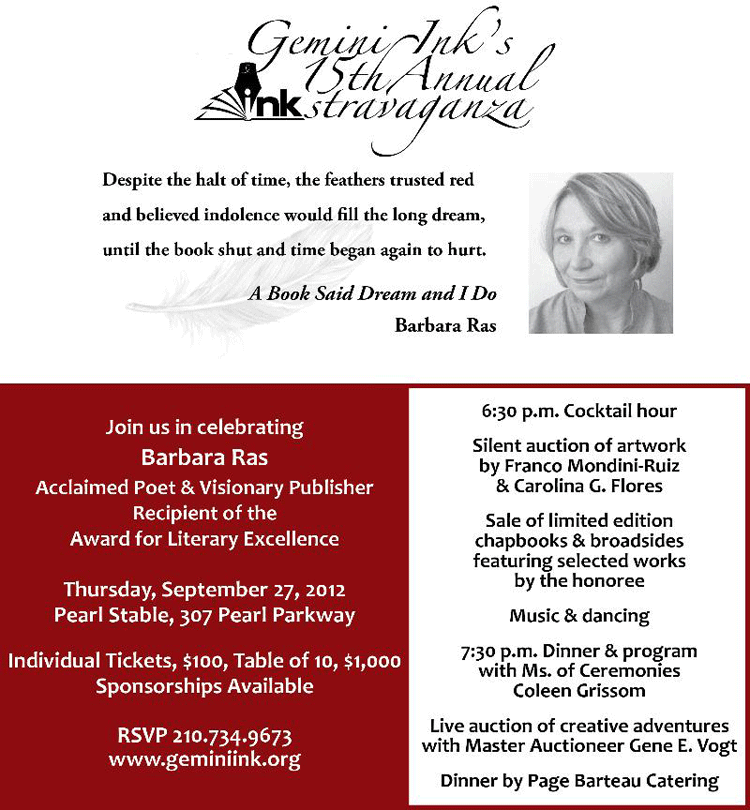
Update on September 11, 2012: Gemini Ink is honoring Barbara Ras at its 15th Annual Inkstravaganza at Pearl on Thursday, September 27, and one should never miss an opportunity to hear the utterances emitted by Coleen Grissom.

Ode to the Comma

I am used to editing other people’s work, which means I determine the punctuation rules applied.  Through the years, I decided consistency in application trumps any changes in grammar rules with which I disagree – primarily in regard to the comma. 

My two years in high school under the strict tutelage of Mrs. Masterson ingrained her comma rules in my writing, and no arbitrary changes in fashion can alter them.  I tend to prefer my commas in tidy pairs, married for life, no matter that The New Yorker now leaves one hanging alone like a recent divorcee.

But what happens when I am not the editor?  As I prepare to turn the manuscript for The Last Farm Standing on Buttermilk Hill over to Lynnell Burkett for editing, I realize my comma standards could be endangered species.   She taught journalism for years; she edited the editorial page at the San Antonio Light and Express-News.  I will have no leg on which to stand when Lynnell brandishes the most recent version of the Associated Press Stylebook.  Lynnell probably has never even heard of Mrs. Masterson of Norfolk Academy.

I decided, prior to suffering the loss of any of my commas or the insertion of unwanted ones, to pen an ode to the comma.  Checking online to make sure no one else had devoted effort to praise this punctuation point, I naturally found someone had.   

“The Grammar Girl,” whose link appears broken (found it), conducted a poetry contest in honor of National Punctuation Day (Yes, you were not alone in missing the celebration of this and the related baking contest on September 24).  Fortunately, Textbroker Blog preserved the winning entries in Grammar Girl’s contest, including the following:

Ode to the Comma

The female body part of punctuation,
So tiny, yet able to arouse such aggravation.
The comma slips in under the quotation,
Tells you when to pause for reflection,
Then plunge ahead to the period’s conclusion.
Neglect it at your peril: accusations,
law suits, wars. Nations
fall. Pretend it doesn’t exist at all? Risk condemnation.
Treat it right for absolution.
That’s right, put it there: Yes, oh, yes . . . satisfaction.

– Stacey Harwood
Stacey Harwood is a policy analyst with the New York State Department of Public Service. She is a freelance writer and managing editor of The Best American Poetry blog.

Lynnell, I am warning you now.  I might not be able to muster a strong case against the AP Stylebook, but, touch my commas, and the ghost of Mrs. Masterson could render your nights sleepless.

Update on Wednesday, February 29, 2012: On, no. This post provides indisputable evidence. I am a pilkunnussija.

In Nine Foreign Words English Definitely Needs, Cole Gamble and Cathal Logue define this useful Finnish word as:

A person who believes it is their destiny to stamp out all spelling and punctuation mistakes at the cost of popularity, self-esteem and mental well-being.

I feel no need to supplement this definition with their literal translation of the compound word, but I wish they had included a pronunciation guide.

In the same column, the authors also reference the existence of the Apostrophe Protection Society.

Note Added on August 28, 2012: Stumbled across this profile of Patty Masterson….

Note Added on October 23, 2012: Tom Gething interviews the endangered semicolon….