I saw Sweden was involved, and I immediately jumped to the conclusion it was all about sex.
Surely, for garlic to be worth $13.1 million, the news story last week had to be referring to garlic that has engaged in unbridled cross-pollination in the wild – the kind of free garlic sex that is rampant only in the four too-hard-too-spell-or-pronounce “-istans” that were formerly part of the Soviet Union. These flavorful specialty garlics did not become available to outsiders until the Cold War thawed and are much sought after.
But I was wrong. So then I thought the whole thing must be a joke, one of those stupid-things-criminals-do stories.
Like this recent one, January 9, from ABC News:
 Police nabbed a South Carolina teenager when they followed a trail of Cheetos leading from a convenience store to a local residence where he was staying….
“Cheetos were all over the parking lot, at the place where he parked his car, and at the residence,” Buckholz said…. “He was very easy to catch….”
Turns out smuggling garlic is hot in the European Union right now. And those who buy and sell are not seeking the gourmet bulbs; they are satisfied with plain old cloned garlic from China. The easy-to-find kind that we take for granted in the this country.
What could make garlic so valuable? Taxes. According to a January 9 story written by Tony Paterson for The Independent:
The EU imposes as 9.6 per cent duty on imported foreign garlic in an attempt to prevent the continent’s growers from being driven out of business by Chinese farmers who have captured large swathes of the global market by producing crops at knock down prices.
But the duty, which came into force in 2001, has led to a surge in illicit imports into the EU because smugglers can make millions by avoiding the tax.
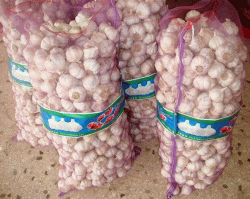 There is an active “international gang” of garlic smugglers involved in multinational intrigue led by a pair of British masterminds, according to Paterson and other news sources. The garlic travels by boat from China to Norway because the Norwegians have imposed no duty on garlic. Perhaps Norway is a country that takes keeping vampires out seriously enough to allow more garlic into the country than Norwegians could ever possibly consume. Then the Chinese garlic is slipped secretly into Sweden and trucked throughout the EU.
OLAF, the European Anti-Fraud Office, views this underground garlic invasion as major criminal activity because it has gotten so large-scale. Members of the garlic mafia who are caught face stiff penalties. Paterson writes that a London merchant who tried to fool investigators by claiming he was importing duty-free ginger, not garlic, was sentenced to six years imprisonment last month. An Irish man who tried disguising the garlic as apples received the same punishment last year. Somebody must have turned and ratted on the big guys.
It’s obviously been a tough year for the garlic gang.
But that is what makes the story so ideal for a television series. Wouldn’t you feel more empathy for Walt if he were engaged in garlic smuggling instead of meth production in Breaking Bad? Think of how contentedly Carmela Soprano would be cooking if Tony had presented her with some of that sexy ‘istani garlic for her Mario Batelli green beans.
Maybe a whole season of garlic would get tiring. But I think the food-crime theme would work overall. Let’s throw in some tonier products. Maybe Anthony Bourdain could do kind of an Alistair-Cooke-Masterpiece-Theatre-style intro explaining why foodies would go to such extreme measures to obtain illegal foodstuffs and why rare foods are worth risking jail.
It’s hard to imagine squeezing Operation Malossol into just one episode.
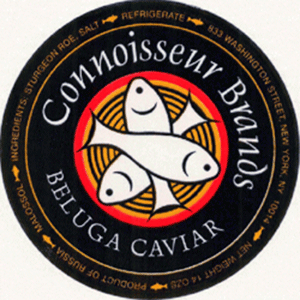
 Alfred Yazback was the king of caviar. The Justice Department alleged he virtually double-crossed everybody with illegal, counterfeit and/or doctored sturgeon roe.
The Justice Department media release says that the Holiday 1999 catalogue of Dean & Deluca hailed its Yazback-supplied caviar as a Christmas miracle:
New regulations made finding impeccable Beluga caviar tantamount to seeking the Holy Grail this year. We got lucky.
Except, its impeccability was questionable. Yazback had purchased some of the caviar out of suitcases delivered to him by Eugene Koczuk, who used a system of paid couriers to smuggle in the petite eggs of endangered sturgeons. There was a problem with this black-market form of shipping. According to the Justice Department:
Some of the caviar may not have received proper refrigeration at some point, so Connoisseur Brands engaged in various practices to “dress it up” for sale. The company used a process known as “caviar washing” which entailed defrosting frozen caviar, draining it of oil, washing it with salt water, adding walnut or hazelnut oil to disguise spoilage, bad smell or taste and then partially pasteurizing the roe.
Sometimes Yazback bought real stuff through proper channels. But then he would double-invoice, substituting lower price invoices to conceal the actual price and avoid paying import fees, particularly on the expensive tins of Beluga caviar.
Of course, why waste the good stuff on the masses, the people who purchase it through Balducci’s, Harry & David or even Trader Joe’s? Let them eat paddlefish roe.
Well, look out CSI and Law and Order. A sly undercover agent in Operation Malossol turned to the expertise of the Fish and Wildlife National Forensics Laboratory in Oregon. DNA testing revealed much of the caviar being sold as Russian Sevruga caviar was in fact not. It was white paddlefish roe.
Although not well-regarded by the gourmet crowd, the paddlefish substitution presented even more problems for Yazback. Paddlefish, native to the Tennessee and Mississippi Rivers, is a protected species in this country. Much of what Connoisseur Brands was selling was illegally caught, a charge hard to defend against when an Alabama undercover agent was wearing a wire.
Would this not be great t.v.?
And then there are truffles. People love shows that feature animals. They will go crazy for pigs or trained truffle-snuffler dogs.
In 2007, according to The China Post, Chang Chen-men, “the No. 1 cooker of French cuisine in Taiwan,” was fined more than $100,000 for smuggling in white truffles from northern Italy.
On the website Whiskey Goldmine, Matt Goldstein writes:
Because the price and demand for truffles are so high, gangsters, thieves, smugglers and bootleggers have gotten into the mix. Famous French Chef Bruno, who was featured on 60 Minutes, was robbed of 200 of Kilos. The thieves did not even try to steal any money. Workers in the French Truffle industry have been carjacked, beaten with baseball bats and even murdered. Gangsters are even kidnapping truffle hunting dogs as to use themselves to find the truffles.
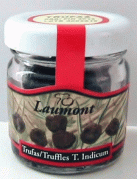 Not content with producing cheap garlic, the Chinese have gotten into truffles as well. And some of the truffle-smugglers are using stunts from Yazback’s playbook. Goldstein continues:
Theft, violence and gangsters have made the truffle trade dangerous but perhaps the worst thing for authentic French Truffles, are the cheap Chinese knock offs. Truffle in China were basically worthless at one point and used as animal feed, but one business man thought instead of feeding it to the pigs, why not feed it to the French? There is no difference anyway. Just kidding, of course there is a difference between the truffles. The cheaper, more abundant Chinese truffles are now mixing up the market and the being packaged in France with labels claiming they are a product of France.
Chinese truffles are harvested immediately when found, but French truffles are harvested usually when ripe. The difference is a major impact on flavor. Chinese truffles are about $20 per pound while French truffles are about $1000. Hundreds of French restaurants are passing off the Chinese truffles but still charging French truffle prices. With 400,000 pounds of Chinese truffles being imported into France each year, many of the truffles are packaged and then exported with a label saying product of France. Because of the law, the package Chinese truffles from France will usually say “Tuber Indicum,” on the back in small print, meaning “Chinese Truffles.” Deceitful yes, but legal of course.
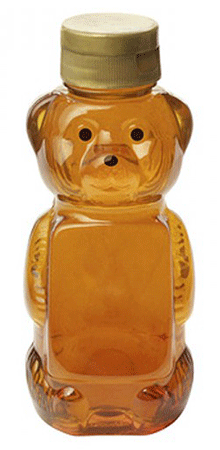
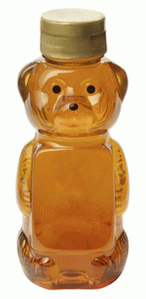 Adventurous honey crooks were caught with sticky fingers in 2010 from tampering with honey destined for U.S. markets. According to the BBC:
US authorities have indicted 11 German and Chinese executives for conspiring to illegally import $40m (£26m) worth of honey from China.
The executives were accused of being part of an operation which mislabelled honey and tainted it with antibiotics in an attempt to avoid import duties….
Officials say it is the biggest food smuggling case in US history.
Ten of the suspects were senior executives at Alfred L Wolff, a German company, which allegedly bought cheap Chinese honey and, en route to the US, filtered out “pollen and other trace elements that could indicate that the honey originated from China”, according to the charge sheet….
Some of the honey was mixed with Indian honey to disguise its origin, or adulterated with antibiotics, in an attempt to avoid paying $80m in import duties….
Those involved are alleged to have made 606 illegal shipments over six years, beginning in March 2002.
Senator Charles Schumer said he welcomed the fact that law enforcement agencies were taking “honey laundering” seriously.
And cheesy North American crime abounds as well. The year started off with headlines such as this one from the El Paso Times: “230 pounds of contraband queso seized at Santa Teresa port.”
The poor Canadians pay through the nose just to put plain old mozzarella on their pizzas. The temptation to profit even tempted a policeman this fall, according to Philippa Lees on Food:
In the ‘Great White North’, cheese lovers pay three times as much as those in the U.S and one group of unscrupulous entrepreneurs has just been busted for running a smuggling ring accused of illegally importing $200,000 of mozzarella.
This week, three men including a police officer were arrested and charged over the large-scale smuggling scheme to distribute cheese products and other food items into Canada, according to Niagra Regional Police Service.
The “brick” cheese, commonly used by pizzerias, was allegedly smuggled over the border in cars at a profit of up to $2000 per trip.
Restaurants were reportedly offered cases of the smuggled mozzarella at discount prices….
These true stories were uncovered easily online. Surely they are just a tip of the food crime chain. There are more smuggling scum bags out there poised to be caught and put in the spotlight as the next Tony Soprano.
Hmmm. All I need is a catchy name and a few investors.






 Postcards from Barton Springs