Once upon a time, northern San Antonio was a land of dairies….

The Trustees of the Max and Minnie Tomerlin Voelcker Fund are hosting a celebration of the publication of The Last Farm Standing on Buttermilk Hill: Voelcker Roots Run Deep in Hardberger Park from 5 to 7 p.m. on Tuesday, November 16, at The Twig Book Shop, 200 East Grayson at Pearl Brewery.  Music Max and Minnie would have loved will be provided by the Lone Star Swingbillies.  During the event, 60 percent of any sales of the book will benefit the Phil Hardberger Park Conservancy.

Char Miller, W.M. Keck Professor of Environmental Analysis at Pomona College of Claremont, California, and author of Deep in the Heart of San Antonio: Land and Life in South Texas, wrote: “Few San Antonians remember Buttermilk Hill, but Gayle Spencer has recovered its significance through an intimate portrait of the dairy-farm families who once inhabited the rolling North Side terrain.  Only the Voelckers held out against encroaching sprawl, and the result is Hardberger Park, a verdant vestige of the city’s bucolic past.”
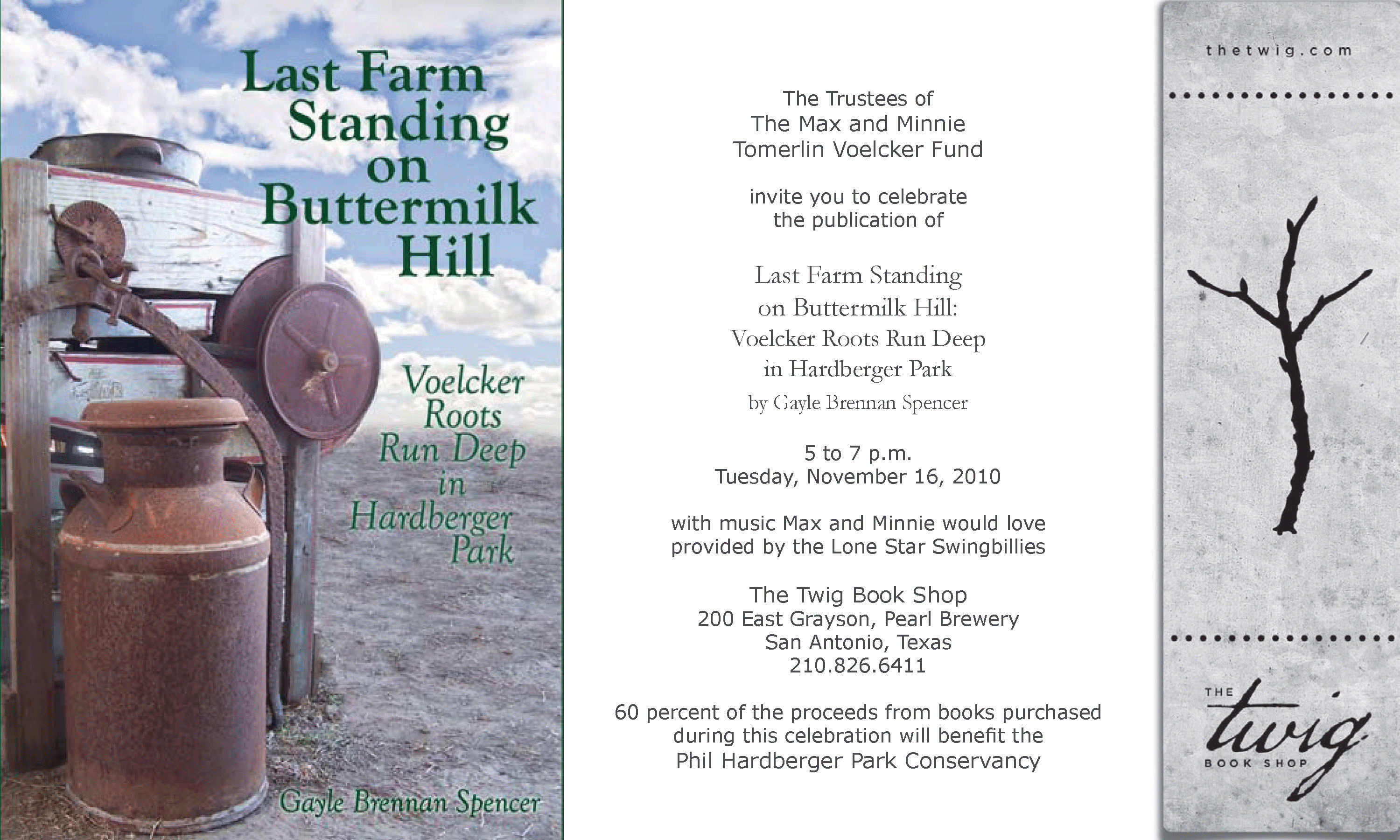
After the Texas Revolution, land grants from the Republic of Texas attracted new settlers to the outskirts of San Antonio.  The grandparents of Max and Minnie Tomerlin Voelcker were among those drawn by “gold” to a community known as the Coker Settlement, just north of today’s Loop 410 but, at the time, a full day’s round-trip by wagon on bumpy dirt roads. Unlike that of California, their gold was, first, the opportunity to produce golden butter and, later, the value of the land itself.

By the late 1800s, so many dairies dotted the countryside that the area became known as Buttermilk Hill.  Last Farm Standing on Buttermilk Hill traces the early migration to this community and the daily challenges faced by those who farmed the land.  Dairy farming involved rising before dawn to churn milk drawn the night before into butter, answering the twice-daily calls from cows in need of milking and driving long distances to deliver cream and butter to city-dwellers.  Life was not easy, and nature did not always cooperate.

Max and Minnie both were born on Buttermilk Hill and learned to milk cows almost as soon as they could walk.  With farming in their blood, they naturally married from within the Coker settlement.

As dairy farming became big business in Texas, small dairies no longer could compete.  But by then, the land itself was so valuable protracted court battles embroiled the Voelckers and their siblings, leaving permanent scars. San Antonio swallowed up one farm after another, until the Voelcker farm, part of which is Phil Hardberger Park, was the last one standing on Buttermilk Hill.
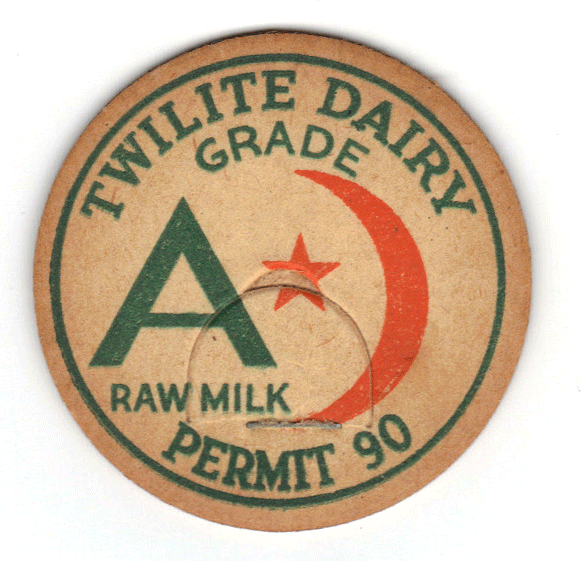
Update on November 9:  Unused, there are no remnants of cream glopped onto the back of this wonderful milk bottle cap Carolene dropped by my house.  She says (see her comment below) the Twilite Dairy was located out Blanco Road about a mile past Voelcker Lane.  That dairy on Buttermilk Hill, which no longer stands, had been owned by Josephine and Onis Lester Harrison (1910-1954), the son of Nancy Cordelia Tomerlin Harrison (1889-1962),  Minnie Voelcker’s half-sister.

Update on November 14Ed Conroy’s review in the Express-News is better written than the book itself.
“Nuit of the Living Dead”

“Oh, I see that you have a little swimming mouse.”

I have to thank Texas Public Radio for sending Keynotes into my inbox this morning with news that David Sedaris is coming to San Antonio.  That brought to mind my all-time favorite short story, ideal for Halloween – “Nuit of the Living Dead” from Sedaris’ Dress Your Family in Corduroy and Denim

Actually, I first read “Nuit,” then titled “The Living Dead,” in a 2004 issue of The New Yorker while waiting at Shag the Salon.  Tears cascaded down my cheeks.  Couldn’t stop laughing long enough to even begin to explain what could possibly be funny about a man attempting to drown a mouse. (Fortunately, Shag is not an ’09 salon where everyone is supposed to pretend they are “normal.”  As though normalcy exists.)

Sedaris will read from his most recent book, Squirrel Seeks Chipmunk: A Modest Bestiary, at Borders in the Quarry Market at 7 p.m. on Saturday, November 20.  I feel as though I shouldn’t blog about his appearance in advance because I fear he will attract far more people than can be accommodated and I would like to be able to hear him.  But I guess I was not the only person in San Antonio to receive the Keynotes email.

Have only read a couple of these animal “fables,” including this excerpt relevant to gated communities or the not-so-great wall of the Rio Grande:

Then a squirrel disappeared, and it was decided that something had to be done.  A meeting was convened in the clearing near the big oak, and the hawk, who often flew great distances in search of food, proposed that they build a gate.  “I’ve seen one where the humans live, and it seems to work fairly well.”

“Work how?” asked a muskrat. 

The hawk explained that once the gate was erected, anyone entering the forest would have to stop and identify himself.  “It keeps out the riffraff,” he said, adding that when bad things happened, that was usually who was responsible – riffraff.

Wondering if anyone has read what the squirrel and chipmunk might be up to in the book….  Would it be safe for Parky the Squirrel, the mascot of Friends of the Parks, to show up wearing her tail? 

Heller Mcalpin might have answered that question for me on NPR’s website:

Despite chatty barnyard animals and charming illustrations by Ian Falconer, creator of the Olivia children’s book series, don’t be fooled into thinking this is a children’s book.  Remember the puritanical brouhaha over Maurice Sendak’s naked urchin in In the Night Kitchen and the hen’s egg-shaped bulges in Ron Barrett’s drawings for Animals Should Definitely Not Wear Clothing?   Well, we’ve come a long way, baby:  “The Grieving Owl” features a puckered pink hippopotamus rectum.

Although “The Cat and the Baboon” includes mention of a less-than talented harp-playing squirrel, it gets rather “assy” as well.  Sorry, Parky.  Think you better leave your tail at home and go incognito.

And, when I go to Shag next week, I hope they behave like Sedaris’ hair-grooming baboon:  No matter what I say, just nod and smile and say you remember the swimming mouse well, “the way one must in the service industry.”

Seduced away from intellectual pursuits by the sounds of the squeezebox….

Last year during the Texas State Book Fair in Austin, my daughter and I left the Paramount Theatre inspired by the words of Margaret Atwood.  As much as I love hearing great authors muse on their writings and on the art of writing itself, this year I felt conflicted.  Why would someone have scheduled the Book Fair on the same weekend as the International Accordion Festival?

I’m weak.  The squeezebox won.

Funding woes put a little bit of a squeeze on the Accordion Festival’s schedule this year – one stage instead of two, not as many groups from distant lands, not as many good food booths – but, hey, it’s admission-free and almost in my backyard.  Missed some of the performances, but enjoyed Copper BoxOrgullo Vallenato and Debra Peters and the Love Saints.  And then there was the hometown band that blew everyone away with a sound like Brave Combo on speed – Piñata Protest.

Only hope the festival can grow back to two stages next year and does not conflict with the Texas State Book Fair.

Note Added on October 25:  The “Arty Semite” blogs about Socalled’s set, which I unfortunately missed.