Postcard from Oaxaca: Weaving new translations of ancient traditions

The magic of the first carpet had our attention. And the second. Brilliant colors, traditional patterns passed from wrinkled hands to nimble young fingers generation after generation in villages in the interior of Mexico.

Santiago Borja’s carpet appears traditional at its heart but melts into modernism at its edges. Weavers from the workshop of Jeronimo Hernandez in Teotitlan del Valle, Oaxaca, completed its execution.

But then something happened on the next wall. The scarf escaping from the flat surface, its fringe fluttering free as though a butterfly freed from its cocoon…

This slideshow requires JavaScript.

…a phrase too obviously transitioning to the title of the exhibition at the Museo Textil de OaxacaCocoon Me from My Feet Up: Traditional and Contemporary Carpets. Curator OlgaMargarita Davila assembled work by 18 artists from four countries “to connect ourselves with the meaning of the fabric we inhabit: our body.”

Bodies resembling dancing Guatemalan worry dolls bob along the top and bottom of a linear weaving by Susan Martin Maffei whose website explains:

Crocheted 3 dimensional trims, quipus and found objects enhance the narrative visuals of many works, influenced by textile forms and embellishments of the many ancient cultures I have explored.

An “unwrapped” piece caught my eye, but then the artist almost cheated to make me a fan – a postcard. He created a postcard to the curator to accompany one of his pieces.

….there is such a contribution to be made by adapting examples from the history of our chosen medium and quietly exploring a simple form or image through line, grid-form or in separate units, repeating and developing it again and again.

Archie Brennan, Tapestry Art Today, Summer 2004

And then, he has such a fine last name.

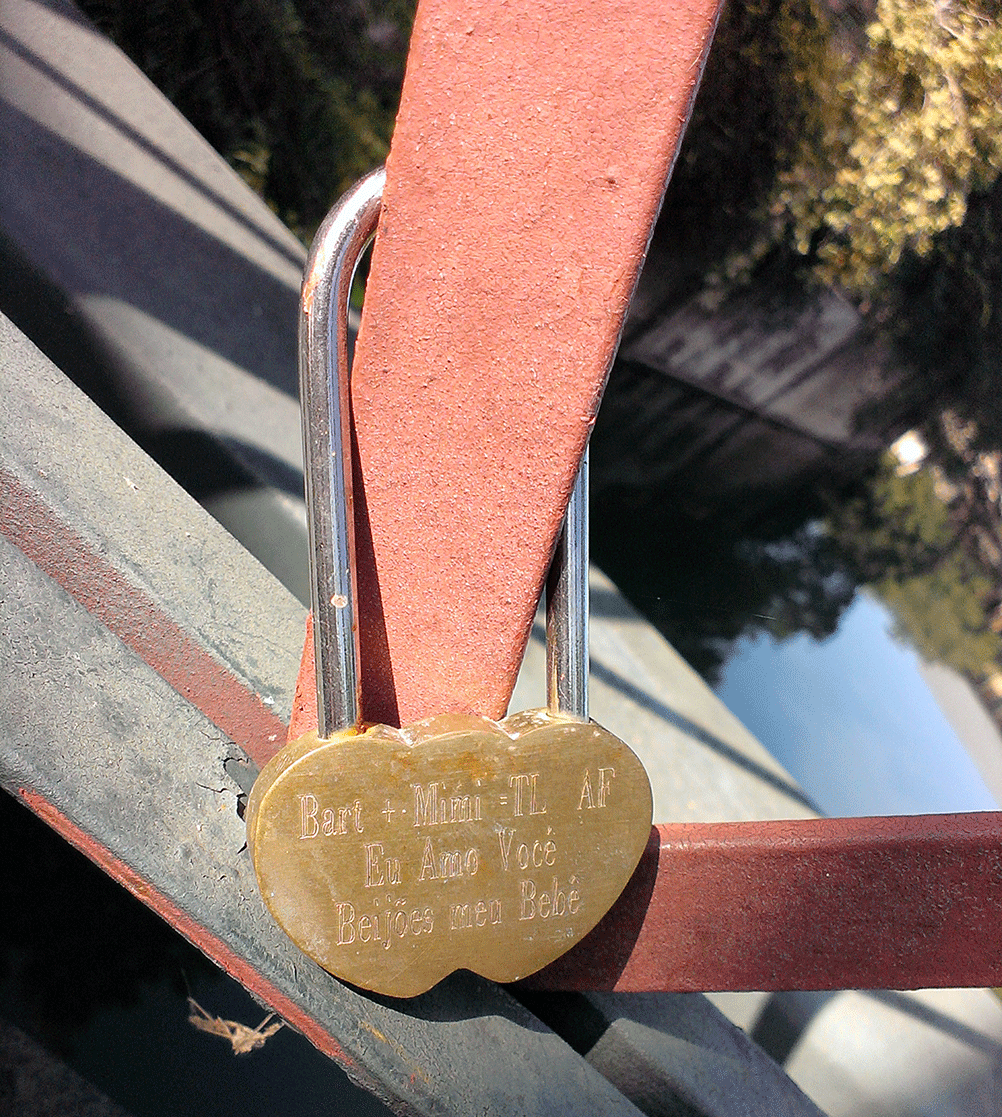
Bart + Mimi: Locked in love on ‘O. Henry’s Bridge’

Been watching “Bart + Mimi” for a while on morning walks, waiting to see if their public proclamation of love in Portuguese would multiply as love locks on bridges have around the world.

Multiplication is not desirable. A solitary lock is much more romantic, and cities where historic bridges are targeted struggle to cope with the weight of the demonstrations of love.

At first, I thought writing this blog would take much research into these cases, but fortunately “Mr. and Mrs. Adventure” spared me a lot of googling. They recently posted a blog on padlocked proclamations, including such sites as Via dell’ Amore in the Cinque Terre and the narrow 1828 Pont de l’Archevêché in Paris.

A few years ago according to The Independent, Parisian officials took action, only to be quickly reconquered by determined lovers:

A year after their mysterious disappearance, the “love-locks” of Paris are back on the city’s bridges, more plentiful and vibrant than ever despite lingering suspicions that unromantic officials from City Hall may again swoop with their wire cutters and remove the tokens of couples’ love….

In May 2010, Paris Town Hall expressed concern over the growing number of love-locks, saying: “they raise problems for the preservation of our architectural heritage”. It’s not only the Town Hall that expressed doubts; from time to time a dejected ex-lover has been seen desperately hacking at a padlock with a pair of pliers.

Shortly after this announcement, the bridge was found all but bare following a nocturnal clean-up.

Since the disappearance, lovers have shown their indignation by building-up collections once more….

The narrow pedestrian bridge in the King William Historic District on the south side of downtown Bart and Mimi selected to share their beijoes certainly looks the part. Some call the Johnson Street Bridge the O. Henry Bridge. Built in 1983, it replicates an earlier one removed from this spot during inartistic flood-control work completed in the 1960s. The 1880 bridge had been moved to Johnson Street from its original location on Commerce Street, where it served as an inspirational setting for writer Sidney Porter, or O. Henry.

This slideshow requires JavaScript.

While the moniker O. Henry might sound romantic, his morbid short story of suicidal consumptives set on the former Commerce Street Bridge was not. The following is from his Fog in Santone:

The drug clerk looks sharply at the white face half concealed by the high-turned overcoat collar.

“I would rather not supply you,” he said doubtfully. “I sold you a dozen  morphine tablets less than an hour ago.”

The customer smiles wanly. “The fault is in your crooked streets. I  didn’t intend to call upon you twice, but I guess I got tangled up. Excuse me.”

The purchaser of the morphia wanders into the fog, and at length, finds himself upon a little iron bridge, one of the score or more in the heart of the city, under which the small tortuous river flows.

But Bart and Mimi’s lock has triumphed over the inherited gloom, assuming its role as one of San Antonio’s quills:

If peculiarities were quills, San Antonio de Bexar would be a rare porcupine. Over all the round of aspects in which a thoughtful mind may view a city, it bristles with striking idiosyncrasies and bizarre contrasts.

Retrospects and Prospects by William Sydney Porter (O. Henry)

Hopefully, their en amo voce will remain a single quill and not inspire a wave of others to turn the little footbridge into an obese bristling porcupine.

Interpreting Texas via “my square mile”

One Square Mile: Texas (OSMTX) is a documentary television series that portrays Texas culture from the perspective of distinct square miles across the Lone Star state.  As a whole, the series is a microcosm of Texas life and a collective portrait of the state.

The series represents the many faces and facets of Texas from the perspective of the individual while spanning the emotional, demographic and physical landscapes. This is a series about shared challenges and aspirations.  The square miles include urban, suburban and rural communities and neighborhoods from every corner of the state.

Each episode has a theme by which the series examines the square miles and provides a cohesive thread that allows us to explore, compare and shed light on universal issues. Looking beyond the preconceived notions or stereotypes that typically define the state, OSMTX’s objective viewpoint provides a platform and outlet for discussion of the collective and varied identity of the state and the regions and towns that comprise it….

Our culture must be documented as it is happening, lest it be lost or re-interpreted. This series provides a tangible link between where we have been and where we are going.  A template and online platform for the cross-pollination of ideas will bring students and individuals together from the diverse regions across Texas. Students are encouraged to document their own square miles with video, photography, art and written word that is to be shared with the OSMTX community.

One Square Mile – Texas

A series focusing on selected square miles of Texas as microcosms capturing the character of the state as a whole will air this fall on PBS stations. One of the square miles is “mine,” which engages my interest in the progress of this project because I am so smitten by the ‘hood in which I live. If I were visiting San Antonio on vacation, this is precisely where I would want to stay.

A major bonus is that only today my daughter and son-in-law moved into the downtown square mile of Austin included in the series. The Austin teaser is not up on the website yet, but stay tuned.

And, while posting video about the neighborhood, Erik Bosse‘s short showcasing portions of the parade during the King William Fair makes it appear more polished than in real life:

Update on May 24, 2013: The teaser for the Austin Square Mile in which my daughter and son-in-law live has just been added to the website…

One Square Mile: Texas – Austin Teaser from Brazos Film & Video on Vimeo.