Postcard from Segovia, Spain: The Plaza Mayor San Antonio should emulate

This is a Plaza Mayor every city wants. It certainly is the one I would want San Antonio to attain. And San Antonio could, perhaps, with the new residential components slated for Main Plaza.

Tourists come through the plaza in Segovia in large groups, but the plaza remains Segovian despite our invasions. It refuses to be conquered.

Both the Cathedral and City Hall border the huge public space. Tolling bells still regulate the time for the city. Military bands march through. Weddings from City Hall spill into the plaza. Student concerts take place. Races begin there. Labor Day rallies take place. A farmers market occurs on Thursdays (the oliveman parked below our balcony). Cleaning crews came through immediately after the market closes in the early afternoon, and the surrounding restaurants quickly drag their tables back out into the sunshine.

This is a place for morning coffee and, a little later, to have it corrected with cognac. Locals still gather for lunch or drinks extending into the evening. They arrive on foot.

Old people (even older than us) park on benches waiting for friends to wander by. In the afternoon, baby carriages grow in number. Scampering children run freely, the bandstand serving as their stage. Parents are relaxed enough to sit at the cafes while children romp.

The age of the children in the bandstand increases hourly, until, sometimes in the wee hours of the morning the college-age crowd takes over. The cleaning crew comes through once again, leaving the sprawling plaza spotless before the newsstand opened for business. The Mister witnessed this when suffering from a bit of time-zone adjustment. It could happen nightly, but we would not know.

The apartment we rented overlooks the plaza. And the view was never static. Gazing out our windows or walking out onto our little balcony next to City Hall was much more entertaining than any television show could be.

This is a plaza that seems to never sleep, except maybe between about 7 to 8 in the morning. Then the man opens his news kiosk and spreads out the daily papers and gossip magazines. Delivery trucks have a small window to replenish the cafes as waitstaff return tables and chairs offering prime viewing of all the action.

This is no quiet place. It is the throbbing heart of a thriving urban center.

What made it possible to enjoy were double-paned windows and major louvered shutters that could be lowered over them so we could sleep peacefully at night.

The Plaza Mayor in Segovia. This is a place I would want to be parked when I am too old to move. Perch me on a balcony in a spot like this, and let me enjoy watching life.


Postcard from Segovia, Spain: Castilian castle commands bluff despite those painful pointy-toed shoes

There was a lot of fighting going on in what we now call Spain, Portugal and the rest of Europe in the old days. Boundaries constantly were changing; kingdoms were proclaimed and reclaimed over and over.

My feet were never meant for pointy-toed shoes, but what were those medieval designers thinking? I mean, Jimmy Choo’s highest spiked heels are so much kinder to women’s feet than the armor those soldiers were forced to endure.

Realize one would want every body part protected during battle, but how could one move without assistance in such absurdly curved and pointed shoes? And, with every finger armored, how could one wield a sword? I guess the more the protection inhibited movement, the more protection one would need?

Fortunately for the rulers ensconced at Alcazar, geography played a role in preventing mobile-impaired soldiers from having to maneuver more than possible.

The castle seems so familiar, so, well, Disney-like. But Alcazar definitely came first, its turrets and spires serving as inspiration for Walt centuries later.

Ruins of an ancient Roman fortress became the base for a Moorish post, which in turn was the foundation for a monumental stone compound, the primary home for Spanish royalty and its parliament.

King Alfonso VIII (1155–1214) began the first permanent construction of Alcazar, with Juan II (1405-1454) adding the major tower during his reign. Felipe II (1527-1598) updated things to keep up with the latest European architectural whims of royals by adding the slate-covered pointy spires.

Things went south from that point. King Felipe II moved the seat of government to Madrid, and the former home of royalty suffered the indignity of serving as a prison for two centuries.

King Carlos III (1716-1788) repurposed it into the Royal Artillery School. But that meant storage of highly explosive materials within the fortress walls, which added to the spectacular fireworks display when a fire broke out in 1862.

Royalty briefly was out in Spain, but, when reestablished (a major oversimplification of history), Alfonso XII (1857-1885) began restoration of this monument to Spain’s past. Although the young monarch died of complications from tuberculosis and dysentery at age 28, Alcazar still reigns over Segovia and the surrounding countryside.


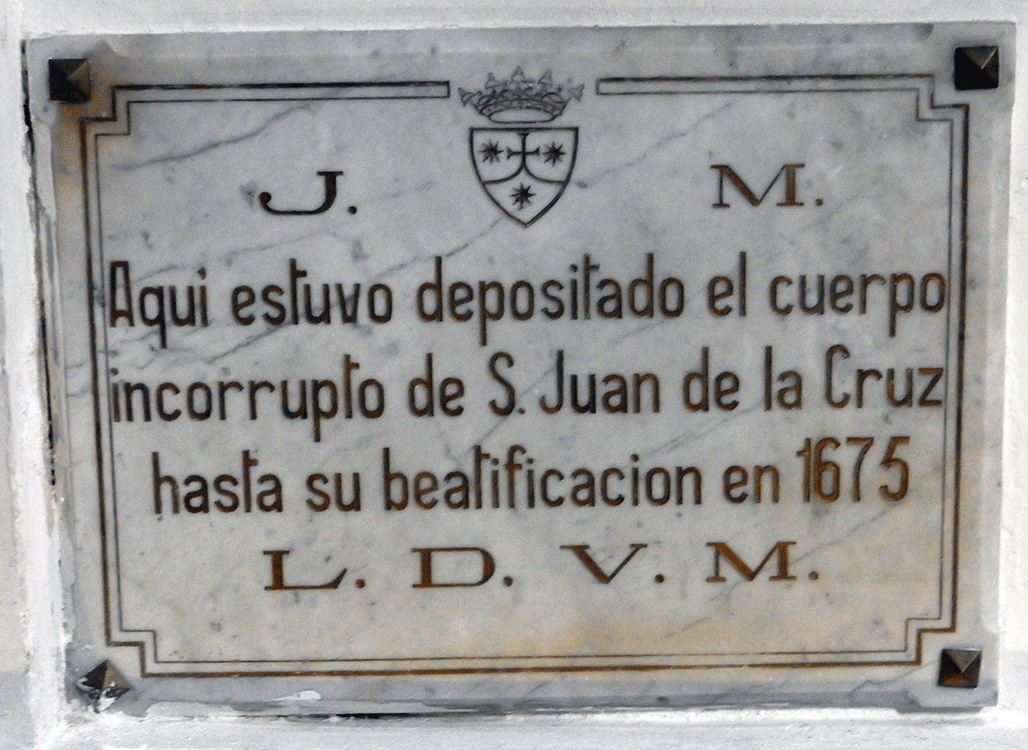
Postcard from Segovia, Spain: Saintly mystery, a case of incorruptu disruptus?

San Juan de la Cruz (1542-1591) and Santa Teresa de Avila (1515-1582) figure prominently in churches in this portion of Spain. Disagreements with Moors and pagans represented only a portion of the conflicts facing Roman Catholics.

Juan and Theresa ran counter to many of the early Carmelites for their insistence upon deprivation among the order, promoting the discalced discipline, meaning a shoeless existence, in addition to religious contemplation in isolation. Those other Carmelites thought they deserved shoes, and a few more basic luxuries, in exchange for their devotion.

The complicated politics involving different orders of Catholics are so far beyond comprehension based on the simplistic teaching of Roman Catholicism to children in the United States. We always went barefoot whenever possible and often when impractical in Virginia Beach, but I’m fairly certain that had little to do with where we stood on the discalced argument within the church. And Father Habit certainly would not have let us attend Mass in a shoeless state; he definitely was a no-shoes, no-host kind of priest. Otherwise, Catholic surfers might have caught one last wave and tracked sand all the way up to the altar.

But one quickly senses in Europe, all Roman Catholics are not alike. Religion is more complicated than those Hail Mary’s and Our Father’s we repeated somewhat mechanically following weekly confessionals.

But enough uninformed diversion about those distinctions.

Segovia is filled with Romanesque churches existing in the shadows of the Cathedral.

But I might have to go back to the claim of the plaque at the head of this post. “Incorruptu.” That means San Juan’s body remained intact, miraculously even after burial. However, that proclamation ignores all the harvestings by those who wanted to retain some of his miraculous powers in close geographical proximity.

According to Catholic Online:

The morning after John’s death, huge numbers of the townspeople of Úbeda entered the monastery to view John’s body; in the crush, many were able to take home parts of his habit. He was initially buried at Úbeda, but, at the request of the monastery in Segovia, his body was secretly moved there in 1593.

The people of Úbeda, however, unhappy at this change, sent representatives to petition the pope to move the body back to its original resting place. Pope Clement VIII, impressed by the petition, issued a Brief on 15 October 1596 ordering the return of the body to Ubeda. Eventually, in a compromise, the superiors of the Discalced Carmelites decided that the monastery at Úbeda would receive one leg and one arm of the corpse from Segovia (the monastery at Úbeda had already kept one leg in 1593, and the other arm had been removed as the corpse passed through Madrid in 1593, to form a relic there). A hand and a leg remain visible in a reliquary at the Oratory of San Juan de la Cruz in Úbeda, a monastery built in 1627 though connected to the original Discalced monastery in the town founded in 1587.

The head and torso were retained by the monastery at Segovia. There, they were venerated until 1647, when on orders from Rome designed to prevent the veneration of remains without official approval, the remains were buried in the ground. In the 1930s they were disinterred, and now sit in a side chapel in a marble case above a special altar built in that decade.

Sounds like a major case of incorruptu disruptus.