A trail of body parts all along the river. Leftover scraps from a gluttonous feast.
Yesterday morning left the crawdads facing much the same fate as turkeys on Thanksgiving eve.
We finally had rain. A deluge in fact.
The flood gates were thrown open, once again sparing the downtown river bend from flooding.
But, after it’s work was done, Gate No. 5 failed to close.
The river bend did not flood; it was drained.
So water was diverted to concentrate on refilling the bend, an effort circling us back to the crawdads in our stretch of the river. Downstream went almost dry.
A feast day for egrets and herons. The crawdads didn’t have a chance, plucked from the muck in rapid succession.
This slideshow requires JavaScript.
Fortunately, the water is back. When I walked along Eagleland this morning, most of the birds were so stuffed they had no need to show up for breakfast.
Tomorrow it will be back to work for them. But will there be any crawdads left?
According to one crayfish man, nature knows how desirable crawdads are. Hatches average more than 100 each. Here is his graphic video depicting them at birth:
While there are peak seasons, crawdads will have sex any time. So, if Mother Nature can doll up those remaining females tonight, we could have another new crop in two to four weeks. Those overstuffed egrets better hope so.
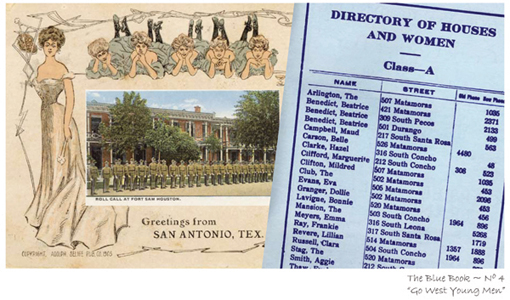
Blue Book No. 4, “Go West Young Men,” digital collage by Gayle Brennan Spencer. Early 1900s’ postcard of some of San Antonio’s blue ladies is combined with a period mini-postcard image of “Roll Call at Fort Sam Houston” and a page from “The Blue Book.” The page is headlined “Directory of Houses and Women – Class-A” and lists the names and addresses of some of San Antonio’s welcoming women in 1911. Visit http://postcardssanantonio.com.
I had always heard the banks of the San Antonio River Walk were declared off-limits after dark for members of the military in San Antonio for many years, but I had never seen proof:
The area known as the “River Walk” is “Off Limits” during the periods 2400 hours to 0600 hours daily. It begins at Lexington Street, near the Auditorium, and extends about three hundred yards west of St. Mary’s Street, near the Plaza Hotel.
Office of the Provost Marshal, Fort Sam Houston, December 20, 1945
Although designed to serve as a warning to soldiers, this list was almost as efficient a guide for “those seeking a good time while in San Antonio, Texas,” as the 1911-1912 guide, The Blue Book. Col. Cribby’s list not only identified which places around town were “off-limits,” but why – whether because of immorality, prostitution, danger of venereal disease or gambling.
Gohlke’s post pertained to “San Antonio’s queer community,” but the list aided those in search of bisexual entertainment as well:
All a GI or WAC need do is read the list, understand the codes, and head out for a night of same-sex recreation. Ironically, the military imperative to regulate deviance facilitated the very behaviors such regulations were designed to stamp out.
Some of the same neighborhoods identified in The Blue Book were still hot spots flourishing under the eyes of lax local law enforcement three decades later.
The Blue Book No. 1, “See Sallie after the Alamo,” digital collage by Gayle Brennan Spencer. The back cover of the 1911-1912 edition of “The Blue Book” reads “For Information of the Red Light District Ask Me. Meet me at the Beauty Saloon.” This image is combined with advertisements, including Sallie Brewer’s, from an inside page of the guide to San Antonio’s “Sporting District,” a red light and an early 1900s’ postcard of The Alamo. Visit http://postcardssanantonio.com.
But what about today? This is from the fact sheet for visitors of participants in Lackland Air Force Base’s Basic Training Program:
Off Limits Areas and Establishments
The San Antonio Armed Forces Disciplinary Control Board has placed establishments off-limits to help maintain the health, morale, and welfare of Armed Forces personnel. Your Airman may not visit these establishments and will know which ones they will not be able to service prior to town pass.
The River Walk has been family-friendly for decades, but now I am curious about what places in San Antonio are deemed too or lascivious or dangerous for today’s military. This list, not nearly as clear and complete a guide to local entertainment as the 1941 blacklist, is from a 2009 edition of the Lackland Talespinner:
The following locations are off-limits:
• Cracker Box Palace – 622 W. Hildebrand • Planet K – all locations in the following counties: Bexar, Atascosa, Wilson, Guadalupe, Comal, Kendall, Medina and Bandera • Voodoo Tattoo Parlor – 202 Aransas • Players Club (PC) of San Antonio – 8235 Vicar • Boys Town – Acuna, Mexico • Widows Web Bar and Night Club – Acuna, Mexico • The Up and Down Club – Acuna, Mexico
With no Blue Book or more detailed list available on base, what’s a newcomer in search of a little lascivious behavior to do?
It’s so simple nowadays. Just follow those huge “come-hither” billboards around north Loop 410 or grab a free issue of San Antonio Current for pages and pages of full-color “service” ads.
Sergio Gonzales and Randy Allee of KLRN on location filming Justin Boyd
The river is an amazing resource.
Justin Boyd
How do you take the essence of something as sweeping as the Mission Reach of the San Antonio River and compress it into a to-go size box?
Artist Justin Boyd does this in a multimedia format incorporating sound and video recordings and natural and manmade found objects in “Days and Days,” an exhibit on display through February 10 at the Southwest School of Art.
Although not as immense as trying to condense a broad landscape into a small box in a gallery, I struggled with adjusting my writing style to a television format in collaborating with the crew at KLRN-TV for this piece for ARTS. Whittling and weaving Justin’s dialogue into a story presented difficult and complicated choices for me, and, in turn, for David Bibbs at KLRN.
Although our paths never had crossed, Justin and I walk the same stretch of river often. But he has added new layers to my thoughts – the river representing time and its passage – as I meander southward along the river’s banks.
While celebrating the restoration of the Mission Reach as part of the San Antonio Improvements Project, Justin’s art is conscious of the litter man continually discards:
The impact we have as humans on the landscape…. This impact is so heavy…. Manmade objects are sitting right next to natural objects….
When you are down here everyday, you can’t help but reflect on how we are affecting our landscape.
January 28, 2013, Update:
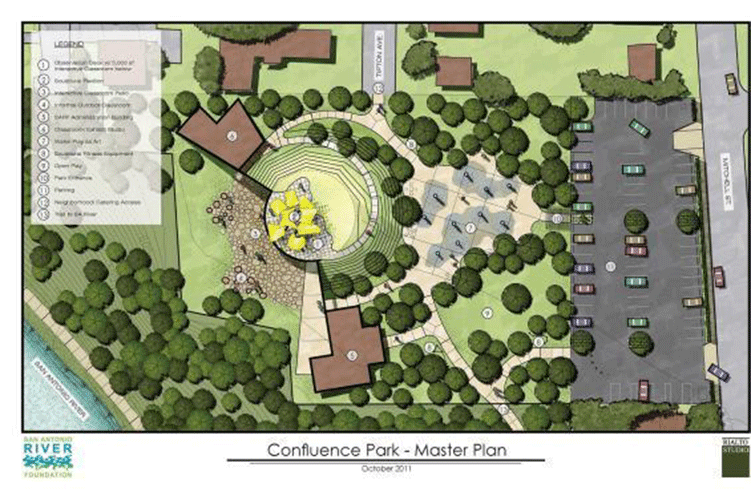
The photo above was shot at the point where the waters of San Pedro Creek (left) join the San Antonio River. The San Antonio River Foundation recently announced, according to the San Antonio Express-News, the commission of a pair of designers from the firm of Ball-Nogues Studio to design amenities for this point, to be known as Confluence Park:
With vague hopes of developing “some type of gathering place for the community,” the foundation spent about $300,000 on the park site several years ago and deeded it to SARA, said foundation executive director Estela Avery, wife of James Avery.
Plans gathered steam late last year, after Ball-Nogues Studio was invited to offer designs. The award-winning studio has created installations around the world that meld art and function, including works in California, New York, France, Italy and Hong Kong.
In recent months, designers Benjamin Ball and Gaston Nogues have collaborated with local water experts, botanists and others to create tentative concepts for the site at 310 W. Mitchell St.
“We’re working with an idea for a pavilion that will be enshrouded in vegetation, that’s also three windmills,” Ball said.
“We also have some features we’re calling ribbons, which are a man-made geology for the site. We’re trying to create some sense of discovery when you’re moving through the site so that you’re creating different vistas, different moments,” he said.
Added Nogues, “There’s going to be quite an extensive rainwater catchment system, which is going to mimic a cistern.”
Nogues appreciates the river restoration, noting that the Los Angeles River “suffered a similar fate” as the San Antonio River when its natural channel was lined with concrete decades ago. Most concrete has been removed here in the past few years during the river’s ecosystem restoration.
“It’s really an inspiration for what the Los Angeles River could become as well,” Nogues said.
Foundation interim project manager Stuart Allen said design details are pending, but the park’s purpose is firm.
“We want this park to be a really unusual destination,” Allen said.
“It’s going to be a park geared toward teaching about ecosystems, sustainable living, water transport mechanisms and watersheds. The park will be designed around forms that collect water and direct them to an underground cistern. The water will be recirculated back into the park.”
Fundraising received a major boost from a gift of $1 million for an educational endowment fund from James and Estela Avery.
January 31, 2013, Update: Nancy Cook-Monroe writes about Confluence Park and the announcement of the Avery gift to the River Foundation:
This one, with a water catchment system, solar panels and windmills, will be all about teaching sustainability, stewardship and environmental science. Its centerpiece will be an artistically designed educational pavilion. Other elements will be laced with double meanings, such as a “foraging fence.”
“It doesn’t keep neighbors out but invites them to enjoy decorative and edible plants,” said planning architect Gaston Nogues of Ball-Nogues Studio in Los Angeles.



 Postcards from Barton Springs