San Juan de la Cruz (1542-1591) and Santa Teresa de Avila (1515-1582) figure prominently in churches in this portion of Spain. Disagreements with Moors and pagans represented only a portion of the conflicts facing Roman Catholics.
Juan and Theresa ran counter to many of the early Carmelites for their insistence upon deprivation among the order, promoting the discalced discipline, meaning a shoeless existence, in addition to religious contemplation in isolation. Those other Carmelites thought they deserved shoes, and a few more basic luxuries, in exchange for their devotion.
The complicated politics involving different orders of Catholics are so far beyond comprehension based on the simplistic teaching of Roman Catholicism to children in the United States. We always went barefoot whenever possible and often when impractical in Virginia Beach, but I’m fairly certain that had little to do with where we stood on the discalced argument within the church. And Father Habit certainly would not have let us attend Mass in a shoeless state; he definitely was a no-shoes, no-host kind of priest. Otherwise, Catholic surfers might have caught one last wave and tracked sand all the way up to the altar.
But one quickly senses in Europe, all Roman Catholics are not alike. Religion is more complicated than those Hail Mary’s and Our Father’s we repeated somewhat mechanically following weekly confessionals.
But enough uninformed diversion about those distinctions.
Segovia is filled with Romanesque churches existing in the shadows of the Cathedral.
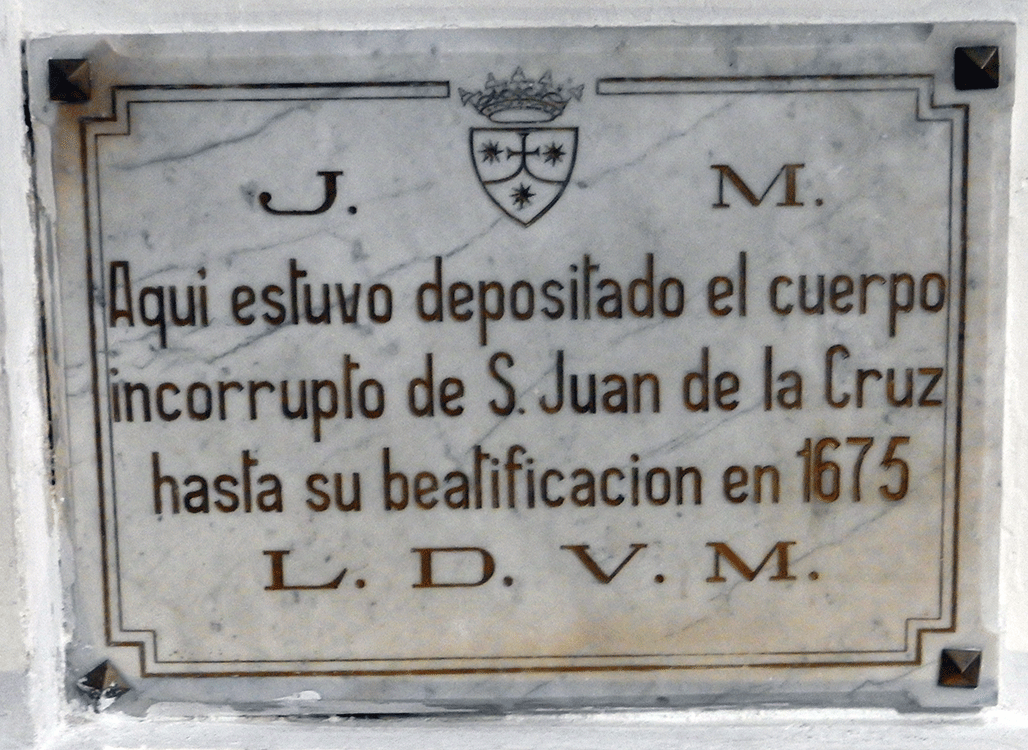
But I might have to go back to the claim of the plaque at the head of this post. “Incorruptu.” That means San Juan’s body remained intact, miraculously even after burial. However, that proclamation ignores all the harvestings by those who wanted to retain some of his miraculous powers in close geographical proximity.
According to Catholic Online:
The morning after John’s death, huge numbers of the townspeople of Úbeda entered the monastery to view John’s body; in the crush, many were able to take home parts of his habit. He was initially buried at Úbeda, but, at the request of the monastery in Segovia, his body was secretly moved there in 1593.
The people of Úbeda, however, unhappy at this change, sent representatives to petition the pope to move the body back to its original resting place. Pope Clement VIII, impressed by the petition, issued a Brief on 15 October 1596 ordering the return of the body to Ubeda. Eventually, in a compromise, the superiors of the Discalced Carmelites decided that the monastery at Úbeda would receive one leg and one arm of the corpse from Segovia (the monastery at Úbeda had already kept one leg in 1593, and the other arm had been removed as the corpse passed through Madrid in 1593, to form a relic there). A hand and a leg remain visible in a reliquary at the Oratory of San Juan de la Cruz in Úbeda, a monastery built in 1627 though connected to the original Discalced monastery in the town founded in 1587.
The head and torso were retained by the monastery at Segovia. There, they were venerated until 1647, when on orders from Rome designed to prevent the veneration of remains without official approval, the remains were buried in the ground. In the 1930s they were disinterred, and now sit in a side chapel in a marble case above a special altar built in that decade.
Sounds like a major case of incorruptu disruptus.





 Postcards from Barton Springs